
 5 days ago
36
5 days ago
36
Arc is the EVM-compatible layer 1 built by Circle, the issuer of USDC, purpose-built for stablecoin-native finance — payments, FX, treasury, and capital-markets settlement. It ran as a public testnet from October 2025 with institutional participants including BlackRock and Visa. Mainnet opened September 16, 2026 with eleven founding validators — including BlackRock, DTCC, Mastercard, Standard Chartered, and Visa — alongside Circle.
The teams building here are banks, payment networks, and licensed fintechs. An endpoint that rate-limits during a settlement window, lacks tracing for audit trails, or carries no SOC 2 attestation can stop a settlement or put a license on review — this is stablecoin infrastructure, held to a higher bar than general-purpose RPC. This comparison reflects each provider’s testnet offering; confirm mainnet availability directly, since Circle only published mainnet details at launch.
Quick comparison
| Provider | Dedicated Nodes | Self-Hosted | Free Tier | SOC 2 | ISO 27001 | Pricing |
| Chainstack | ✅ | ✅ | ✅ (3M RU/mo) | ✅ | ✅ | Request units |
| Blockdaemon | ✅ | ❌ | ✅ (3M CU/mo) | ✅ | ✅ | Compute units |
| Uniblock | ❌ (aggregator) | ❌ | ✅ (usage-based) | ❌ | ❌ | Pay-as-you-go |
| Alchemy | Enterprise only | ❌ | ✅ (30M CU/mo) | ✅ | ❌ | Compute units |
| Quicknode | ✅ | ❌ | Trial only | ✅ | ✅ | Credit-based |
1. Chainstack
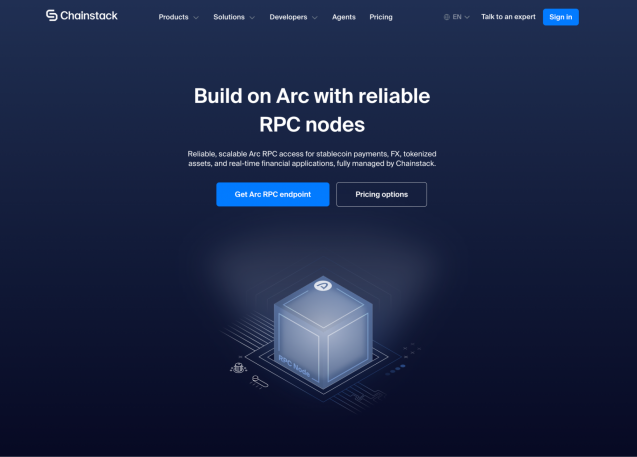
Chainstack supports Arc on both mainnet and testnet — testnet support began in July 2026, extended to mainnet at launch — with full debugging and tracing tools and out-of-the-box compatibility with ethers.js, viem, and web3.py. It’s the only provider here offering three deployment models from a single control plane:
- Global Nodes — auto-scaling, 99.99% uptime, best for wallets and USDC payment apps
- Dedicated Nodes — isolated, unlimited requests, built for FX desks and treasury teams moving stablecoin volume
- Chainstack Self-Hosted — runs inside the customer’s own cloud or bare metal, for banks and settlement teams that can’t let transaction data leave their environment
Pricing is request-unit based: a free Developer tier includes 3M RU/month; the Growth plan is $49/month for 20M RU. Chainstack serves 100,000+ developers across 70+ chains and holds SOC 2 Type II and ISO 27001. The platform also ships a Model Context Protocol (MCP) server that lets developers query Arc data and deploy nodes from Claude, Cursor, Windsurf, ChatGPT, Codex, and Gemini.
Where it falls short: not Arc-native, no prebuilt stablecoin-payment indexing APIs.
2. Blockdaemon
Blockdaemon supports Arc, positioned at banks, custodians, and funds accessing tokenized and stablecoin assets, with SOC 2 and ISO 27001 backing its compliance posture. It’s one of the older institutional infrastructure providers, built around node operation, staking, and custody services for banks. A self-serve free tier (3M compute units/month, 5 RPS) and published Starter/Growth plans are available; only the top Enterprise tier requires a sales conversation.
Where it falls short: it’s built around general institutional infrastructure rather than dedicated Arc tooling, and there’s no self-hosted deployment option.
3. Uniblock
Uniblock supports Arc with full coverage through its unified API — one endpoint across 300+ blockchains via 55 data partners, with patented auto-routing for provider selection and failover. It’s a well-funded aggregator with real production traffic, including customers like Plume Network and Apechain, and usage-based pricing with no minimums.
Where it falls short: built as a multichain aggregation layer, not dedicated Arc infrastructure, so there’s no dedicated-node or self-hosted option, and it doesn’t publish SOC 2 or ISO 27001 — a blocker for regulated banking and payments workloads.
4. Alchemy
Alchemy supports Arc with enhanced APIs, monitoring, and debugging tools, plus a 30M CU/month free tier and SOC 2 Type II. It’s one of the largest general-purpose Web3 platforms, best known for enhanced APIs on top of standard RPC.
Where it falls short: isolated infrastructure is enterprise-only (Dedicated Clusters, sales-access), the compute-unit model is method-weighted, and Alchemy doesn’t publish ISO 27001.
5. Quicknode
Quicknode supports Arc, offering managed endpoints, tracing, globally distributed nodes, and dedicated clusters — with dual SOC 2 Type II and ISO 27001 attestations. It’s one of the longest-running multichain RPC providers, known for broad chain coverage (80+ chains) and add-ons like Streams and Webhooks.
Where it falls short: free access is trial-based, not perpetual, and credit-based pricing is method-weighted, so audit-heavy workloads burn credits fast.
Final thoughts
Now that Arc mainnet is live, the deciding factor is compliance-grade infrastructure: archive and trace access paired with a current SOC 2 attestation — what separates a provider you can put behind a regulated payments product from one you can’t.
What’s the best RPC provider for Arc? For most teams, Chainstack is the strongest fit — the only provider here with dedicated, self-hosted, and managed deployment plus dual SOC 2 Type II and ISO 27001 certification. Teams with a niche need or an existing multichain account elsewhere may reasonably pick differently.
Disclosure: This is sponsored content. It does not represent Crypto Briefing's editorial views. For more information, see our Editorial Policy.






 English (US) ·