
 1 month ago
76
1 month ago
76
Tether lost $791 million this week, a single-token drop that accounted for 41% of the $1.9 billion pulled from the entire stablecoin market. Most of its top competitors also finished lower, with USDC shedding 1.05% and Sky Dollar plunging 2.36%.
Key Takeaways
- Tether’s USDT held a $184.112 billion market cap and a 59.14% dominance share this week.
- Paypal’s PYUSD posted the top gain among the top 15, rising 4.25% to $2.836 billion.
- Sky Dollar’s USDS fell 2.36%, the steepest weekly drop among the top 15 stablecoins.
The total stablecoin market cap sits at $311.311 billion, down 0.61% over the past seven days, a drop of $1.911 billion, according to Defillama data. As of this weekend, Tether’s USDT now accounts for 59.14% of that total.
The top 15 stablecoins span a wide range of issuers, from established players like Tether and Circle to newer entrants. Their combined performance over the last seven days shows a market moving in small steps rather than sharp swings.
Tether and USDC Lead by Size
USDT dropped a modest 0.43% over the week but remains the third largest crypto asset by market cap in the entire space, trailing only bitcoin and ethereum. Traders continue to use USDT as the primary settlement token on exchanges worldwide.
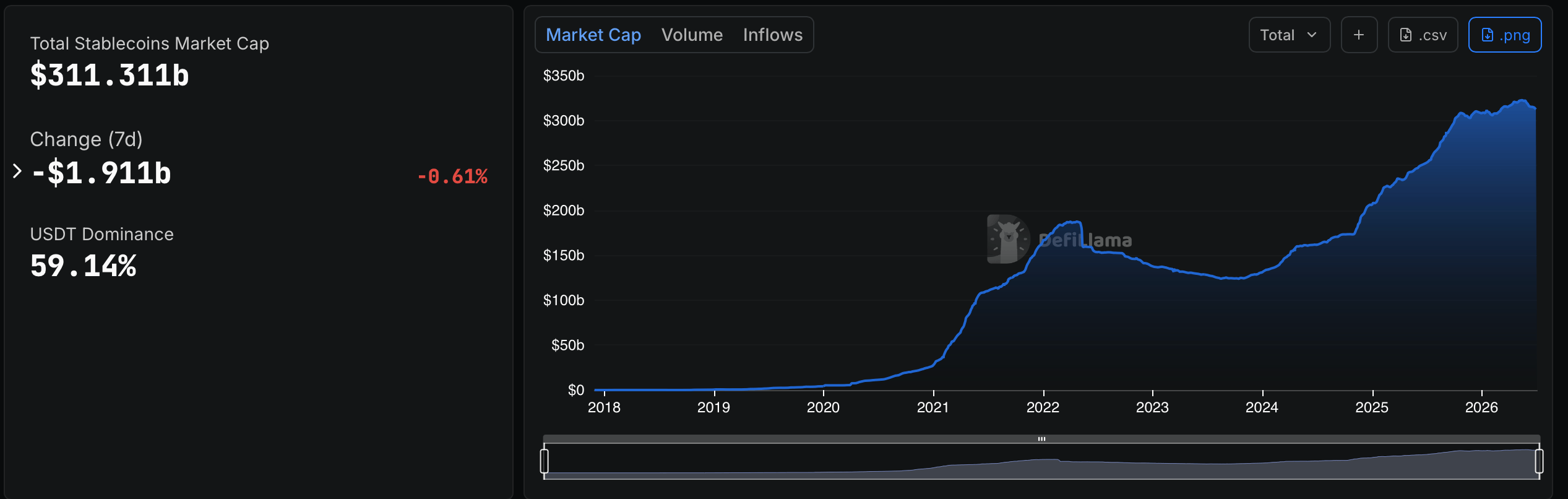 Stablecoin market cap on July 5, 2026, via Defillama data.
Circle’s USDC sits in second place among stablecoins with a $73.098 billion market cap as of July 5. USDC fell 1.05% over seven days, a steeper drop than USDT posted. Circle’s token ranks as the fifth-largest crypto asset overall.
Traders watching the two largest stablecoins saw a similar pattern play out. Both lost ground, but neither moved far from its starting point. The gap between them and the rest of the field still remains quite wide. Together, USDT and USDC account for more than 82% of the entire top 15 market cap.
How Stablecoin Supply Works As A Market Gauge
Stablecoin market cap moves through a simple mechanism. Issuers mint new tokens when users deposit dollars or equivalent reserves, and they burn or redeem tokens when users withdraw. A rising total supply means more dollars are entering the crypto system through that channel. Unless a stablecoin depegs, which is something it is not supposed to do, a falling total market cap means dollars are leaving the system.
Traders and analysts often treat stablecoin supply as a rough measure of capital sitting ready to buy bitcoin and other digital assets, sometimes called “dry powder.” When that supply grows, it can signal more buying capacity waiting on the sidelines. When it shrinks, it can mean less immediate capital available to absorb selling pressure.
This week’s 0.61% dip in total stablecoin market cap is a small move by that measure. It does not, on its own, point to a broader shift in how much capital sits inside the crypto system. Reading too much into a single week of data misses the larger picture of a market that has held near $300 billion to $310 billion for months on end. Still, over the last few weeks, the downturn has been noticeable enough to flag.
Paypal Stands out With a 4.25% Gain
Paypal’s PYUSD posted the strongest weekly performance among the top 15 stablecoins this past week. PYUSD climbed 4.25% to reach a $2.836 billion market cap, a move that put daylight between it and every other token in the group.
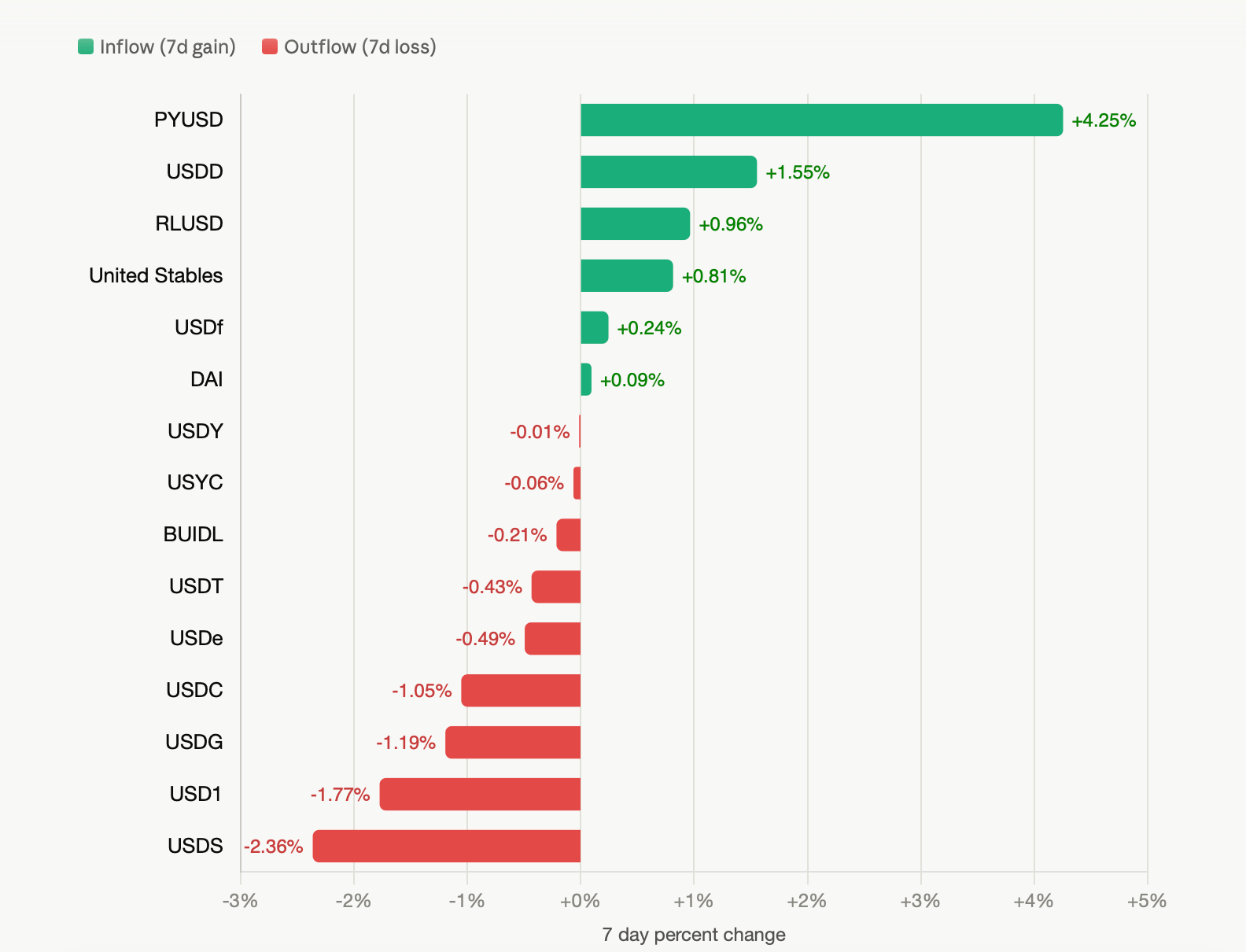 Stablecoin inflows and outflows over the last seven days, according to Defillama stats on July 5, 2026.
No other stablecoin in the top 15 matched that pace. Ripple’s RLUSD followed with a 0.96% gain, pushing its market cap to $1.585 billion. USDD added 1.55%, reaching $1.396 billion. Both moves suggest traders added positions in newer payment and settlement tokens even as larger stablecoins slipped.
Sky Dollar Posts The Week’s Steepest Drop
Sky dollar (USDS) fell 2.36% over seven days, the sharpest decline among the group. Its market cap now stands at $8.02 billion, still enough to hold third place overall behind Tether and USDC.
World Liberty Financial‘s USD1 dropped 1.77% to a $4.61 billion market cap. Global dollar (USDG) fell 1.19% to $2.871 billion. Ethena’s USDe slipped 0.49% to $4.439 billion, a smaller decline than several of its peers in the middle of the pack.
Sky’s original stablecoin DAI moved against that trend, gaining 0.09% to reach $4.851 billion. The gain was small, but DAI stood out as one of only a handful of tokens in the top ten to post a positive week. Circle’s USYC and Blackrock‘s BUIDL both held close to flat, losing 0.06% and 0.21% respectively, showing minimal movement compared to the rest of the field.
Smaller Stablecoins Split Between Gains And Losses
Among the bottom five in the top 15, gains outnumbered losses. Ondo’s USDY stayed nearly flat, down 0.01% to $2.157 billion. Falcon’s USDf rose 0.24% to $1.258 billion. United stables (U) gained 0.81%, closing the week at $1.023 billion, its first time crossing the $1 billion threshold in recent weeks. The split between small and large token performance stood out as one of the clearer patterns in this week’s data.
Where Newer Stablecoins Fit In
Several tokens in the bottom half of the top 15 carry a different structure than USDT or USDC. BlackRock USD and Circle USYC represent tokenized money market products, offering exposure to short-term government debt rather than functioning purely as trading dollars. Ondo US Dollar Yield follows a similar model, passing along yield from underlying Treasury holdings.
These yield-bearing tokens compete for capital that might otherwise sit in a traditional bank account or money market fund. As interest rates remain a factor for investors, tokenized Treasury products give holders a way to earn a return while keeping funds inside the crypto ecosystem. That competition adds a second layer to the stablecoin market beyond the trading-dollar function that USDT and USDC serve.
What Traders Are Watching Now
Stablecoin market cap often signals how much capital sits ready for deployment into Bitcoin and other crypto assets. A 0.61% weekly dip is a small move compared to the swings stablecoins have seen in past years, and the total figure remains close to its recent range.
Tether’s dominance near 59% means its weekly performance carries the most weight for the total figure. A move in USDT of even half a percent shifts billions of dollars in market cap, more than most other tokens in the top 15 combined.
Traders tracking PYUSD’s 4.25% gain will watch whether Paypal’s stablecoin keeps climbing or gives back the move next week. The same applies to Sky Dollar’s decline, the largest drop in the group, as traders assess whether the pullback continues or stabilizes.
For now, the top 15 stablecoins hold a combined position worth hundreds of billions of dollars, with Tether and USDC controlling the large majority of that total. The rest of the field, spread across a dozen smaller issuers, continues to compete for a shrinking share of a market still dominated by two names.




 English (US) ·