
 1 month ago
60
1 month ago
60
- TRON has activated quantum-resistant digital signatures on its Nile testnet following the approval of Committee Proposal No. 20628.
- The upgrade allows developers to begin testing cryptographic technology designed to withstand future quantum computing attacks.
- While the feature is still limited to the testnet, it marks another step toward strengthening blockchain security for the long term.
TRON is taking an early step toward preparing its blockchain for the age of quantum computing.
Following the approval of Committee Proposal No. 20628, the network has activated quantum-resistant digital signatures on its Nile testnet, allowing developers to begin experimenting with cryptographic technology built to defend against future quantum-based attacks.
The announcement came from TRON founder Justin Sun, who confirmed the proposal had been approved on July 2. Developers have since been invited to test the new feature using official documentation released by the network.
The market reaction, however, was fairly muted.
Following the announcement, TRX traded around $0.319, giving the cryptocurrency a market capitalization of roughly $30.26 billion. The token posted only modest gains, suggesting investors viewed the update as an important infrastructure improvement rather than an immediate price catalyst.
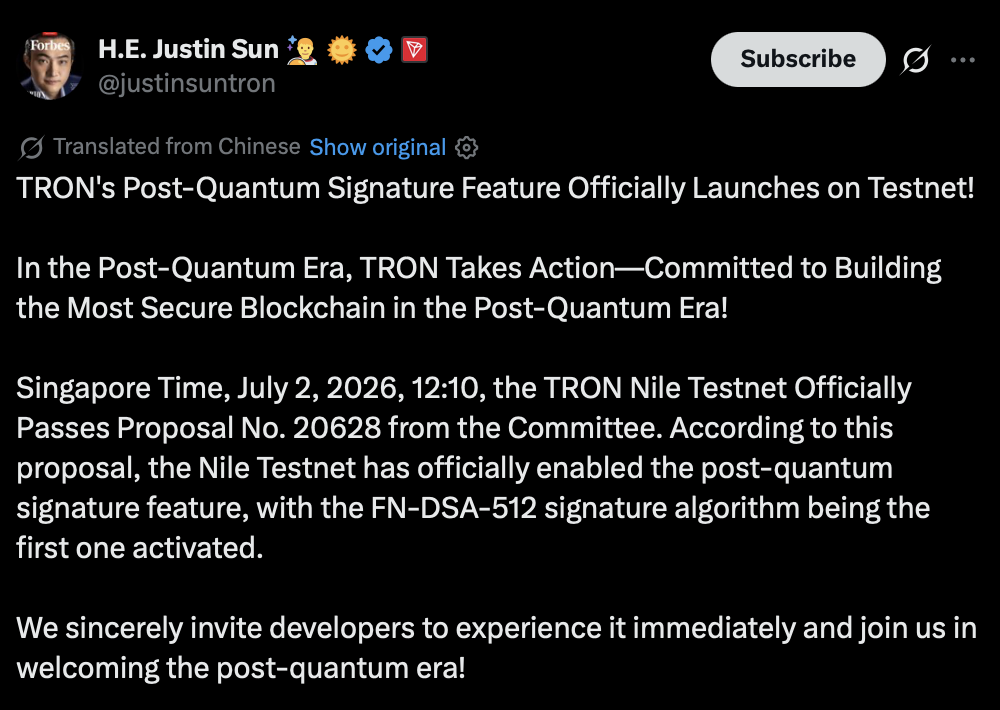
TRON Begins Testing Post-Quantum Security
The new feature is currently available only on TRON’s Nile testnet, a development environment where engineers can safely experiment with new blockchain features before they’re considered for deployment on the main network.
Because the testnet uses tokens with no real market value, developers can freely test smart contracts, transaction processing, and security upgrades without risking actual funds.
The primary goal of the latest release is to prepare for a future where quantum computers become powerful enough to threaten today’s cryptographic systems.
Most major blockchains currently rely on elliptic-curve cryptography to secure transactions. While existing quantum computers aren’t remotely capable of breaking those systems today, researchers generally agree that sufficiently advanced quantum machines could eventually pose a serious risk.
TRON’s latest upgrade is therefore preventative rather than reactive.
Why FN-DSA-512 Matters
The newly activated feature introduces support for FN-DSA-512, a lattice-based digital signature algorithm derived from Falcon-512, one of the cryptographic systems selected through the U.S. National Institute of Standards and Technology’s post-quantum cryptography program.
FN-DSA, short for FFT over NTRU-Lattice-Based Digital Signature Algorithm, is designed specifically to resist attacks from future quantum computers.
Unlike ML-DSA, which has already been standardized under FIPS 204, FN-DSA is still progressing through the standardization process as part of FIPS 206.
One practical advantage is efficiency.
Falcon-512 signatures are relatively compact, reaching a maximum size of roughly 667 bytes. Smaller signatures help reduce storage requirements and bandwidth usage, making them more practical for large blockchain networks processing significant transaction volumes.
Mainnet Deployment Still Has Several Hurdles
Although the technology is now live on the Nile testnet, a production release remains some distance away.
The current upgrade supports post-quantum transaction signatures, block validation, and other verification processes needed across the blockchain. While the software also includes support for ML-DSA-44, each cryptographic algorithm requires separate governance approval before becoming active.
Proposal No. 20628 specifically enabled FN-DSA-512.
The testing phase will allow developers to evaluate how larger cryptographic signatures affect transaction speeds, storage requirements, bandwidth usage, and overall network performance.
Those factors are particularly important for TRON, which processes high transaction volumes and hosts one of the largest stablecoin ecosystems in the crypto industry.
A Gradual Transition Is Likely
Even if the technology performs well during testing, launching it on the mainnet would require broad ecosystem support.
Wallet providers, cryptocurrency exchanges, validators, infrastructure companies, and decentralized application developers would all need to update their software before widespread adoption becomes possible.
Existing users may also require a migration path that allows assets to move into newly created quantum-resistant accounts without disrupting normal network activity.
One possible approach would involve a hybrid system that accepts both traditional cryptographic signatures and quantum-resistant signatures simultaneously. That would allow the transition to happen gradually while minimizing disruption for users and service providers.
For now, though, no mainnet launch date has been announced.
Committee Proposal No. 20628 simply opens the door for developers to begin testing the technology on Nile, giving the TRON ecosystem an opportunity to evaluate whether quantum-resistant cryptography is ready for the blockchain’s next chapter.
Disclaimer: BlockNews provides independent reporting on crypto, blockchain, and digital finance. All content is for informational purposes only and does not constitute financial advice. Readers should do their own research before making investment decisions. Some articles may use AI tools to assist in drafting, but every piece is reviewed and edited by our editorial team of experienced crypto writers and analysts before publication.






 English (US) ·