
 1 month ago
57
1 month ago
57
- President Donald Trump and senior officials are renewing efforts to pass the CLARITY Act in the coming weeks.
- The legislation would establish the first comprehensive federal regulatory framework for the U.S. crypto industry.
- Debate over ethics provisions remains one of the biggest obstacles before the bill can reach the president’s desk.
Momentum is building once again for the CLARITY Act as President Donald Trump, lawmakers, and senior administration officials push to advance what could become the most significant cryptocurrency legislation ever passed in the United States.
Congress has returned to Washington following its Fourth of July recess with only a limited legislative window to move several major bills before lawmakers shift their attention to government funding and other priorities. Among them is the CLARITY Act, which seeks to establish a comprehensive federal framework for regulating digital assets.
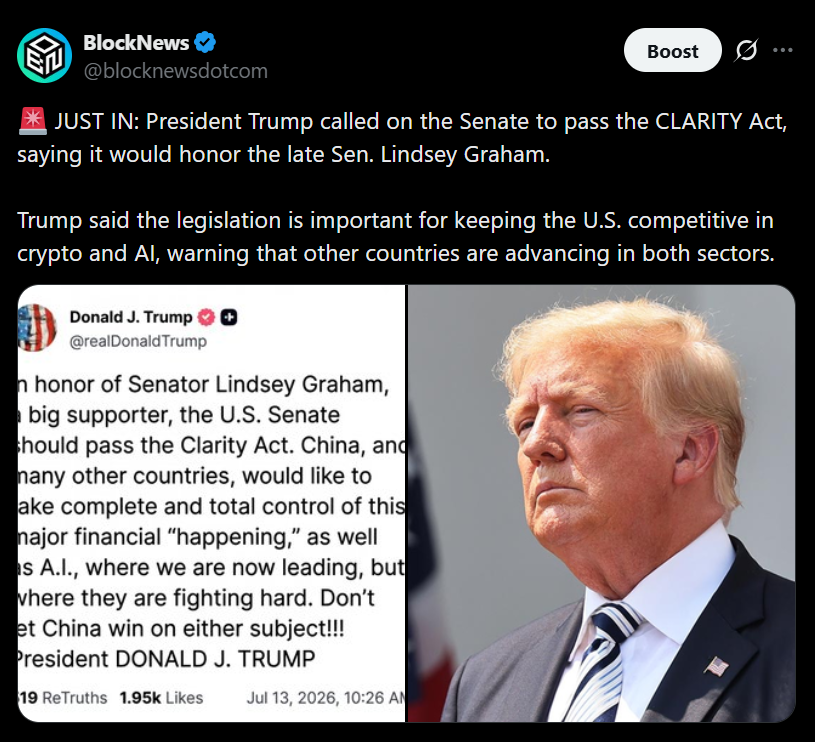
Trump recently urged the Senate to approve the legislation, describing crypto and artificial intelligence as strategic industries where the United States must maintain its global leadership amid increasing competition from countries such as China. His comments came while paying tribute to longtime ally Senator Lindsey Graham, who died unexpectedly over the weekend.
CLARITY Act Nears a Critical Vote
The CLARITY Act has been under development for more than a year as lawmakers work to define regulatory oversight for cryptocurrencies at the federal level.
The House previously approved its version of the bill, while several Senate committees have advanced their own proposals in recent months. Updated legislative text is expected to be released this week before a potential Senate floor vote. If approved, the legislation would return to the House before reaching the president’s desk.
Supporters argue the bill would provide long-awaited regulatory clarity for crypto companies, exchanges, and investors by establishing clearer jurisdiction over digital assets.
Ethics Debate Continues to Divide Lawmakers
One of the biggest remaining points of contention centers on ethics rules for public officials involved with digital assets.
Negotiators from both parties have spent months discussing whether the legislation should prohibit presidents, vice presidents, members of Congress, senior government officials, and their immediate families from profiting through cryptocurrency ventures while serving in office.
According to reports, the latest version of the bill does not currently include those ethics provisions. That omission has drawn criticism from several lawmakers and anti-corruption organizations, which argue stronger safeguards are necessary before the legislation advances.
Senator Elizabeth Warren said the current draft still contains significant shortcomings, calling for explicit restrictions that would prevent senior government officials and their families from financially benefiting from the crypto industry while holding public office.
Industry Watches Washington Closely
The White House’s top crypto adviser, Patrick Witt, also urged lawmakers to move quickly, saying substantial work has already gone into crafting the legislation and warning that further delays could slow America’s progress in digital asset innovation.
Supporters of the bill believe regulatory certainty could encourage greater institutional participation, foster innovation, and strengthen the United States’ position in the rapidly evolving blockchain industry.
With updated legislative text expected soon, the coming weeks could prove pivotal for the future of cryptocurrency regulation in the United States. If lawmakers can overcome the remaining political disagreements, the CLARITY Act may become the first comprehensive federal crypto framework enacted into law.
Disclaimer: BlockNews provides independent reporting on crypto, blockchain, and digital finance. All content is for informational purposes only and does not constitute financial advice. Readers should do their own research before making investment decisions. Some articles may use AI tools to assist in drafting, but every piece is reviewed and edited by our editorial team of experienced crypto writers and analysts before publication.








 English (US) ·