
 7 months ago
103
7 months ago
103
The US federal government’s interest payments on national debt surpassed $1 trillion for the first time in fiscal year 2025. Interest expenditure now exceeds both defense spending and Medicare—a first in American history.
Wall Street analysts and social media users alike are invoking “Weimar” as warnings of fiscal crisis mount. Meanwhile, the US Treasury is positioning stablecoins as a strategic tool to absorb the growing flood of government debt.
The Numbers: A Crisis in Plain Sight
In fiscal year 2020, net interest payments totaled $345 billion. By 2025, that figure nearly tripled to $970 billion—outpacing defense spending by approximately $100 billion. When accounting for all interest on publicly held debt, the figure crossed $1 trillion for the first time.
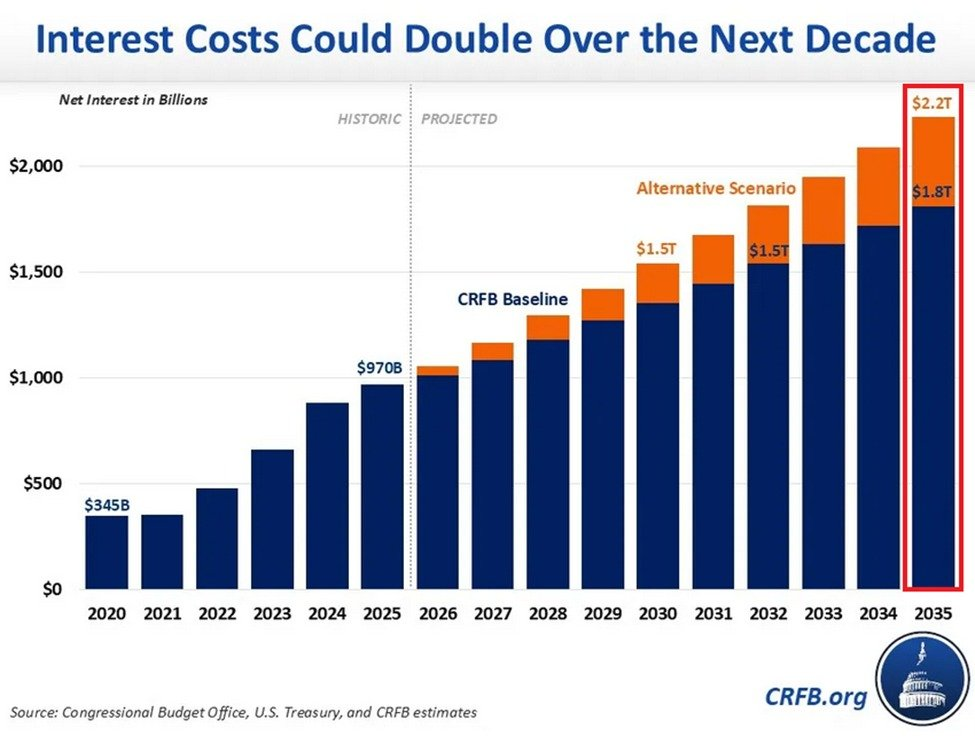 Source: US Congressional Budget Office via KobeissiLetter
The Congressional Budget Office projects cumulative interest payments over the next decade will total $13.8 trillion—nearly double the inflation-adjusted amount spent over the past two decades.
The Committee for a Responsible Federal Budget warns that under an alternative scenario where tariffs are ruled illegal and temporary provisions of recent legislation are made permanent, interest costs could reach $2.2 trillion by 2035—a 127% increase from current levels.
Why This Is Unprecedented
The debt-to-GDP ratio has reached 100%, a threshold not seen since World War II. By 2029, it will surpass the 1946 peak of 106% and continue climbing to 118% by 2035.
Most concerning is the crisis’s self-reinforcing nature. The federal government borrows approximately $2 trillion annually, with roughly half going solely toward servicing existing debt. CRFB analyst Chris Towner warned of a potential “debt spiral”: “If the people who loan us money get worried we’re not going to pay it all back, we could see higher interest rates—which means we have to borrow more to pay interest.”
| Interest exceeds Defense spending | 2024 | First time since World War II |
| Interest exceeds Medicare | 2024 | Debt servicing now largest healthcare expense |
| Debt reaches 100% of GDP | 2025 | First time since WWII aftermath |
| Debt to surpass 1946 peak (106%) | 2029 | Will exceed all-time historical record |
Market Reaction: “Weimar” and “Buy Gold”
Social media erupted at these projections. “The trajectory is unsustainable if unchanged,” wrote one user. Another posted “weimar”—a reference to 1920s German hyperinflation. “The debt service era,” declared another, capturing the sentiment that America has entered a new phase.
The overwhelming majority called for flight to hard assets—gold, silver, and real estate. Notably absent was little mention of Bitcoin, suggesting traditional “gold bug” thinking still dominates retail sentiment.
Market Implications
Near-term, surging Treasury issuance absorbs market liquidity. With risk-free yields near 5%, equities and cryptocurrencies face structural headwinds. In the medium term, fiscal pressure may accelerate regulatory tightening and cryptocurrency taxation.
Long-term, however, presents a paradox for crypto investors. As fiscal instability deepens, Bitcoin’s “digital gold” narrative strengthens. The worse traditional finance performs, the stronger the case for assets outside the system becomes.
Stablecoins: Crisis Meets Solution
Washington has found an unexpected ally in its fiscal troubles. The GENIUS Act, signed in July 2025, requires stablecoin issuers to maintain 100% reserves in US dollars or short-term Treasury bills. This effectively transforms stablecoin companies into structural buyers of government debt.
Treasury Secretary Scott Bessent declared stablecoins “a revolution in digital finance” that will “lead to a surge in demand for US Treasuries.”
Standard Chartered estimates stablecoin issuers will purchase $1.6 trillion in T-bills over four years—enough to absorb all new issuance during Trump’s second term. This would exceed China’s current Treasury holdings of $784 billion, positioning stablecoins as a replacement buyer as foreign central banks reduce US debt exposure.
The Debt Service Era Begins
America’s fiscal crisis is paradoxically opening doors for cryptocurrency. While conventional investors rush toward gold, stablecoins are quietly becoming critical infrastructure for US debt markets. Washington’s embrace of stablecoin regulation is not merely about innovation—it is about survival. The debt service era has begun, and crypto may be its unlikely beneficiary.
The post US Debt Interest Hits $1T: The Hidden Catalyst for Stablecoin Adoption appeared first on BeInCrypto.







 English (US) ·