
 4 months ago
91
4 months ago
91
TLDR
- The greenback climbed over 1% during the week, marking its largest weekly advance since the beginning of March
- Traders now assign a 65%+ probability to a Federal Reserve rate increase by year-end, compared to less than 20% seven days earlier
- Escalating U.S.-Iran conflict keeps crude prices elevated, amplifying inflation concerns
- The British pound dropped to a five-week trough as UK Prime Minister Keir Starmer confronts leadership pressure
- The Trump-Xi meeting concluded with minimal market movement, though Iran’s blockade of the Strait of Hormuz remained a focal point
The American dollar delivered its most impressive weekly showing in more than eight weeks on Friday, advancing over 1% versus a basket of major currencies and reaching a four-week peak of 99.203 on the DXY index.
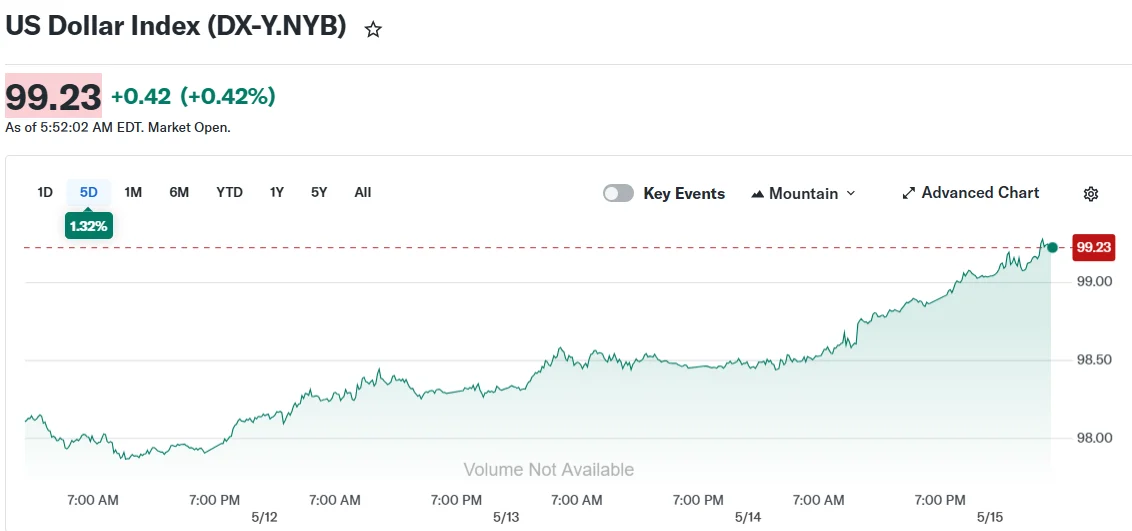 US Dollar Index (DX-Y.NYB)
The upward momentum was fueled by climbing U.S. Treasury yields, which touched 12-month highs, alongside mounting speculation that the Federal Reserve could implement interest rate increases before year-end.
Market participants currently factor in greater than 65% odds of a Fed rate hike by December. Merely seven days prior, that probability stood under 20%, based on CME FedWatch tool data. Additionally, markets are completely pricing in a rate increase by March 2027.
This dramatic shift followed a series of robust U.S. economic reports. Import price figures and producer price data both exceeded analyst projections earlier in the week. April retail sales demonstrated growth, while weekly unemployment claims suggested labor market resilience.
Persistent friction between Washington and Tehran is contributing to inflationary headwinds. With the Strait of Hormuz remaining blocked, oil prices stay elevated. Rising energy expenses are permeating broader inflation metrics, strengthening arguments for Federal Reserve intervention.
“The dollar is catching up with the strong data we’ve seen this week,” said Francesco Pesole, FX strategist at ING. “It feels like there’s a realisation that the U.S. story in an energy crisis may just end up being much better than many other places in the world.”
British Pound Pressured by Political Instability
The UK currency declined to a five-week nadir versus the dollar, briefly touching $1.3332 before moderately rebounding to $1.3347. The pound is tracking toward its sharpest weekly decline since November 2024.
Prime Minister Keir Starmer confronts intensifying leadership opposition following disappointing local election outcomes. Andy Burnham, Greater Manchester Mayor, signaled intentions to pursue a parliamentary seat to launch a leadership bid. Jefferies economist Mohit Kumar observed that markets worry a more progressive leader might expand the UK’s fiscal gap.
The European common currency likewise weakened against the dollar, sliding to a four-week low of $1.1632 and poised to shed 1.3% across the week.
Trump-Xi Talks Conclude With Muted Market Response
A 48-hour summit featuring U.S. President Donald Trump and Chinese President Xi Jinping wrapped up Friday. Financial markets showed minimal reaction. Beijing cautioned Washington regarding Taiwan and declared the U.S.-Iran conflict “should never have started.”
Trump indicated his patience with Iran was dwindling and noted both leaders desire Strait of Hormuz reopening and oppose Iranian nuclear weapons development.
The mainland yuan retreated from a three-year peak versus the dollar to 6.8038, affected by widespread dollar strength.
Across other Asian markets, the Japanese yen depreciated to 158.47 per dollar despite solid domestic producer inflation figures. The Singapore dollar, South Korean won, and Philippine peso similarly edged downward.
The greenback gained 0.3% against the Malaysian ringgit to 3.945, with Kenanga analysts anticipating consolidation between 3.93 and 3.96 in the coming week.
The post US Dollar Climbs to Four-Week Peak as Federal Reserve Rate Hike Odds Jump to 65% appeared first on Blockonomi.





 English (US) ·