
 1 month ago
47
1 month ago
47
The U.S. Treasury will accept philanthropic donations of publicly traded stock to fund Trump Accounts, Secretary Scott Bessent announced two days before the children’s savings program launched, with more than 6 million families already signed up.
Key Takeaways
- Treasury Secretary Scott Bessent said stock gifts open a pathway for large-scale private giving to children.
- About 1.4 million children born between 2025 and 2028 qualify for $1,000 in federal seed money.
- Goldman Sachs and Morgan Stanley now offer employer matches for Trump Account contributions.
How the Stock Donation Pipeline Works
The Treasury Department said it will accept large philanthropic contributions of readily tradable public company stock to support the accounts. Under the new process, eligible donors transfer approved publicly traded shares directly to the Treasury, which then contributes the stock to Trump Accounts for eligible children consistent with the donor’s instructions, applicable law and department guidance. Treasury Secretary Scott Bessent said:
“Today’s announcement makes it easier for philanthropists to help American children build long-term financial security. Treasury is creating a practical pathway for large-scale private giving to support the next generation.”
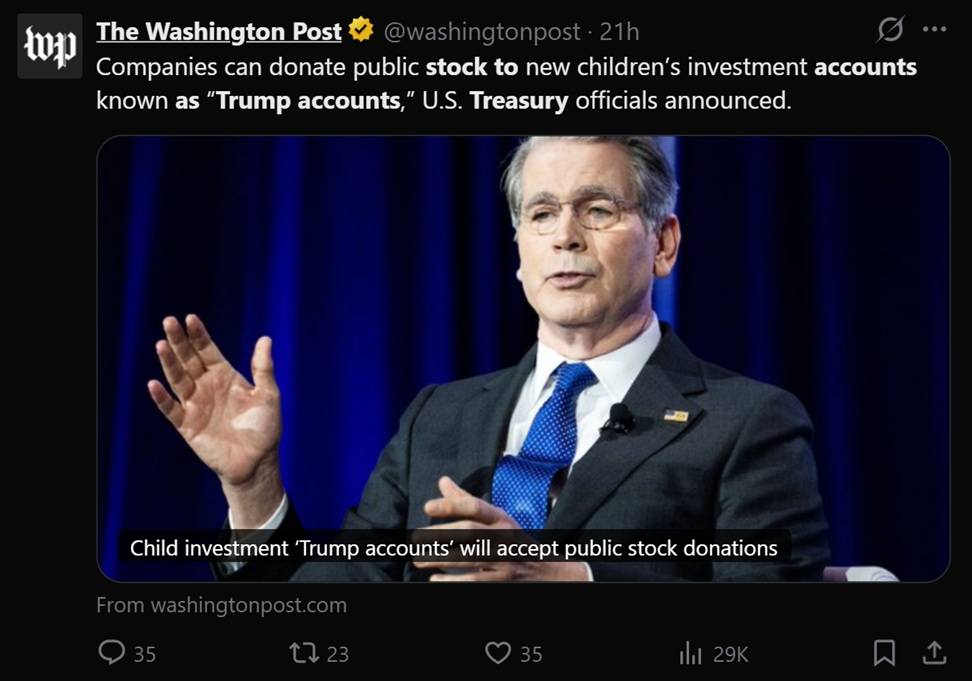 Image source: X
The mechanism is designed to court corporate founders, foundations and wealthy families who hold most of their wealth in equities rather than cash. Donating appreciated stock directly, rather than selling it first, is a long-standing philanthropic technique, and the Treasury’s framework now applies it to a federal savings program for minors.
A July 4 Launch With 6 Million Sign-Ups
Trump Accounts, created under the tax-and-spending legislation signed in 2025, are open to U.S. citizens under 18. Parents can enroll through an official mobile application or at trumpaccounts.gov. More than 6 million people signed up ahead of the program’s formal launch on July 4, according to U.S. officials.
Roughly 1.4 million of those accounts belong to children eligible for $1,000 in federal seed funding, a benefit reserved for those born between 2025 and 2028. The accounts are structured as long-term investment vehicles intended to track U.S. equities, meaning donated shares slot naturally into the program’s design.
The private sector has begun building around the accounts as well. Goldman Sachs and Morgan Stanley are the latest employers to unveil matching programs that add company money to workers’ children’s accounts, joining a growing list of firms treating the accounts as a recruiting benefit. That corporate layer could ultimately channel more money into the program than the government’s own seed contributions.
A Savings Push From a Market-Focused White House
The stock-donation framework extends the Trump administration’s broader effort to modernize how Americans interact with federal financial infrastructure. The White House has already ordered a massive digital shift in how the government sends and receives payments, phasing out paper checks in favor of electronic rails.
The president’s own balance sheet has also kept markets watching as Trump’s most recent financial disclosure reported at least $1.4 billion in crypto earnings for 2025, led by memecoin royalties and World Liberty Financial token sales. Trump Accounts, by contrast, are built on traditional equities, introducing millions of minors to market-based savings (a constituency crypto firms have long argued will eventually demand digital-asset exposure as well).
Skeptics have raised familiar questions about the program, i.e. whether philanthropic stock gifts will materialize at scale, how donor instructions will be policed, and whether a program named for a sitting president can outlast him politically. The Treasury has said contributions must comply with its guidance and applicable law, though detailed rules on which stocks qualify as “approved” are still emerging.



 English (US) ·