
 4 hours ago
12
4 hours ago
12
- The US Treasury has proposed new rules explaining how stablecoin issuers and crypto platforms must comply with key provisions of the GENIUS Act.
- The proposal defines when stablecoins are considered issued, offered or sold within the United States, including specific requirements for foreign issuers.
- The GENIUS Act begins taking effect in 2027, while additional restrictions on crypto service providers are scheduled for 2028.
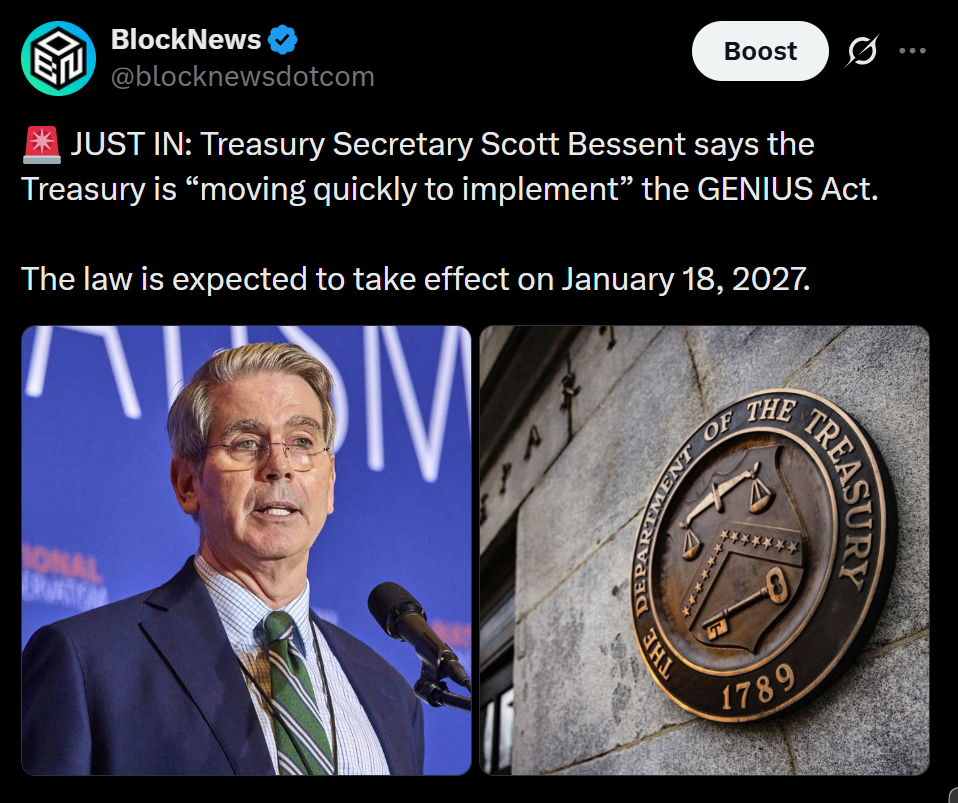
The US Treasury Department is moving forward with the implementation of the GENIUS Act, proposing new rules that could reshape how stablecoins are issued and distributed across the American crypto market.
The proposal focuses on Section 3 of the legislation and attempts to answer an important question: when exactly is a stablecoin considered issued or sold inside the United States?
Generally, Treasury would consider a stablecoin issued in the US when the issuer is located in the country at the time of issuance, or when the person receiving the stablecoin is located there.
Foreign Stablecoin Issuers Face New Requirements
The rules could have significant consequences for international stablecoin companies serving US customers.
Foreign issuers may avoid having their tokens classified as issued in the US when they reasonably believe recipients are outside the country, maintain effective geographic restrictions and don’t specifically advertise or solicit American customers.
Treasury also says qualifying foreign issuers would need technological capabilities allowing them to comply with lawful US orders and applicable reciprocal regulatory arrangements.
The GENIUS Act is expected to take effect on January 18, 2027. After that point, companies generally won’t be permitted to issue payment stablecoins in the US without authorization through an applicable federal or state framework, although qualifying foreign issuers could receive exemptions.
Crypto Platforms Could Face Restrictions in 2028
Another major deadline arrives on July 18, 2028.
From then, digital asset service providers would generally be prohibited from offering or selling stablecoins to people located in the US unless the tokens come from permitted payment stablecoin issuers or qualifying foreign issuers.
Activities that could constitute offering stablecoins in America include directly approaching US customers, advertising availability to them or even helping customers circumvent location restrictions such as IP checks.
Platforms could receive protection when they maintain reasonable controls preventing US transactions and don’t actively target American users.
Self-Custody Transfers Receive an Exemption
The Treasury proposal also contains an important distinction for decentralized crypto activity.
Certain direct person-to-person transfers and transactions involving self-custody wallets would be exempt from Section 3’s prohibitions.
However, several areas still need clarification. Treasury is requesting industry feedback on airdrops, stablecoin buybacks, wrapped assets, blockchain bridges, market makers and transfers involving exchanges or liquidity providers.
The proposal will receive a 60-day public comment period before the regulatory process moves forward.
GENIUS Act Pushes Stablecoins Into a Regulated Era
The rules form another piece of America’s emerging federal stablecoin framework.
The GENIUS Act, signed into law in July 2025, requires payment stablecoins to maintain eligible reserves backing outstanding tokens on a one-to-one basis. Those reserves can include assets such as cash, deposits and short-term US Treasury securities.
Treasury, FinCEN and OFAC have also been developing anti-money laundering and sanctions requirements for permitted issuers.
Together, these measures suggest the US stablecoin market is moving toward a much more defined regulatory structure. Issuers still have time to prepare, but with the first major GENIUS Act requirements arriving in 2027, the compliance countdown has clearly started.
Disclaimer: BlockNews provides independent reporting on crypto, blockchain, and digital finance. All content is for informational purposes only and does not constitute financial advice. Readers should do their own research before making investment decisions. Some articles may use AI tools to assist in drafting, but every piece is reviewed and edited by our editorial team of experienced crypto writers and analysts before publication.






 English (US) ·