
 2 months ago
56
2 months ago
56
- Vietnam could officially launch its regulated crypto market in Q3 2026 after years of legal uncertainty
- Only five companies will receive pilot licences, each requiring roughly $379 million in minimum capital
- With nearly 20 million crypto users already active, Vietnam isn’t creating a market — it’s formalizing one
Vietnam is preparing to officially launch a regulated crypto asset market in Q3 2026, signaling one of the most significant policy shifts yet from a country that spent years watching massive crypto adoption grow largely outside formal regulation.
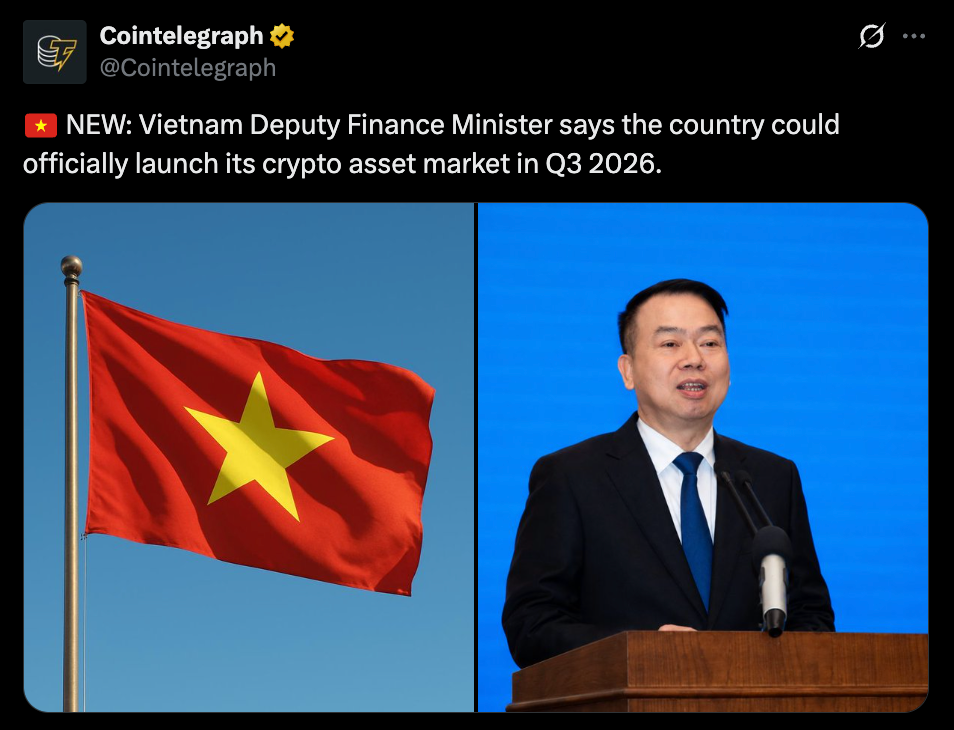
Deputy Finance Minister Nguyen Duc Chi confirmed the timeline this week, following the recent passage of Vietnam’s Law on Digital Technology Industry, which formally brought digital assets into the country’s legal framework for the first time.
For years, crypto activity in Vietnam operated inside a legal grey zone despite the country consistently ranking among the world’s most active crypto adoption markets.
The Entry Bar Is Extremely High
Vietnam’s regulatory rollout won’t be an open-door free-for-all either. Authorities plan to issue only five pilot licences for crypto trading platform operations during the initial launch phase.
The financial requirements alone are enormous. Each approved company must maintain at least 10 trillion Vietnamese dong in charter capital — roughly $379 million. That instantly makes Vietnam one of the strictest crypto licensing markets globally from a capitalization standpoint.
The government says the framework is being coordinated jointly by the Ministry of Finance, the Ministry of Public Security, and the State Bank of Vietnam. Several applicants are reportedly tied to major domestic banking institutions rather than smaller crypto-native startups.
Vietnam Already Has Massive Crypto Adoption
What makes the situation especially interesting is that Vietnam is not building crypto adoption from zero. The country already has an estimated 20 million crypto users, with large portions of trading activity historically flowing through offshore exchanges beyond local regulatory oversight.
In practice, the government is now attempting to formalize and supervise an ecosystem that already became deeply embedded in the country’s digital economy years ago.

That dynamic differs sharply from countries trying to introduce crypto into markets where retail adoption remains relatively small.
Crypto Fits Into Vietnam’s Bigger Economic Plan
The crypto push also aligns closely with Vietnam’s broader digital economy ambitions. The government is targeting a digital economy worth at least 30% of GDP by 2030 while simultaneously pushing for roughly 80% of domestic payments to become cashless.
Inside that framework, digital assets appear increasingly viewed as part of long-term financial infrastructure strategy rather than simply speculative trading products.
The passage of the digital technology law earlier this year gave regulators the legal foundation needed to finally move from informal tolerance toward direct supervision and licensing.
Vietnam Is Moving Faster Than Many Expected
For a country that spent years avoiding direct crypto recognition, the speed and seriousness of Vietnam’s regulatory shift has surprised many observers.
And honestly, the aggressive licensing requirements probably send the clearest message of all: Vietnam does not appear interested in banning crypto anymore. It wants to control it, institutionalize it, and integrate it into the country’s broader digital financial system.
Q3 2026 may end up marking the moment one of Asia’s biggest underground crypto markets officially stepped into the regulated mainstream.
Disclaimer: BlockNews provides independent reporting on crypto, blockchain, and digital finance. All content is for informational purposes only and does not constitute financial advice. Readers should do their own research before making investment decisions. Some articles may use AI tools to assist in drafting, but every piece is reviewed and edited by our editorial team of experienced crypto writers and analysts before publication.









 English (US) ·