
 5 months ago
65
5 months ago
65
- Vitalik Buterin wants “one-click” Ethereum staking to simplify validator setup
- The Ethereum Foundation tested a new DVT-lite system using 72,000 ETH
- Over 37.5 million ETH is already staked, with millions more waiting in queue
Ethereum staking has always sounded simple on paper. Lock up ETH, run a validator, secure the network, and earn rewards. In reality, the process often feels far more complicated, requiring careful infrastructure setup, technical knowledge, and constant monitoring to avoid costly mistakes.
Ethereum co-founder Vitalik Buterin appears increasingly focused on fixing that problem. His latest idea is straightforward: make staking so simple that institutions can launch validators with essentially a single command. If Ethereum wants a truly decentralized validator network, the barrier to entry cannot remain a technical maze that only specialists understand.
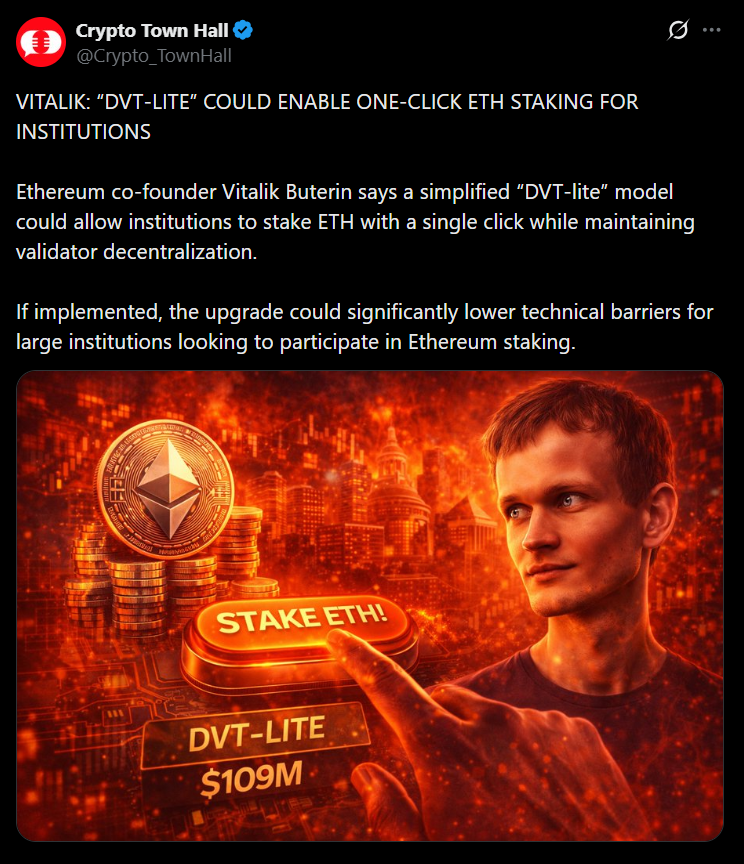
Ethereum Tests the DVT-Lite Validator Setup
The Ethereum Foundation has already begun experimenting with a simplified validator architecture called DVT-lite. In a recent test, the foundation staked roughly 72,000 ETH using this setup to evaluate how the system performs under real network conditions.
Traditional distributed validator technology spreads validator keys across several machines to improve resilience. While effective, these systems can be difficult to configure and maintain, especially for institutions that want reliable uptime without complex infrastructure management.
DVT-lite takes a more practical approach. Instead of splitting validator keys across multiple machines, the system allows several nodes to run the same validator key simultaneously. If one node fails or loses connectivity, another can immediately take over without interrupting the validator’s operation.
Reliability Without Operational Complexity
The goal behind the DVT-lite experiment is to make validator infrastructure far easier to manage while maintaining reliability. Ethereum validators must stay online consistently to avoid penalties such as missed rewards or slashing events.
By allowing multiple machines to back up the same validator key, the system reduces the risk of downtime caused by technical failures. That redundancy could make validator operations far more appealing for institutions that want exposure to staking rewards without running complex infrastructure stacks.
In essence, the approach tries to make staking feel more like deploying software rather than operating a server farm.

Ethereum Staking Demand Remains Strong
Despite Ethereum’s recent price struggles compared to Bitcoin, demand for staking remains high. Currently, more than 37.5 million ETH is locked in staking contracts, representing roughly 31% of the network’s total supply.
Another 3.2 million ETH is currently waiting in the validator queue. That backlog has created a waiting period of nearly two months for new validators to join the network.
These numbers suggest that both institutional and large individual holders remain interested in earning yield from their ETH. However, many would likely prefer a staking setup that requires far less technical expertise.
Simplifying Validators May Strengthen Decentralization
Buterin’s push for one-click staking reflects a broader issue within blockchain infrastructure. Decentralization only works effectively if participation remains accessible to a wide range of participants.
If running validators remains overly complicated, the network risks drifting toward a smaller group of professional operators and large staking providers. Simplifying validator deployment could help ensure that Ethereum’s validator set remains diverse and globally distributed.
In that sense, making staking easier may be one of the most important steps Ethereum can take to strengthen its long-term decentralization.
Disclaimer: BlockNews provides independent reporting on crypto, blockchain, and digital finance. All content is for informational purposes only and does not constitute financial advice. Readers should do their own research before making investment decisions. Some articles may use AI tools to assist in drafting, but every piece is reviewed and edited by our editorial team of experienced crypto writers and analysts before publication.




 English (US) ·