
 3 hours ago
12
3 hours ago
12
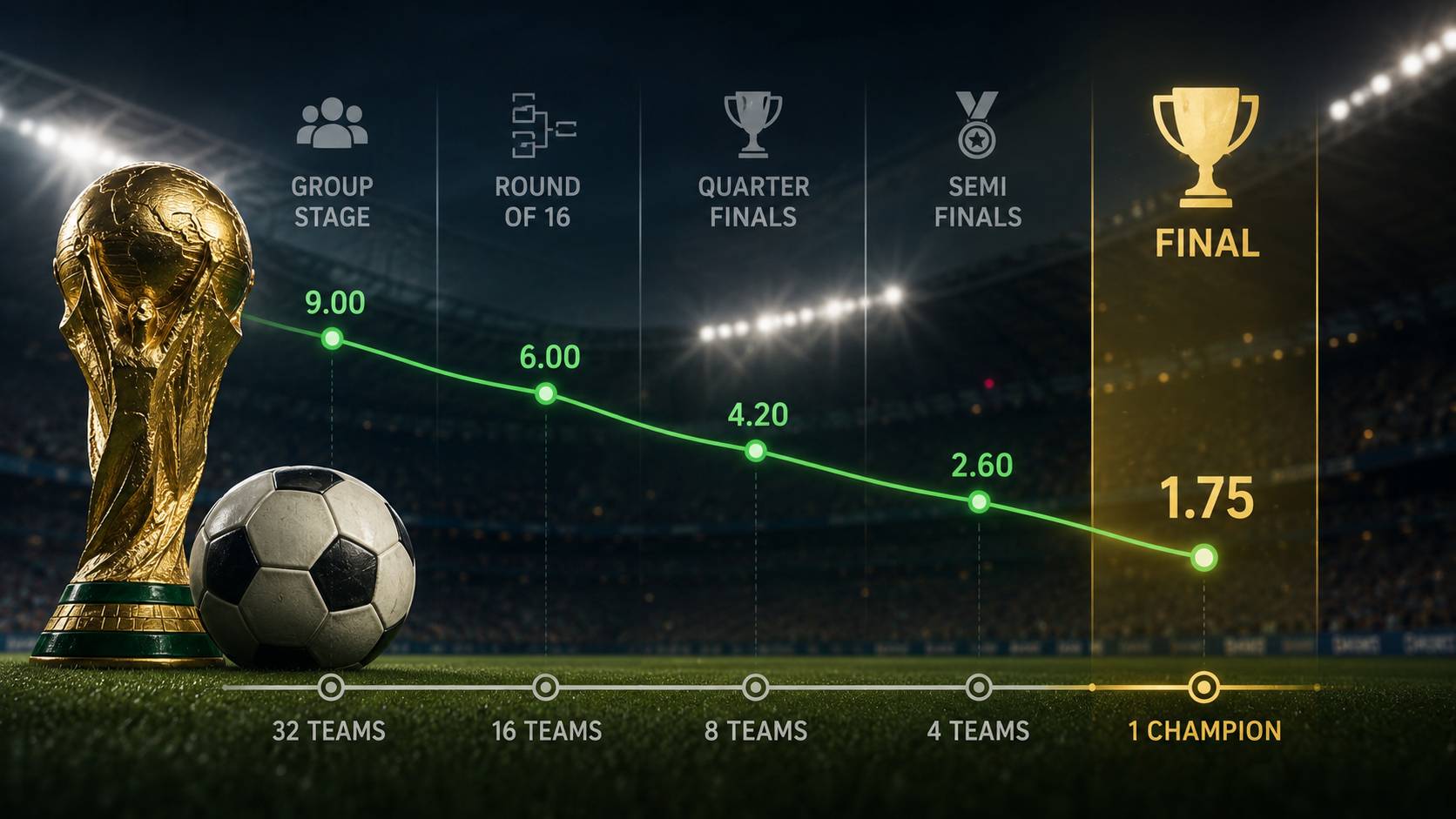
A tournament is not one betting environment. It is three, and they arrive in sequence.
The group stage floods a bettor with fixtures and long-dated futures. The knockouts strip both away and replace them with elimination risk. The Final collapses everything into a single settlement event on one afternoon.
A web3 sportsbook behaves differently at each of those points, and the thing worth understanding is not what on-chain betting is, but what changes about it as a tournament runs down to one match.
With Spain through to Sunday's Final and one semi-final still to play, the 2026 competition has now passed through all three phases, which makes it a clean case study.
The Group Stage Is a Volume Problem
Early in a tournament, the defining feature is quantity. Dozens of fixtures run in parallel, futures markets sit wide open with 48 teams still alive, and a bettor is placing many small positions across many matches.
On-chain, that volume has a direct cost consequence most explainers skip. Every deposit and withdrawal is a blockchain transaction carrying a network fee, so a bettor moving funds repeatedly across a group stage pays that fee repeatedly.
The chain chosen at the start of a tournament compounds over four weeks in a way it never does on a single bet.
A verifiable record is also at its least useful here. When positions are small and numerous, few bettors check a ledger for a €5 group-stage wager. The on-chain desk is quietly recording everything; nobody is reading it yet.
Knockouts Convert Uncertainty Into Elimination Risk
Everything changes at the Round of 32. Draws stop existing as a resting state, extra time and penalties enter the picture, and every match now removes teams permanently.
For futures, this is the brutal part. An outright ticket lives until its team wins the tournament or is knocked out, and elimination kills it on the spot, settled as a loss at the price it was struck.
France's backers learned this on Tuesday: a +150 ticket that had compressed all tournament was worth nothing the moment Spain's second goal went in.
The table maps how the same on-chain sportsbook shifts character across the three phases.
Phase
What dominates
On-chain implication
What to check
Group stage
Fixture volume, wide futures
Repeated network fees on frequent transfers
Which chain you funded with
Knockouts
Elimination risk, compression
Futures settle to zero on exit, permanently recorded
How your market settles
The Final
One match, one settlement
A single high-stakes verification event
Struck price and market rules
This is also where knockout structure reshapes the markets themselves, since progression markets, correct score, and match result all behave differently when a draw is only a waypoint to extra time.
Sunday Collapses It All Into One Settlement
By Sunday, the tournament has compressed to one fixture. Every futures position resolves, every progression market pays or dies, and a month of accumulated betting reaches settlement in roughly two hours.
This is the moment on-chain settlement earns its keep. Across a group stage, verification is a theoretical nicety.
On a Final where a five-week-old outright ticket resolves, being able to check what settled and what did not against a public ledger is a concrete benefit, especially when the platform is under its heaviest load of the year.
One settlement rule catches people out annually, and a Final is where it bites. A standard match-result bet settles on the 90-minute score, so extra time and penalties do not count toward it.
A to-lift-the-trophy market covers the full result, including both. In a Final that goes to a shootout, those two positions on the same team resolve in opposite directions.
On-Chain Design Answers Some Demands, Not Others
Running the tournament arc makes the boundaries clearer than any definition does.
-
It changes the record: a placed wager and its settlement exist on a public ledger, independent of the operator's dashboard.
-
It changes custody: on a non-custodial book, funds sit in a wallet the bettor holds, so an operator dispute is not a hostage situation.
-
It does not change the odds: the same margin sits in an on-chain book's prices as a traditional one's.
-
It does not change elimination: a verified futures ticket on an eliminated team is a verified loss.
-
It does not remove the operator: odds are set off-chain at most books, and pricing stays a business decision.
Where Dexsport Fits the Tournament Arc
Dexsport covers the whole arc from one wallet-first account: more than 100 markets per match through the group stage and knockouts, plus Cash Out on eligible bets for closing a position before the Final decides it.
It spans more than 50 cryptocurrencies across 23 networks, so a bettor can pick a low-fee chain for the frequent-transfer phase.
Its bets post to a public on-chain desk, and it is non-custodial, so funds settle to a wallet the bettor holds, and a five-week-old outright can be checked against the ledger instead of an account statement. Its smart-contract code is audited by CertiK and Pessimistic.
Two boundaries stay honest through all three phases. Dexsport is a hybrid, recording settlement on-chain while setting odds off-chain, so the verifiable part is the outcome and not the pricing. It also has no Bet Builder and no live streaming, which some bettors want during a Final.
Reading a Tournament, Not a Technology
The useful frame is not "is web3 betting better." It is that a tournament puts different demands on a book at different times, and on-chain design answers some of them: cost discipline in the volume phase, permanence in the elimination phase, verifiability in the settlement phase.
None of it improves a single price. A recorded bet is still a bet against a margin, and Spain at -156 is a -156 shot whether the ledger remembers it or not.
Confirm what is legal where you live, keep stakes within a set budget, and play only if you are of legal age, since KYC or AML checks may apply. Responsible gambling matters more at the end of a tournament than at the start, when a month of results has already shaped how people are betting.
Disclaimer: The information here is provided for general purposes only and is not legal, tax, investment, or financial advice. Platform models, market rules, and fees vary and change over time, so confirm current details before betting. Betting carries risk, and rules vary by country, so check the law where you live. Please gamble responsibly, within your means, and only if you are of legal age.








 English (US) ·