
 1 month ago
78
1 month ago
78
Patrick Witt, the White House crypto council executive director who has led CLARITY Act negotiations, works his final day Friday, roughly two days before a Senate floor vote expected around July 20. Deputy Director Harry Jung inherits the final push at the most delicate moment of the bill’s life.
Key Takeaways
- Patrick Witt exits the White House July 18 for Army JAG training days before a July 20 CLARITY floor vote.
- Deputy Director Harry Jung inherits the talks plus Strategic Bitcoin Reserve and GENIUS Act rollout duties.
- A merged draft of the bill is expected this week; the ethics dispute over Trump’s crypto ties is unresolved.
A Departure the Army Wouldn’t Postpone Twice
Witt will begin a months-long leave to start Judge Advocate General (JAG) training with the Georgia Army National Guard on July 27. The 37-year-old applied to the program in spring 2025 and was originally slated to report in April but pushed the date back once to stay at the negotiating table. A second postponement “was not an option.”
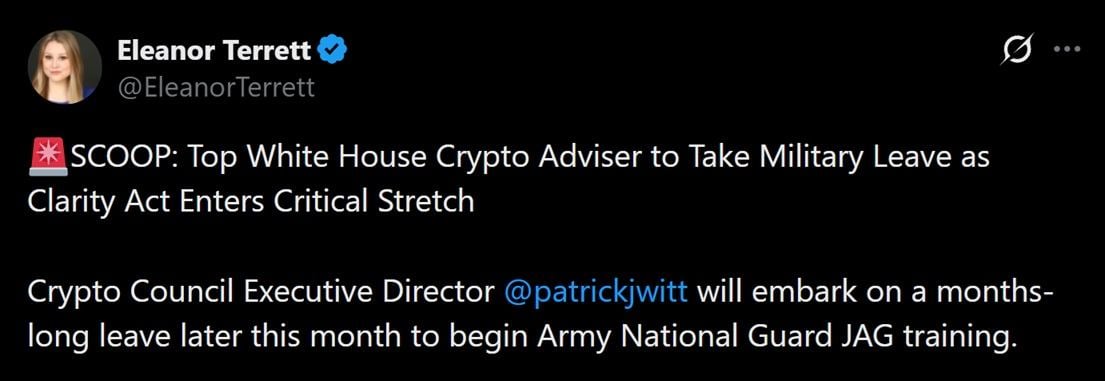 Image source: X
The timing is brutal given that Witt took over the crypto council in August 2025, after his predecessor Bo Hines departed for Tether, and has since run point on the administration’s entire digital asset agenda. This includes implementation of the Strategic Bitcoin Reserve, the rollout of the Guiding and Establishing National Innovation for U.S. Stablecoins (GENIUS) Act, digital asset tax modernization, and above all, the Digital Asset Market Clarity (CLARITY) Act (the market structure bill that would hand the Commodity Futures Trading Commission (CFTC) authority over spot digital asset trading).
Jung Inherits the Final Push
Harry Jung, the council’s deputy director, absorbs Witt’s responsibilities through the fall. The administration is projecting continuity given Jung has been in the room for most of the negotiations Witt led, and Witt is expected to stay connected during training “as much as the Army allows.” Whether Witt returns to the role full-time after his training concludes is reportedly uncertain.
That said, Jung’s inbox is unforgiving given that a merged draft of the CLARITY Act is expected this week, with the floor vote eyed around July 20. Such a timeline leaves the Senate roughly three working weeks before the August recess, widely described as the last realistic window to pass the bill this Congress.
Witt’s negotiating record is part of why his exit stings. He brokered compromises on stablecoin yield provisions that had pitted banks against the crypto industry and addressed law enforcement concerns over illicit fund tracking.
What Stands Between the Bill and 60 Votes
The bill needs 60 votes to clear a filibuster, meaning at least seven Democrats must cross over, and Senate leaders have been racing to pass the measure in July while momentum holds. The largest unresolved fight remains ethics, as democrats want provisions addressing the president’s personal crypto exposure, a dispute sharpened by disclosures indicating Trump earned more than $1.4 billion from crypto ventures last year.
Senator Elizabeth Warren pressed Senate leaders again Monday to bar officials and their families from profiting from crypto, while Senator Cynthia Lummis countered that the bill is “the only path that works.”
In any case, if the bill’s decisive July ends with 60 votes, the handoff will be a footnote, but if it fails by one or two, Washington will remember the week the White House’s crypto dealmaker traded the negotiating table for a military classroom.






 English (US) ·