
 2 months ago
49
2 months ago
49
- RippleX is developing privacy-focused features that could make the XRP Ledger more attractive to institutions.
- New Confidential Multi-Purpose Tokens aim to hide balances and transaction amounts while maintaining regulatory compliance.
- Industry observers believe the technology could remove one of the biggest barriers preventing banks from adopting blockchain infrastructure.
The XRP Ledger is attracting fresh attention, not because of price action this time, but because of a development that could have major implications for institutional adoption. RippleX is actively working on privacy-focused features that aim to give financial institutions something they have long wanted: transaction confidentiality without sacrificing regulatory oversight.
For years, banks and large financial firms have been interested in blockchain technology while remaining hesitant about one key issue. Most public blockchains are transparent by design, meaning transaction details can often be viewed by anyone. That level of openness may appeal to crypto enthusiasts, but it presents challenges for institutions handling sensitive financial information. RippleX believes it may have found a solution.
Confidential Transactions Could Change the Game
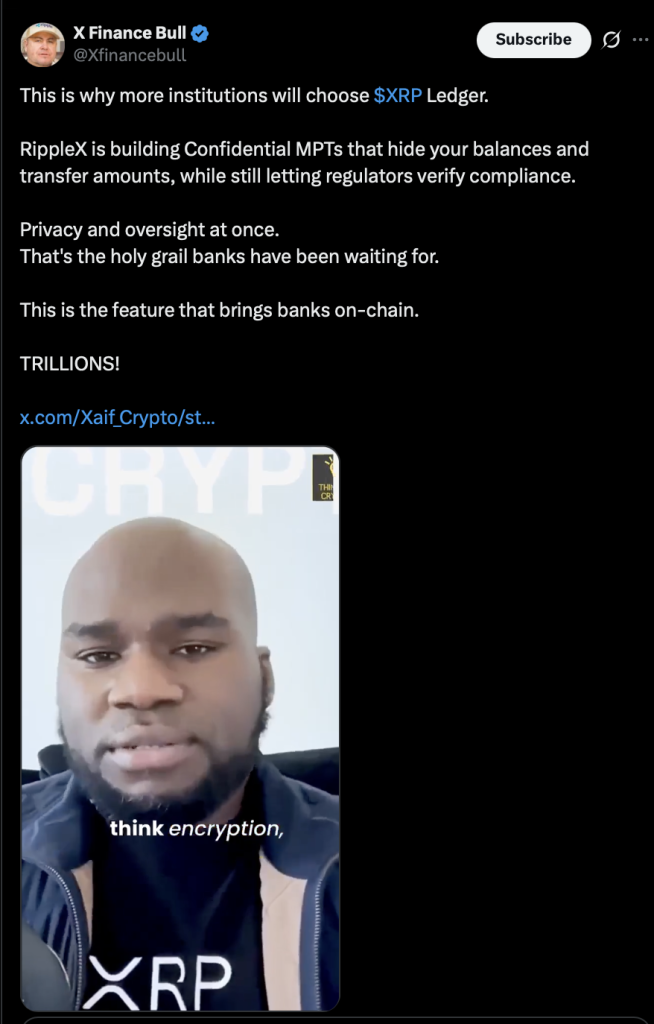
Crypto commentator X Finance Bull recently highlighted RippleX’s work on Confidential Multi-Purpose Tokens, or MPTs, as a potentially significant step forward for the XRP Ledger. These tokens are being designed to conceal balances and transfer amounts while still allowing regulators to verify compliance when necessary.
That combination is important. Financial institutions generally require privacy for operational and competitive reasons, but regulators still need visibility to ensure rules are being followed. Historically, striking that balance has been difficult for blockchain networks.
According to supporters of the initiative, confidential MPTs could offer both. Transaction details would remain hidden from public view, while approved authorities would still have access to the information required for oversight and compliance checks.
RippleX Explains the Vision
Ayo Akinyele, Ripple’s Head of Engineering, recently discussed the project and explained the thinking behind these privacy enhancements. He compared the approach to traditional banking systems, where sensitive transaction data is encrypted and protected from the public but can still be accessed by regulators when required.
The objective is fairly straightforward. RippleX wants to preserve the transparency needed for compliance while shielding sensitive financial information from everyone else. For institutions considering blockchain adoption, that distinction could be critical.
The first stage of the project focuses on hiding transaction amounts and token balances directly on the XRP Ledger. Rather than exposing those details publicly, the system uses advanced encryption techniques to keep them confidential while ensuring transactions remain verifiable.
Zero-Knowledge Technology Plays a Key Role
One of the most interesting components of the framework involves zero-knowledge proofs. This technology allows transactions to be validated without revealing the underlying data itself.
In practice, that means validators can confirm a transaction is legitimate without seeing the actual amount being transferred. The encrypted information remains private, but the network can still verify that everything is functioning correctly.
This approach allows confidential transactions to coexist with the XRP Ledger’s existing validation process. Validators continue performing their role, but sensitive details remain protected. It’s a complicated piece of engineering, admittedly, but one that many institutions have been waiting for.
Adding Privacy to a Public Blockchain Is Not Easy
Akinyele also acknowledged that integrating privacy into the XRP Ledger presents significant technical challenges. The blockchain was originally designed around transparency, so developers are effectively retrofitting confidentiality features onto an existing public infrastructure.
That balancing act requires careful design. Too much privacy could raise regulatory concerns, while too little may fail to address the needs of financial institutions. The goal is to create a middle ground where privacy and compliance can function together rather than compete with one another.
Why Institutions May Care
Supporters argue that this could become one of the XRP Ledger’s most important developments in years. Financial institutions often cite confidentiality requirements as a major obstacle when evaluating public blockchain networks. If RippleX can successfully deliver privacy features without compromising compliance, it could remove a significant barrier to adoption.
That is why some market observers believe the technology has the potential to support trillions of dollars in future on-chain activity. Whether those projections prove accurate remains to be seen, but the underlying idea is clear: institutions want privacy, regulators want oversight, and RippleX is attempting to provide both.
For now, development remains ongoing. But if these confidential transaction features perform as intended, they could strengthen the XRP Ledger’s position as a blockchain network designed not only for crypto users but also for large-scale financial institutions.
Disclaimer: BlockNews provides independent reporting on crypto, blockchain, and digital finance. All content is for informational purposes only and does not constitute financial advice. Readers should do their own research before making investment decisions. Some articles may use AI tools to assist in drafting, but every piece is reviewed and edited by our editorial team of experienced crypto writers and analysts before publication.







 English (US) ·