
 1 month ago
25
1 month ago
25
- Short-term speculative holders exited during XRP’s 40% decline, reducing unstable selling pressure.
- Long-term holders increased accumulation while leverage remained balanced, improving market structure.
- A breakout above $1.52 could open the path toward $1.70, while $1.31 remains key downside invalidation.
XRP has dropped almost 40% since January 5, sliding from $2.35 to roughly $1.40. Normally, a move like that tears through market structure. Panic selling kicks in. Long-term confidence cracks. The damage lingers.
But this time, the reaction was… different.
Instead of cascading liquidation and relentless selling, the data shows something almost counterintuitive. The weakest holders quietly exited. The strongest ones didn’t flinch. And leverage? Surprisingly balanced. Add steady institutional flows to the mix, and the crash starts to look less like a breakdown — and more like a reset.
Speculators Left — And That Matters
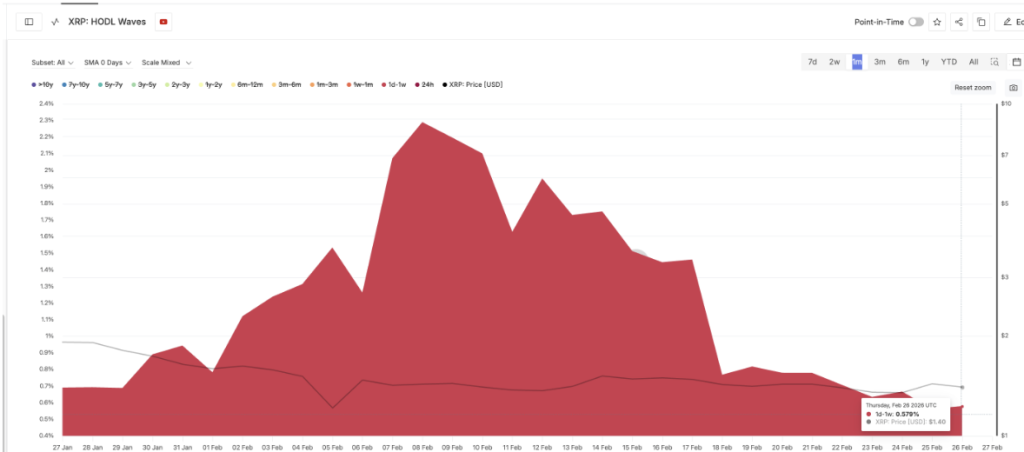
One of the clearest shifts showed up in HODL Waves data, which tracks wallet cohorts by holding time. Short-term holders — those who typically hold XRP for one day to one week — tend to be momentum-driven. They buy strength. They sell volatility. Fast.
On February 8, these speculative wallets controlled 2.29% of XRP’s supply. By February 26, that number had collapsed to just 0.579%. That’s a 74% reduction in speculative supply share in under three weeks — all while price was falling.
That’s not subtle.
When short-term holders exit during a drawdown, they remove a major source of future selling pressure. These are the same traders who often dump into small rebounds, preventing sustainable recovery. Their departure clears unstable supply from the system. In simple terms, weak hands are already gone.
But that alone doesn’t create strength. The real question is what the long-term cohort did during the drop.
Long-Term Holders Increased Exposure
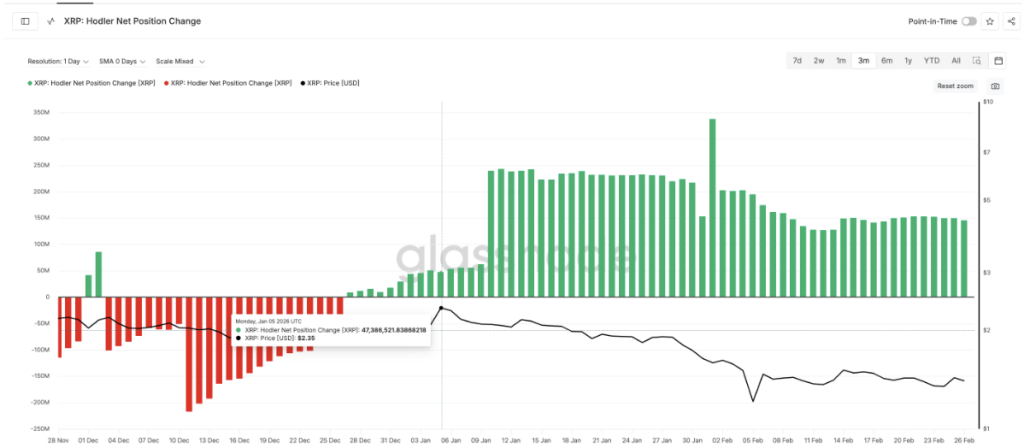
While price was sliding from $2.35 toward $1.40, long-term holders — defined as wallets holding for at least 155 days — were doing the opposite of panicking.
On January 5, their rolling 30-day net accumulation stood near 47.3 million XRP. By February 26, that number had surged to roughly 145.45 million XRP. That’s nearly a 200% increase in net accumulation while price was down 40%.
Let that sink in.
The most patient capital added size into weakness. And since mid-February, those holdings have remained stable even as XRP fluctuated between $1.21 and $1.52. They didn’t sell the volatility. They absorbed it.
That behavior shifts structure. Markets recover more sustainably when supply migrates from reactive hands to conviction-driven holders. It doesn’t guarantee upside — nothing does — but it reduces fragility.
Leverage Isn’t Overcrowded
Another reason crypto crashes spiral is leverage imbalance. When too many traders pile into one side, forced liquidations amplify moves.
Ethereum currently shows that risk clearly, with long leverage significantly outweighing shorts on major perpetual contracts. That kind of imbalance creates downside vulnerability if price slips.
XRP looks different.
On Binance, XRP perpetual contracts show roughly $74.9 million in long leverage and $69.1 million in shorts — nearly balanced. That symmetry matters. There’s no massive cluster of overleveraged longs waiting to be wiped out. There’s no extreme short crowding either.
Balanced leverage creates a healthier environment. Price moves are more likely to reflect genuine demand rather than forced liquidations. That lowers the probability of sudden cascade events.
Institutions Didn’t Pull Back
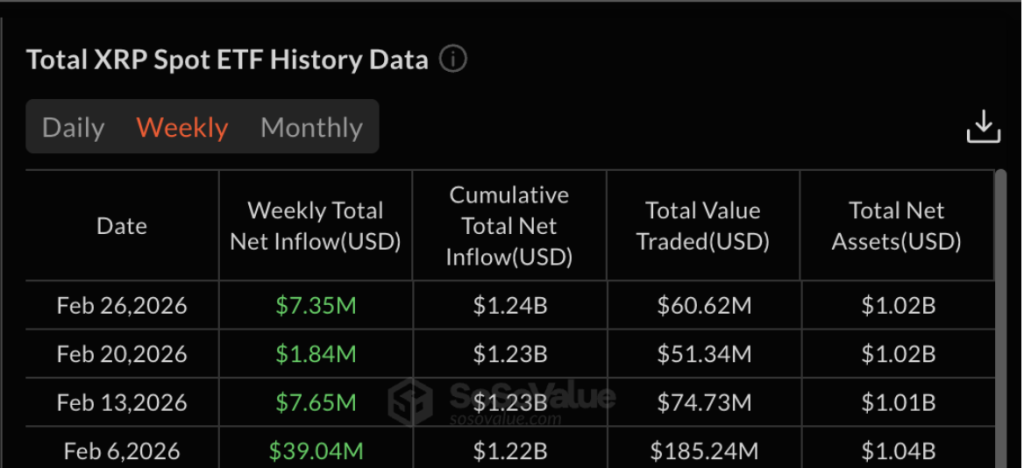
While many altcoins saw ETF outflows during February’s volatility, XRP-linked investment products continued attracting steady inflows. There were no significant net outflow weeks recorded during the drop.
Institutional capital behaves differently from retail momentum traders. It typically operates on longer horizons and doesn’t react to every swing. Consistent inflows during a 40% drawdown signal underlying confidence.
That kind of participation acts as structural support.
The Technical Setup
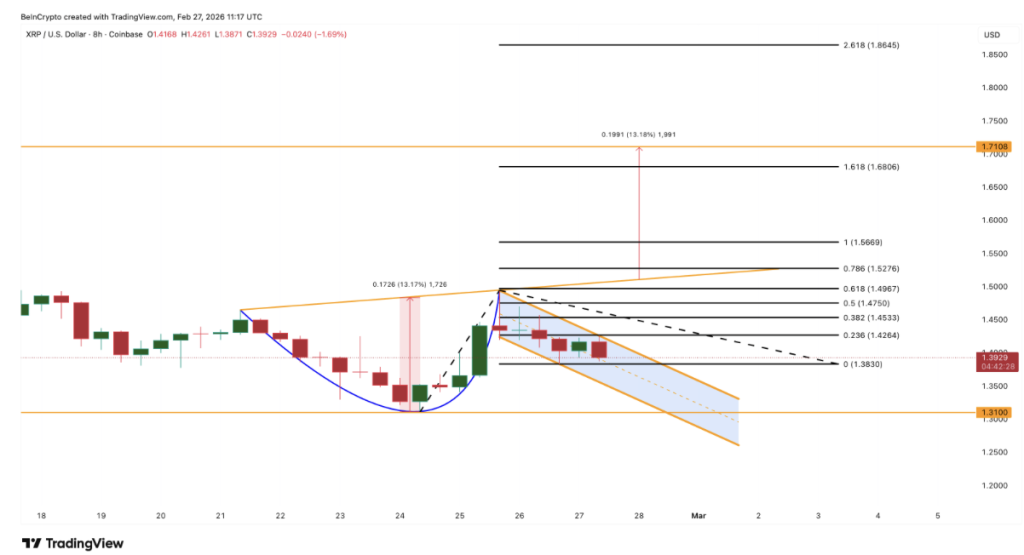
On the 8-hour chart, XRP appears to be forming a cup-and-handle structure. After correcting roughly 7% from its late-February high, price consolidated into a defined handle zone.
Key levels are clear.
As long as XRP holds above $1.38, the bullish structure remains intact. A break below $1.31 would invalidate the pattern. On the upside, price needs to clear $1.42 to confirm handle strength, with $1.52 acting as the neckline resistance.
If $1.52 breaks convincingly, technical projection points toward the $1.70 zone — possibly extending toward $1.86 in a stronger momentum scenario.
For now, XRP isn’t exploding upward. But it isn’t collapsing either.
What the data suggests is subtle but important: the 40% drop didn’t fracture the foundation. It redistributed supply, stabilized leverage, and maintained institutional participation.
Sometimes crashes weaken assets. Sometimes they cleanse them.
This one might fall into the second category.
Disclaimer: BlockNews provides independent reporting on crypto, blockchain, and digital finance. All content is for informational purposes only and does not constitute financial advice. Readers should do their own research before making investment decisions. Some articles may use AI tools to assist in drafting, but every piece is reviewed and edited by our editorial team of experienced crypto writers and analysts before publication.







 English (US) ·