
 2 months ago
73
2 months ago
73
- XRP is down roughly 27% year-to-date despite Ripple continuing to expand banking and payment partnerships globally
- Analysts increasingly point to a disconnect between Ripple the company and XRP the asset itself
- XRP remains heavily dependent on Bitcoin’s direction and broader macroeconomic conditions for momentum
Ripple continues signing partnerships with banks and payment firms around the world, but XRP holders are still staring at mostly flat charts.
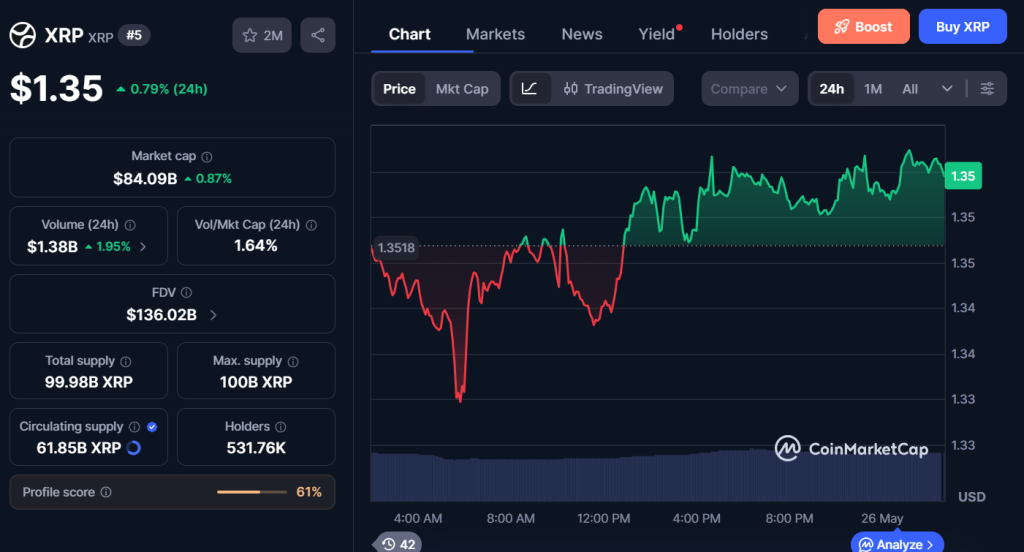
That disconnect has become one of the more frustrating realities surrounding the asset in 2026. While Ripple the company keeps expanding its blockchain payment infrastructure and XRPL integrations globally, XRP itself continues struggling to build sustained upward momentum.
And increasingly, the market seems to be treating Ripple and XRP as two very separate things.
Ripple’s Growth Does Not Automatically Mean XRP Growth
Ripple operates as a fintech company focused on blockchain-based payment infrastructure. XRP is the native token tied to the XRP Ledger ecosystem, but ownership of XRP does not directly represent ownership in Ripple itself. That distinction matters far more than many retail investors originally expected.
Even when Ripple announces major banking partnerships or payment corridor expansions, XRP often reacts only briefly before returning to broader market-driven price action. The token now trades much more like a macro-sensitive crypto asset than a direct reflection of Ripple’s business growth.
XRP Still Moves With Bitcoin More Than Anything Else
One of the biggest challenges for XRP right now is its continued dependence on Bitcoin’s market direction.
Historically, XRP rarely sustains independent breakouts without broader crypto market strength supporting it. Bitcoin and Ethereum still largely dictate overall liquidity conditions, risk appetite, and trader positioning across digital assets.

That becomes a problem when Bitcoin itself struggles to maintain momentum. BTC has spent much of 2026 chopping between roughly $65,000 and $77,000 while repeatedly failing to hold above key resistance levels near $80,000. Without a stronger Bitcoin trend, XRP’s room for meaningful upside remains limited.
Macroeconomic Pressure Is Hurting Risk Assets
The broader market backdrop has not helped either. Rising oil prices, geopolitical tensions in the Middle East, persistent inflation concerns, and uncertainty around global monetary policy continue weighing heavily on speculative assets.
Crypto markets overall remain highly sensitive to macroeconomic sentiment shifts right now. That means even fundamentally positive developments inside specific ecosystems often struggle to overpower broader market caution. XRP is not immune to that environment.
XRP’s Identity Problem Is Still Unresolved
Ripple the company increasingly looks like a serious enterprise payments infrastructure business. XRP, meanwhile, still trades primarily within speculative crypto market cycles rather than enterprise valuation frameworks. Investors continue debating whether XRP should behave more like a utility asset tied to payment rails or more like a high-beta altcoin tied to broader crypto momentum.
Right now, the market is clearly treating it more like the second option. Until Bitcoin stabilizes and broader risk appetite improves, XRP may continue struggling to convert Ripple’s real-world adoption headlines into sustained price appreciation.
Disclaimer: BlockNews provides independent reporting on crypto, blockchain, and digital finance. All content is for informational purposes only and does not constitute financial advice. Readers should do their own research before making investment decisions. Some articles may use AI tools to assist in drafting, but every piece is reviewed and edited by our editorial team of experienced crypto writers and analysts before publication.




 English (US) ·