
 2 months ago
68
2 months ago
68
- XRP Ledger is adding new tools designed to support automated software agents and AI-driven financial activity.
- XRP investment products attracted more than $10 million in fresh inflows during the latest reporting period.
- Developers are also working on security upgrades, lending features, and quantum-resistant protections for the network.
The XRP Ledger is seeing momentum build across multiple areas at once. While much of the attention around XRP often focuses on price movements and ETF flows, activity behind the scenes has been expanding steadily. New payment infrastructure is being introduced, investment products continue attracting fresh capital, and developers are pushing forward with upgrades aimed at strengthening the network for the future.
Taken together, these developments suggest the XRP ecosystem is evolving beyond its traditional role as a payment-focused blockchain. The latest initiatives are increasingly centered on automation, artificial intelligence, lending, and long-term security, areas that could play a larger role in blockchain adoption over the coming years.
XRP Ledger Introduces New Tools for Software Agents
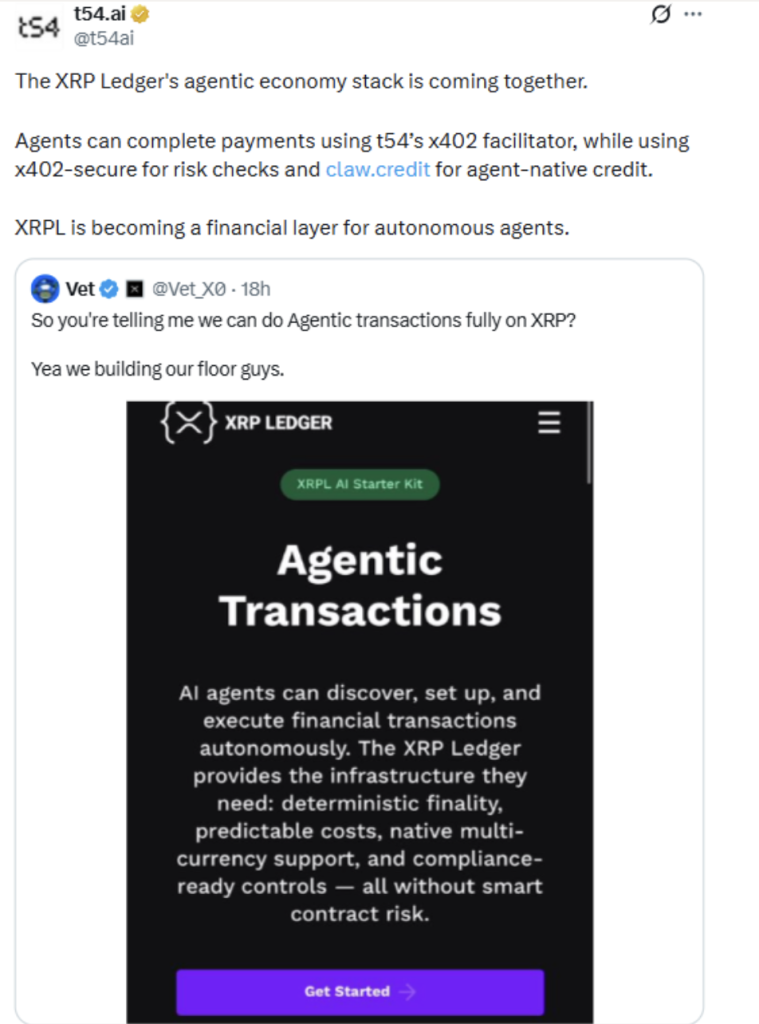
One of the more interesting developments comes from T54, which recently announced a suite of services designed to help software agents operate directly on the XRP Ledger.
The company introduced its x402 facilitator, a tool that allows automated programs to execute payments on the network without requiring constant human involvement. In simple terms, software agents can now send, receive, and manage transactions in a more autonomous way.
But payments are only part of the picture.
T54 also unveiled x402-secure, a service focused on performing risk checks before transactions are finalized. That means software agents can evaluate certain conditions before moving funds, adding another layer of decision-making to automated financial processes.
It’s a subtle shift, but an important one.
Building an “Agentic Economy”
Another piece of the new infrastructure is Claw Credit, a service intended to provide software agents with access to credit inside the same environment where payments are processed.
According to T54, the goal is to combine payments, risk assessment, and credit services into a single stack that allows automated systems to handle increasingly complex financial tasks.
That concept aligns with a broader trend emerging across the technology sector. Developers are exploring how AI systems and software agents might eventually perform routine financial activities on their own, whether that’s making payments, accessing liquidity, or evaluating risk.
Historically, blockchain networks have primarily served human users. Increasingly, however, developers are designing infrastructure with machine-to-machine interaction in mind.
For XRP Ledger, this represents another step toward supporting a wider range of economic activity beyond simple value transfers.
ETF Flows Continue Supporting XRP Interest
While development activity expands, investor interest has remained relatively healthy as well.
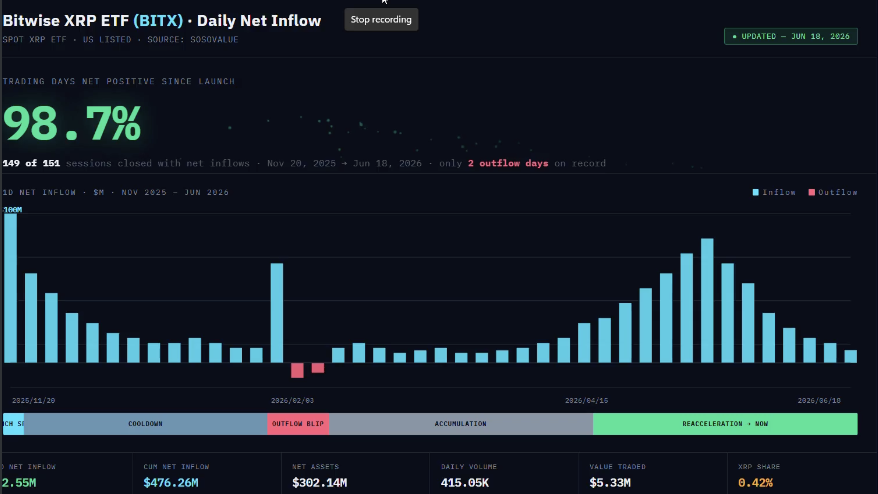
According to figures shared by BankXRP, exchange-traded products linked to XRP attracted approximately $10.66 million in net inflows during the latest week. That may not be a massive number compared to larger financial markets, but it continues a trend that has kept XRP-related investment products in focus.
Franklin’s XRPZ fund accounted for the majority of inflows, bringing in roughly $6.69 million. Bitwise followed with an additional $3.97 million.
The cumulative numbers are becoming increasingly notable.
XRPZ has now accumulated approximately $406 million in total inflows, while the Bitwise product has attracted around $476 million. Those figures suggest that investor interest in XRP-focused investment vehicles remains active despite broader market uncertainty.
Why ETF Demand Still Matters
Fund flows are closely monitored because they provide a window into investor behavior.
When capital continues entering investment products, it often indicates that institutional and retail investors remain interested in gaining exposure to an asset. While weekly inflow figures can fluctuate considerably, sustained positive flows tend to support longer-term confidence.
For XRP supporters, the recent data offers reassurance that interest in the asset has not disappeared.
Importantly, these inflows are arriving alongside meaningful development activity within the XRP ecosystem. That combination, network growth paired with investment demand, tends to attract attention from market participants evaluating long-term trends.

XRPL Developers Focus on Future Security
Beyond payments and investment products, development work on the core XRP Ledger continues as well.
According to reports from ecosystem validator Vet, developers are currently exploring several major upgrades aimed at strengthening the network’s security, resilience, and financial capabilities.
One area receiving particular attention is quantum computing.
While practical quantum threats remain largely theoretical today, blockchain developers are increasingly preparing for a future where advances in computing power could challenge existing security systems. XRPL developers are evaluating ways to ensure the network remains secure if those risks eventually become reality.
It’s the kind of work that often goes unnoticed, but it matters.
Strong security is rarely exciting until it’s needed.
Lending, Liquidity, and AI-Based Testing
The proposed roadmap also includes native lending functionality and additional liquidity-focused improvements. These features could expand the types of financial services available directly within the XRP Ledger ecosystem.
At the same time, developers are using AI-driven testing systems to simulate various security scenarios and identify potential weaknesses before they become problems.
Formal verification methods are also being applied to review code and reduce the likelihood of software errors. These approaches are generally viewed as some of the most rigorous forms of security testing available within blockchain development.
Together, they signal a growing emphasis on building infrastructure that can scale without compromising reliability.
XRP Ledger’s Evolution Continues
The latest developments highlight how XRP Ledger’s ambitions are expanding beyond traditional payments. New tools for software agents, growing ETF interest, lending initiatives, AI-focused infrastructure, and future-proof security measures all point toward a broader vision for the network.
Whether these efforts translate into increased adoption remains to be seen. But the direction is becoming clearer.
Rather than focusing solely on transaction speed and payments, XRP Ledger is gradually positioning itself as a platform capable of supporting automated financial systems, digital credit markets, and more advanced blockchain applications.
And in an increasingly competitive crypto landscape, that evolution may prove important.
Disclaimer: BlockNews provides independent reporting on crypto, blockchain, and digital finance. All content is for informational purposes only and does not constitute financial advice. Readers should do their own research before making investment decisions. Some articles may use AI tools to assist in drafting, but every piece is reviewed and edited by our editorial team of experienced crypto writers and analysts before publication.




 English (US) ·