
 2 months ago
55
2 months ago
55
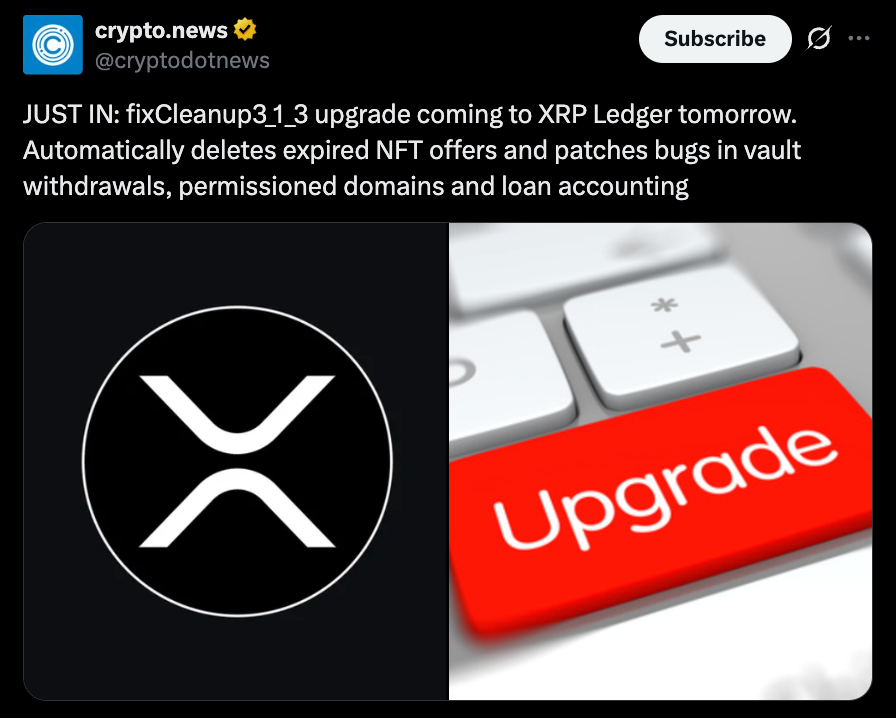
- XRP Ledger is activating a major maintenance upgrade called fixCleanup3_1_3
- The update removes expired NFT data and patches lending-related accounting bugs
- Validators that fail to update risk falling out of sync with the network entirely
XRP Ledger is rolling out one of its more important infrastructure upgrades in recent memory, though this one is less about hype and a lot more about cleaning up years of technical baggage quietly accumulating underneath the network.
The new update, called fixCleanup3_1_3, activates Wednesday and requires validators and node operators to upgrade their software or risk disconnecting from consensus with the rest of the XRP Ledger network. For normal XRP holders, nothing dramatic changes immediately. But behind the scenes, the update touches several core areas tied to ledger maintenance, accounting accuracy, and long-term network reliability.
Honestly, this is the kind of upgrade mature blockchains eventually need whether social media notices or not.
XRP Ledger Is Finally Clearing Out Expired NFT Junk
One of the biggest changes targets expired NFT offers currently lingering on the ledger indefinitely. Until now, failed or expired NFT listings could remain stored permanently, slowly adding unnecessary clutter over time.
The update automatically removes these stale records instead of preserving them forever. Think of it like finally cleaning out years of abandoned marketplace listings nobody planned to touch again anyway.
While that may sound minor on the surface, ledger bloat becomes a genuine operational issue for blockchain networks as activity scales over multiple years. Removing unnecessary historical junk improves efficiency and helps reduce long-term storage overhead for infrastructure operators maintaining the network.
Several Financial Bugs Are Also Getting Patched
Beyond NFT cleanup, the upgrade also fixes multiple bugs tied to lending systems, vault withdrawals, permissioned domains, and accounting logic inside decentralized financial tools operating on XRP Ledger.
According to developers, certain failed transactions previously had the potential to accidentally alter settings or leave stale accounting records behind, which is obviously not ideal behavior inside systems handling financial balances and collateral calculations.
The new safeguards specifically strengthen lending pool accounting by ensuring reserve balances align more accurately with reported collateral positions. Additional protections are also being introduced around vault withdrawal handling and permission management logic.
None of this creates flashy headlines like token launches or meme-fueled rallies. But when financial infrastructure starts growing more complex, accurate accounting and predictable state management become extremely important very quickly.

Validators Must Update Or Risk Falling Behind
The upgrade also carries operational consequences for validators themselves. Nodes that fail to install the new software risk falling out of sync with the rest of the network after activation occurs.
That matters because XRP Ledger consensus depends heavily on validators maintaining compatibility during amendment rollouts. Infrastructure operators who delay upgrades too long can temporarily disconnect themselves from network participation entirely until systems are updated properly.
For institutional adoption especially, stable validator coordination during upgrades becomes increasingly important as financial firms evaluate blockchain infrastructure reliability more seriously.
Mature Blockchains Eventually Need Reliability More Than Hype
What makes this update notable is not necessarily any single feature itself, but what it represents structurally. XRP Ledger is increasingly behaving like a blockchain focused on long-term operational maturity rather than purely speculative momentum cycles.
As networks evolve, the priorities naturally shift. Early-stage ecosystems often focus heavily on growth, adoption, and attracting developers quickly. Later-stage ecosystems eventually start emphasizing reliability, accounting integrity, infrastructure maintenance, and operational stability instead.
That transition is usually a sign the technology itself is maturing underneath the surface.
If XRP Ledger wants deeper institutional usage, tokenized financial infrastructure, or broader integration into payment systems long term, upgrades like this probably matter far more than daily price predictions circulating across crypto Twitter.
Because eventually, financial systems are judged less by hype and more by whether the plumbing actually works consistently.
Disclaimer: BlockNews provides independent reporting on crypto, blockchain, and digital finance. All content is for informational purposes only and does not constitute financial advice. Readers should do their own research before making investment decisions. Some articles may use AI tools to assist in drafting, but every piece is reviewed and edited by our editorial team of experienced crypto writers and analysts before publication.



 English (US) ·