
 3 weeks ago
42
3 weeks ago
42
Zano is preparing to replace its hybrid proof-of-work and proof-of-stake system with Zenith, a privacy-preserving pure proof-of-stake protocol promising 15-second blocks, faster confirmations, and lower token issuance.
Key Takeaways
- Zano’s Zenith targets 15-second blocks and four to six confirmations in 2027.
- Zano could eliminate 262,800 ZANO in annual proof-of-work issuance.
- Andrey Sabelnikov says Zenith builds on more than 12 years of privacy research.
- Alongside the Zenith announcement, Zano launched a new forum.
Zano Targets 2027 for a Major Consensus Shift
The privacy-focused blockchain announced that Zenith is now in implementation, with a network transition planned for 2027, subject to testing, analysis, and review. Zano has not announced an activation date, and the proposed operating parameters remain subject to network-level validation.
Zenith emerged from years of research into Zano’s hybrid model. The team initially sought to strengthen the combination of proof of work and proof of stake, but repeated design efforts continued to inherit limitations tied to mining. After encountering those structural constraints, Zano and blockchain research firm Common Prefix explored pure proof-of- stake alternatives.
The collaboration produced two research paths, StakeNote and Zenith. Zano selected Zenith because it extends the privacy machinery already built into the network through Zarcanum rather than requiring a separate architecture.
Private Staking Moves to the Center
Conventional proof-of- stake systems often expose validator balances, staking histories or links between participants and their funds. That model would conflict with Zano’s privacy goals, which center on hiding balances, transaction histories and user identities. Zenith is designed to determine whether a participant is eligible to produce a block without revealing the amount staked or creating a permanent public link between outputs and identity.
“Privacy projects should not have to choose between stronger consensus security and protecting their users’ privacy,” Andrey Sabelnikov, co-founder and core developer of Zano remarked.
The Zano developer added:
“Zenith is the result of more than 12 years of research into how a network can gain the benefits of modern proof of stake while preserving the privacy that users expect from Zano.”
Blocks Accelerate to 15 Seconds
Under the proposed design, Zano’s block time would fall from about one minute to roughly 15 seconds. The recommended confirmation threshold would decline from 10 blocks to between four and six, cutting typical confirmation time to about 60 to 90 seconds. Zano detailed that six Zenith confirmations are expected to provide stronger security guarantees than the 10 confirmations used today, although those figures remain targets until testing is complete.
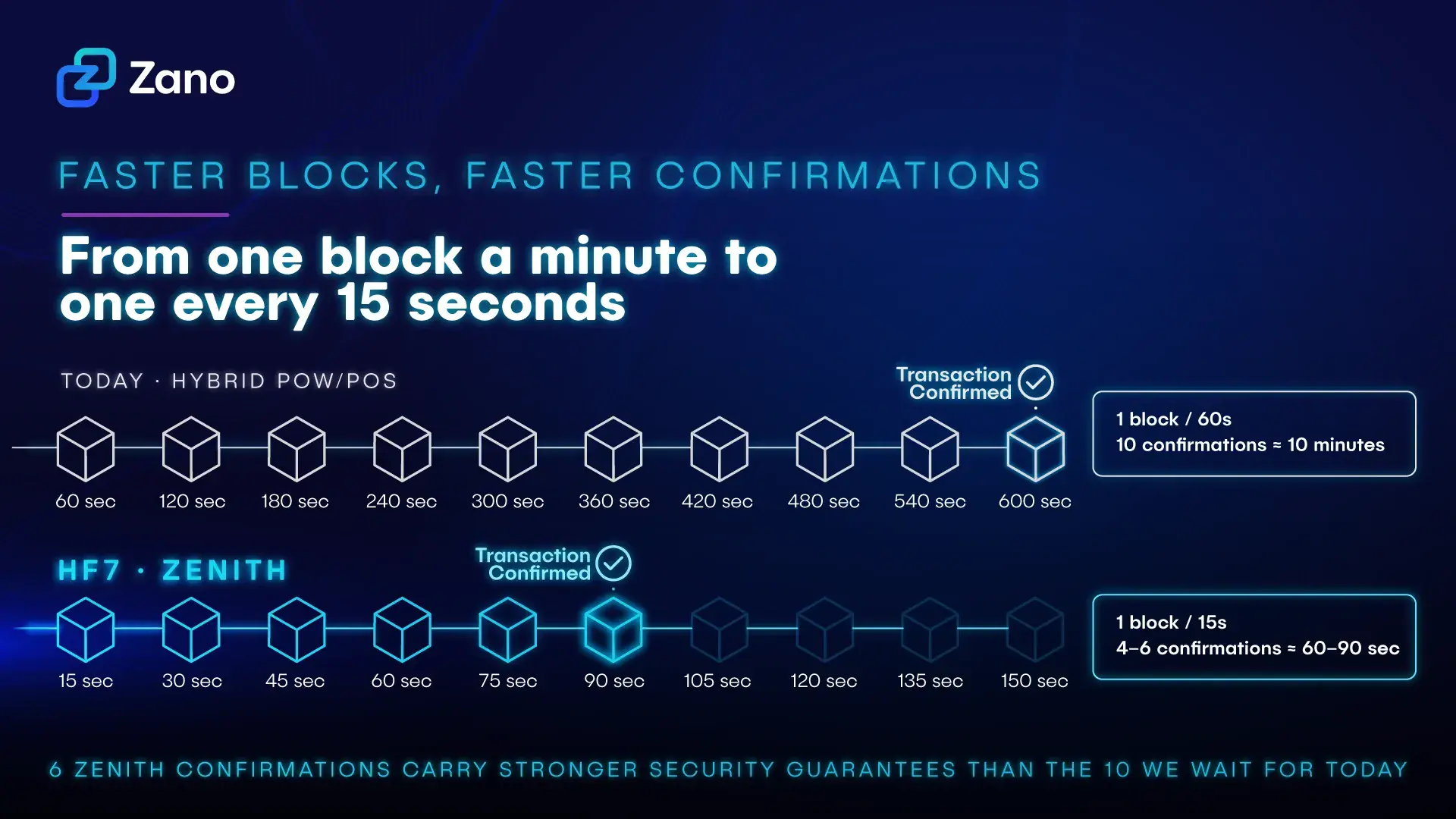 Zenith blocks visual.
Faster settlement could improve private payments, wallet transfers, decentralized trading, bridge activity, and application integrations. For users, the main change would be quicker confidence that a transaction has become part of the accepted chain without weakening the privacy protections surrounding the transfer.
Ephemeral Blocks Aim to Control Chain Growth
In the announcement, the team noted that a fourfold increase in block frequency could ordinarily increase storage and synchronization demands. Zenith addresses that issue through ephemeral blocks, which retain full data near the chain tip but become more compact after an epoch is finalized. Under the proposed parameters, each 10-minute epoch would contain 40 blocks.
After finalization and a retention period, most blocks would be reduced to compact cryptographic records that preserve the chain structure and essential commitments. One block reward per epoch would remain permanently recorded in Zano’s global output index, while the other 39 reward records would not require permanent indexing. An optional archival mode would preserve complete historical data for operators who want it.
Mining Emissions Face Elimination
The economic change may be equally significant. Proof-of-work miners currently receive about 720 newly created ZANO per day, equal to roughly 21,600 ZANO per month or 262,800 ZANO per year. Once Zenith activates and proof-of-work mining ends, that portion of issuance disappears.
Zano argues the shift would reduce the amount of newly created ZANO entering circulation and remove some cost-driven selling associated with electricity, equipment, hosting, and maintenance expenses. The project stopped short of making a price forecast, noting that demand, liquidity, adoption, and broader market conditions will still determine ZANO’s market value.
Testing Now Becomes the Decisive Phase
Zenith represents Zano’s planned move from a hybrid network launched in 2019 to a pure proof-of- stake system rooted in Zarcanum’s privacy technology. For holders and node operators, the proposal combines faster settlement, lower issuance, and private staking without exposing validator balances. The 2027 transition remains conditional, but Zano has now established the technical direction for its next consensus era.
Alongside the Zenith rollout, the team has launched the official Zano Forum as a dedicated hub for questions, technical discussion and community support. Members can verify their on-chain aliases to receive a visible badge, giving users a clearer way to distinguish authenticated accounts from unverified participants and reducing uncertainty over who is providing information.
Zano launched its Lite Wallet Beta on May 22, 2026, giving desktop users on Windows, Mac, and Linux a way…
Zano Ships Desktop Lite Wallet Beta Connecting Users to Remote Nodes Instantly
Zano launched its Lite Wallet Beta on May 22, 2026, giving desktop users on Windows, Mac, and Linux a way…
Zano Ships Desktop Lite Wallet Beta Connecting Users to Remote Nodes Instantly
Zano launched its Lite Wallet Beta on May 22, 2026, giving desktop users on Windows, Mac, and Linux a way…





 English (US) ·