
 3 months ago
52
3 months ago
52
- U.S. soldier charged after turning $33K into ~$400K using classified intel
- First known DOJ prosecution tied to insider trading on prediction markets
- Case raises broader questions about selective enforcement across markets
A U.S. Army Special Forces soldier, Gannon Ken Van Dyke, is now at the center of what looks like a landmark case for crypto prediction markets. Prosecutors say he used classified information tied to the January 2026 raid that captured Venezuela’s Nicolás Maduro to place 13 bets on Polymarket, turning roughly $33,000 into more than $400,000.
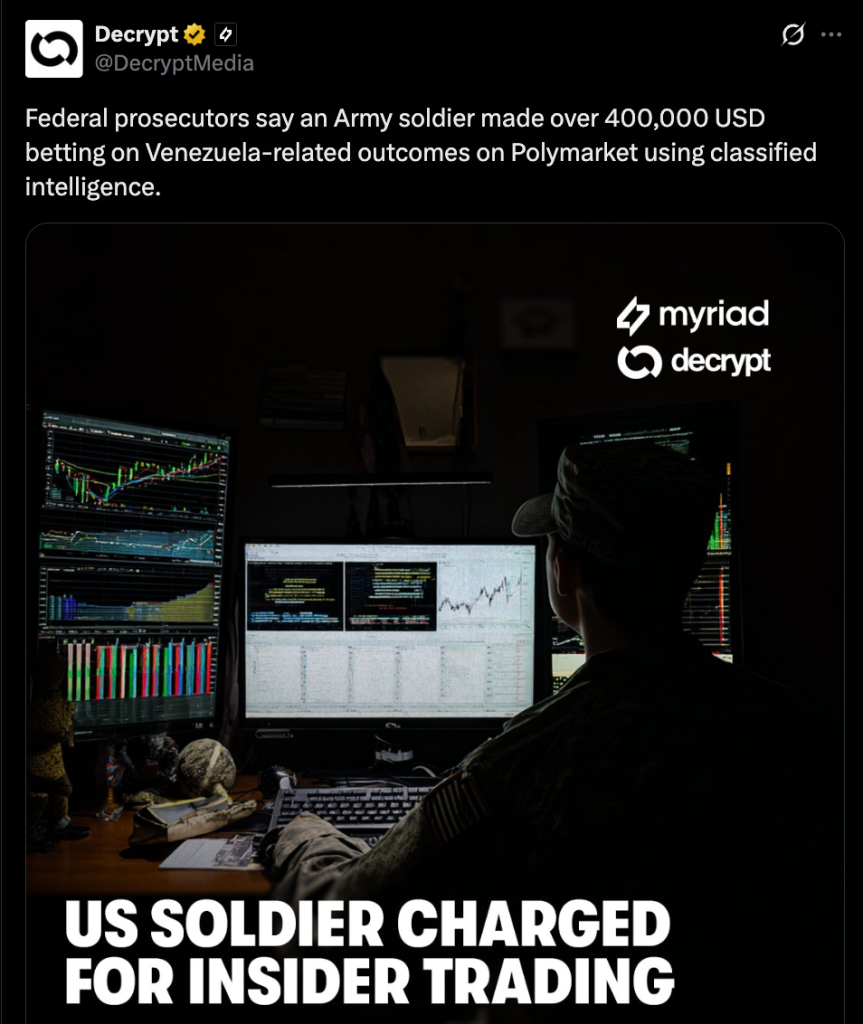
That alone would be controversial, but what makes this case different is that it’s the first time U.S. authorities have brought insider trading-style charges against someone using a prediction market, not traditional equities or commodities.
A First for Prediction Markets
According to the indictment, Van Dyke had direct access to nonpublic, classified details about “Operation Absolute Resolve,” the mission that ultimately removed Maduro from power.
He allegedly placed bets on outcomes like U.S. military involvement and Maduro’s removal before the information became public, with all 13 trades landing correctly once the operation was announced.
Authorities framed it clearly, prediction markets are not exempt from insider trading rules when nonpublic information is used for profit.
Why This Case Stands Out
The legal theory isn’t entirely new, using privileged information for financial gain has always been illegal, but applying it to decentralized or crypto-based prediction platforms is new territory.

That’s why this case is being watched closely, not just as a criminal proceeding, but as a precedent for how regulators might treat similar behavior going forward.
The Bigger Question Lurking Underneath
At the same time, the case has sparked a broader, and more uncomfortable, discussion. Insider trading concerns exist across multiple markets, from commodities to equities, especially around major geopolitical or regulatory events.
Yet enforcement has historically been uneven, with large-scale institutional activity rarely facing the same level of scrutiny as smaller or more visible cases. This situation highlights that contrast, even if it doesn’t resolve it.
What Happens Next
Van Dyke now faces multiple federal charges, including wire fraud and misuse of government information, with potential penalties that could reach decades in prison if convicted.
Meanwhile, the case is likely to accelerate regulatory attention on prediction markets like Polymarket, which are already growing quickly and attracting more capital.
Whether this becomes a one-off example or the start of broader enforcement is still unclear, but one thing is certain, the line between information and advantage in these markets is now under much closer watch.
Disclaimer: BlockNews provides independent reporting on crypto, blockchain, and digital finance. All content is for informational purposes only and does not constitute financial advice. Readers should do their own research before making investment decisions. Some articles may use AI tools to assist in drafting, but every piece is reviewed and edited by our editorial team of experienced crypto writers and analysts before publication.








 English (US) ·