
 2 months ago
57
2 months ago
57
- Congressman Matt Van Epps co-led a bill that would codify a U.S. Strategic Bitcoin Reserve into federal law.
- The reserve would hold confiscated Bitcoin and only allow future sales for reducing national debt.
- The proposal also protects self-custody rights and requires public Proof of Reserve audits every quarter.
A new Bitcoin-focused bill moving through Congress is starting to draw serious attention, not just because of what it proposes, but because of what it says about how deeply crypto has started embedding itself into American politics and regional economies.
Representative Matt Van Epps helped introduce the American Reserve Modernization Act of 2026 this week, and he framed the legislation less like a distant national security proposal and more like a reflection of what he already sees happening back home in Tennessee. According to Van Epps, Nashville is quickly becoming one of America’s biggest Bitcoin hubs, fueled by institutions like Bitcoin Park, a rapidly expanding digital asset community, and the return of the annual Bitcoin conference in 2027.
For the freshman congressman representing Tennessee’s 7th District, the issue appears personal. Van Epps, a West Point graduate and former combat helicopter pilot who won his seat in a December 2025 special election, described the bill as an extension of the financial innovation already taking place inside his district rather than some abstract federal experiment.
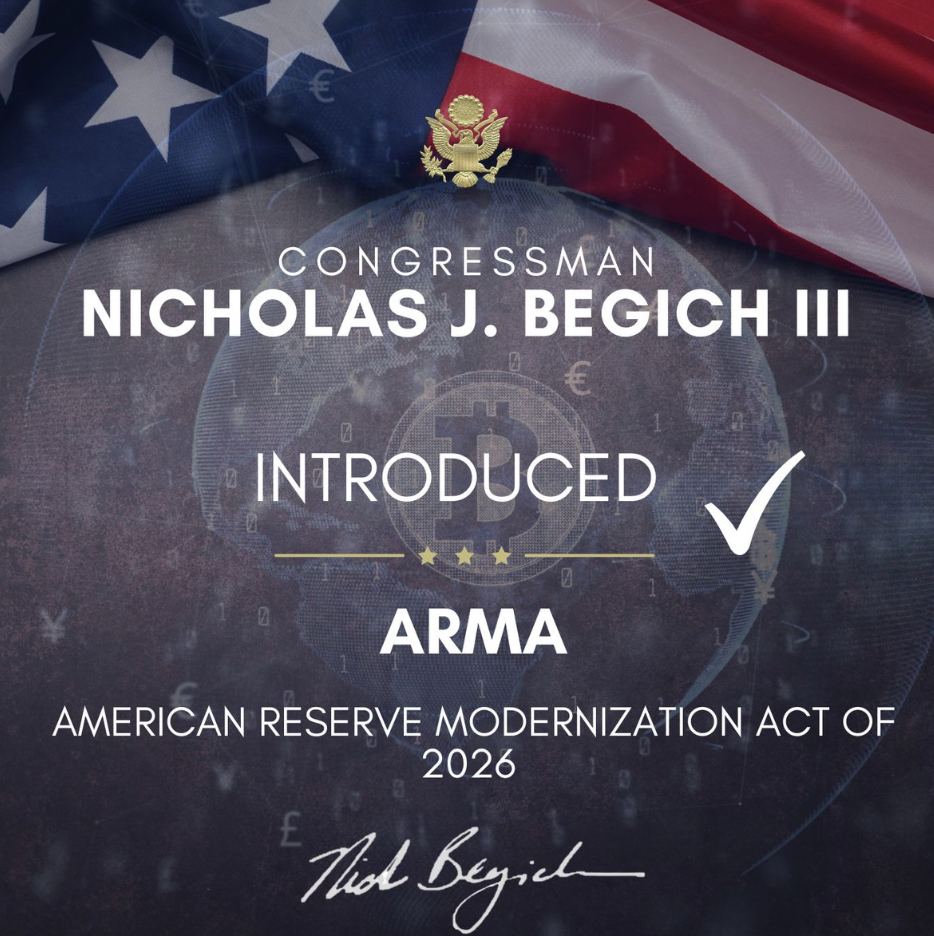
The ARMA Bill Would Officially Create a Strategic Bitcoin Reserve
Van Epps co-led the legislation alongside Representative Nick Begich of Alaska. The proposal, officially called the American Reserve Modernization Act — or ARMA — would transform President Trump’s March 2025 executive order establishing a Strategic Bitcoin Reserve into permanent federal law.
That distinction matters quite a bit.
Executive orders can be reversed by future administrations fairly easily, but codifying the reserve into statute would give it far more durability and political weight moving forward. Under the proposal, the reserve would sit under the U.S. Treasury Department and primarily hold Bitcoin obtained through federal seizures, civil penalties, and law enforcement forfeitures.
Importantly, the bill argues the reserve could be built without directly costing taxpayers additional money. Instead of purchasing Bitcoin on the open market using public funds, the government would essentially repurpose confiscated BTC into a long-term national reserve asset.
And unlike normal government asset pools, ARMA places strict rules around how Bitcoin could eventually be sold.
Bitcoin Reserve Would Be Used Only for National Debt Reduction
Van Epps repeatedly framed the legislation as a fiscal strategy tied directly to America’s growing debt problem. With U.S. national debt approaching $39 trillion, he described the reserve as an “essential” piece of legislation capable of helping stabilize long-term government finances.
Under the bill, any future sale of Bitcoin from the reserve would only be allowed for one purpose: reducing national debt. The language specifically blocks the reserve from becoming a discretionary spending account for unrelated federal programs or political priorities.
That limitation appears designed to reassure Bitcoin supporters worried about government misuse while also presenting the reserve as a generational balance-sheet strategy rather than a short-term political tool.
The proposal also requires all BTC held inside the reserve to remain untouched for at least 20 years. That’s a pretty aggressive holding period by government standards, honestly. But supporters argue Bitcoin’s fixed supply and long-term appreciation potential make it fundamentally different from traditional reserve assets like gold certificates or Treasury holdings.
Van Epps even suggested Bitcoin could eventually help “solve major problems” facing the United States if managed correctly over long time horizons.
Property Rights and Self-Custody Remain Central Themes
Another major part of the bill focuses on digital property rights. ARMA includes language explicitly protecting an individual’s right to own, transfer, and self-custody digital assets without government interference.
That piece reflects the broader libertarian streak running through much of the pro-Bitcoin movement inside Congress right now. Many lawmakers supporting crypto legislation increasingly frame self-custody rights as financial free speech rather than simply investment preferences.
The bill also attempts to address transparency concerns by requiring quarterly public Proof of Reserve reports alongside independent third-party audits. Those additions would create more oversight than currently exists under the executive order framework alone.
The Senate Battle May Be Much Harder
So far, ARMA has attracted 18 original co-sponsors spanning nine different states, showing growing political support for Bitcoin-related legislation across parts of Congress. Still, the Senate remains a much more difficult hurdle.
Several competing crypto bills are already moving through Senate committees, and securing the 60 votes likely needed for broader passage remains uncertain. Regulatory disagreements around stablecoins, securities law, and digital asset oversight continue dividing lawmakers even as Bitcoin itself gains more institutional acceptance.
But regardless of whether ARMA passes in its current form, the bigger signal feels increasingly clear: Bitcoin is no longer sitting outside the American political conversation. It’s becoming part of it.
And lawmakers from places like Nashville seem determined to make sure that trend continues accelerating.
Disclaimer: BlockNews provides independent reporting on crypto, blockchain, and digital finance. All content is for informational purposes only and does not constitute financial advice. Readers should do their own research before making investment decisions. Some articles may use AI tools to assist in drafting, but every piece is reviewed and edited by our editorial team of experienced crypto writers and analysts before publication.






 English (US) ·