
 3 weeks ago
61
3 weeks ago
61
Prediction market traders on Polymarket and Kalshi are pricing in a Democratic takeover of the U.S. House in the 2026 midterms while giving Republicans the edge to hold the Senate, with tens of millions of dollars wagered across hundreds of individual races and primary markets.
Key Takeaways
- Polymarket prices Democrats at 86% odds to win House control, with $9 million traded on the market.
- Kalshi’s KY-04 GOP primary, Gallrein versus Massie, leads all midterm markets at $22 million.
- Nevada’s abortion protection amendment carries the strongest odds among ballot measures at 92%.
On Polymarket, bettors give Democrats an 86% probability of winning House control, with $9 million traded on that single market. The platform’s current seat projection points to 232 Democratic seats against 203 for Republicans. The Senate outlook favors Republicans at 56%, with traders projecting a 49 to 51 seat split in the GOP’s favor. That Senate market has drawn $3 million in volume.
Ballot measures are also drawing money. California’s proposed one-time wealth tax on billionaires sits at 34% odds to pass, with $4 million traded. Michigan’s push to rewrite its state constitution is priced at just 19% odds on $6,400 in volume. In Missouri, a ban on abortion and gender transition care for minors is trading at 18% odds to pass. Nevada’s abortion protection amendment is the strongest favorite among the ballot measures, with bettors pricing a 92% chance of passage.
Senate Battlegrounds Command Polymarket’s Biggest Bets
Several Senate races account for the bulk of Polymarket’s trading activity. Maine leads the pack at $1 million in volume, with Democrats favored at 68%. Alaska’s governor race, also at $1 million in volume, gives Republicans a 58% edge, though the individual candidate field is fractured. Tom Begich leads that crowded contest at 35%, followed by Bernadette Wilson at 30% and Jonathan Kreiss-Tomkins at 16%.
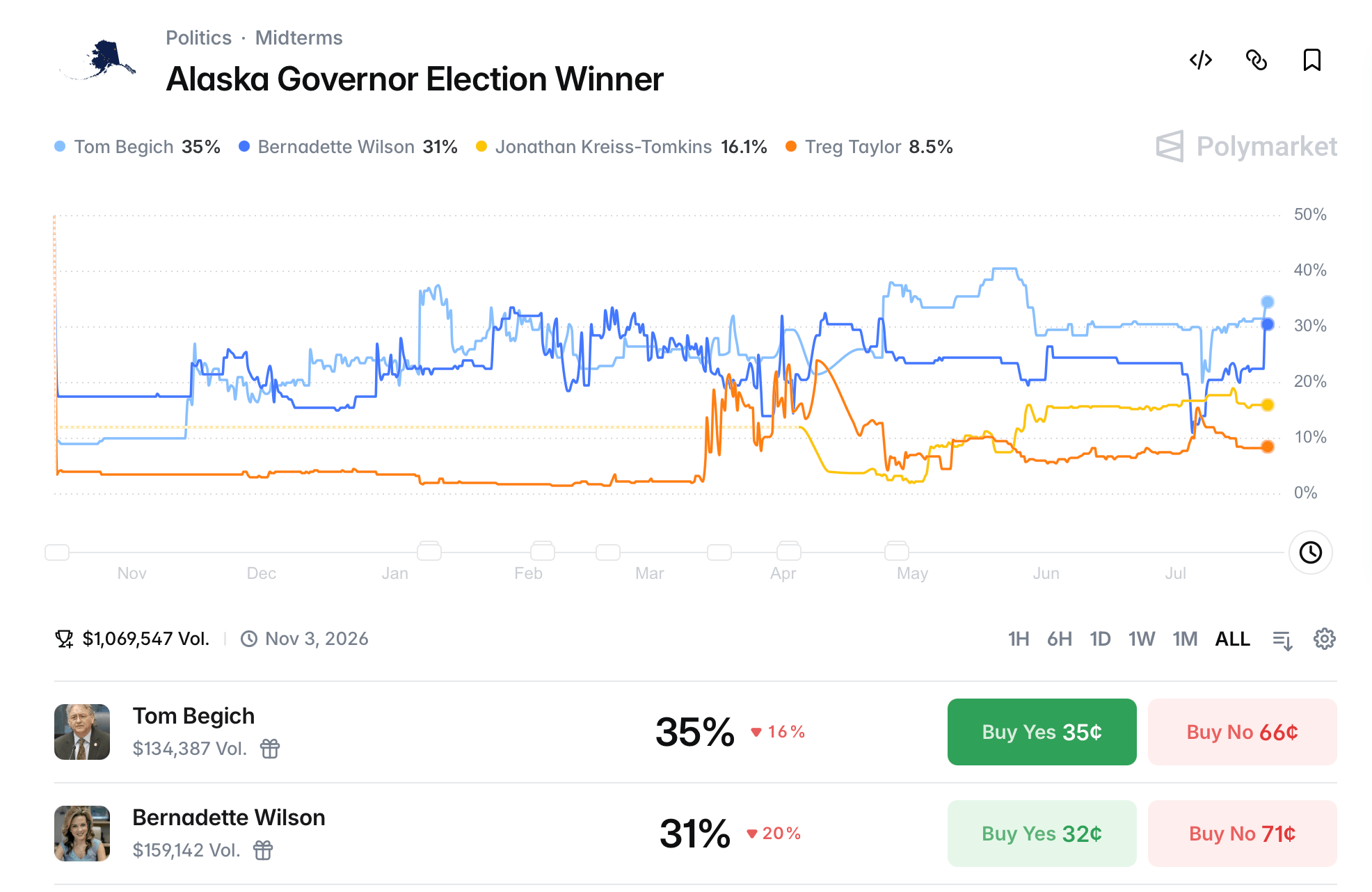 Alaska’s governor race wager on Polymarket, according to July 22, 2026, odds.
Texas and Alaska Senate seats are drawing close bets. Ken Paxton holds a 56% edge over James Talarico in the Texas matchup, a race Polymarket prices as a 50-50 toss-up at the party level on $611,000 in volume. In Alaska, Democrat Mary Peltola leads Republican Dan Sullivan 60% to 42%, with the seat rated lean Democrat on $367,000 traded.
State-by-State Senate Map Shows Safe Seats and Toss-Ups
Beyond the marquee contests, Polymarket has built out a full state-by-state Senate map covering 24 individual races. Republicans are treated as near locks in Nebraska, Montana, Tennessee, and Mississippi, each trading above 90%. Democrats hold similarly safe positions in Colorado, Minnesota, New Jersey, and New Mexico, all above 94%. Toss-up markets have formed in Ohio, Illinois, and Kentucky, each trading at 50% with lighter volume than the headline races.
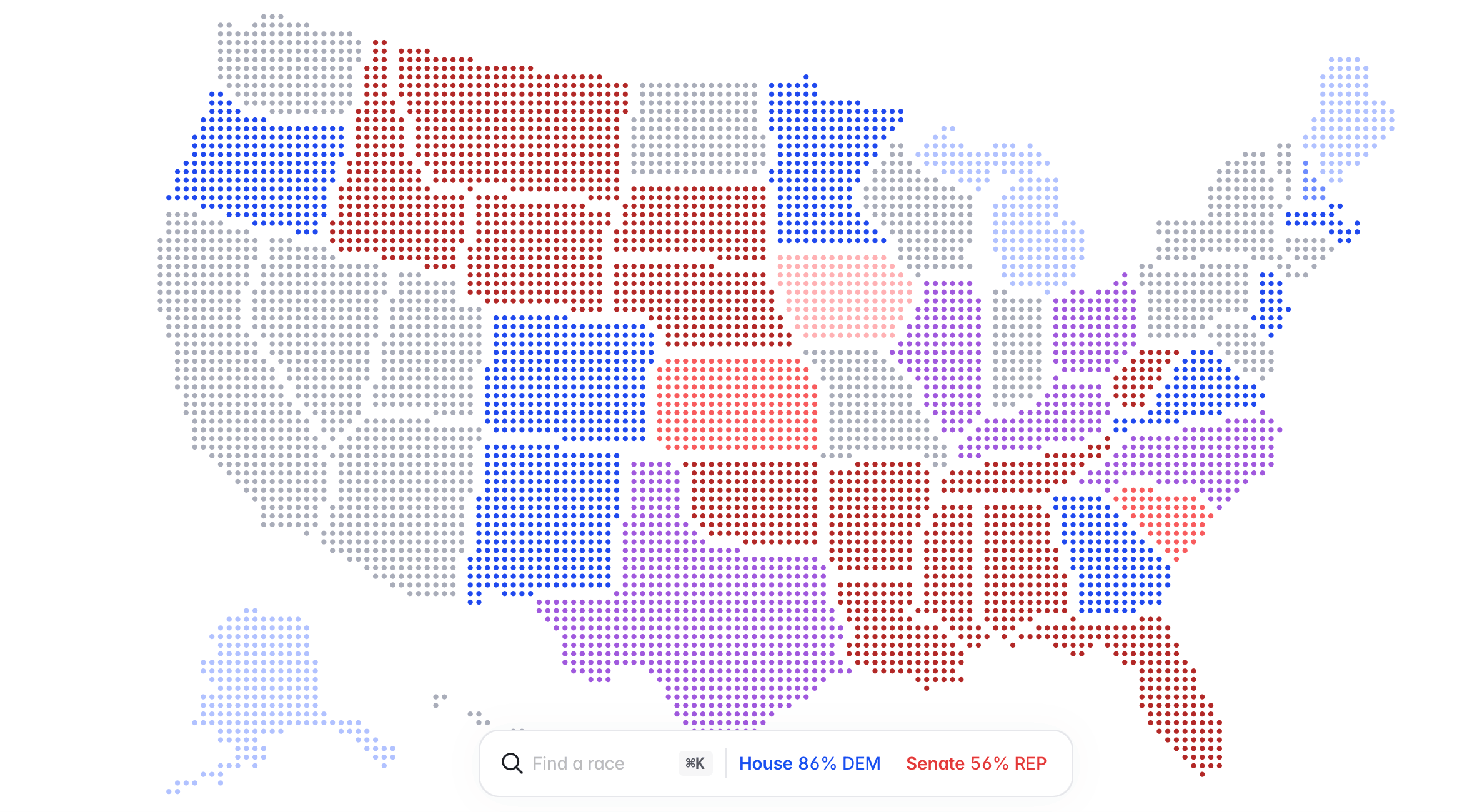 Polymarket state-by-state map logged on July 22, 2026.
Iowa leans Republican at 62%, while Michigan and North Carolina lean Democrat at 68% and 87% respectively, with North Carolina’s market built around Roy Cooper’s bid against Michael Whatley. South Carolina and Kansas both lean Republican in the 83% range, and states like Florida, Idaho, Oklahoma, and Louisiana sit above 86% for the GOP with comparatively thin trading volume under $60,000 apiece.
Governor and House Primaries Fill Out Polymarket’s Midterm Board
Governor’s races round out Polymarket’s midterm slate. Xavier Becerra is favored at 93% over Steve Hilton in California. New York and Maine both show Democrats above 90%, while Arizona’s Democratic candidate holds a 78% edge. Wisconsin and Georgia sit closer to even, with Democrats favored at 57% and 56%, respectively. Vermont is the lone Republican leaning governor’s race among the states listed, with the GOP favored at 83%, and South Dakota and New Hampshire also lean Republican at 93% and 79%.
Polymarket traders are also active in dozens of individual congressional primaries. On the Democratic side, Minnesota Representative Ilhan Omar holds a commanding 98% edge in her primary, while Missouri Representative Cori Bush is favored at 54% over Wesley Bell in a rematch of their 2024 contest. In Michigan’s 13th District, Donavan McKinney leads Shri Thanedar at 75%.
On the Republican side, Florida’s 6th District primary between Randy Fine and Dan Bilzerian favors Fine at 96%, and Alabama Representative Jerry Carl is priced at 99% to turn back a primary challenge. Florida’s 2nd District primary remains the most contested Republican matchup tracked, with Keith Gross narrowly favored over Evan Power at 50% to 33%.
Kalshi’s Primary Markets Attract Far More Capital
Kalshi’s midterm activity centers on primary contests rather than general election matchups, and the volume dwarfs Polymarket’s totals. The Kentucky 4th District Republican primary between Ed Gallrein and Thomas Massie had drawn nearly $22 million, the largest single market on the platform’s midterm slate. The Texas Republican Senate primary between Ken Paxton and John Cornyn has pulled in $18.4 million, while the Texas Democratic Senate primary pitting James Talarico against Jasmine Crockett has traded $14.6 million.
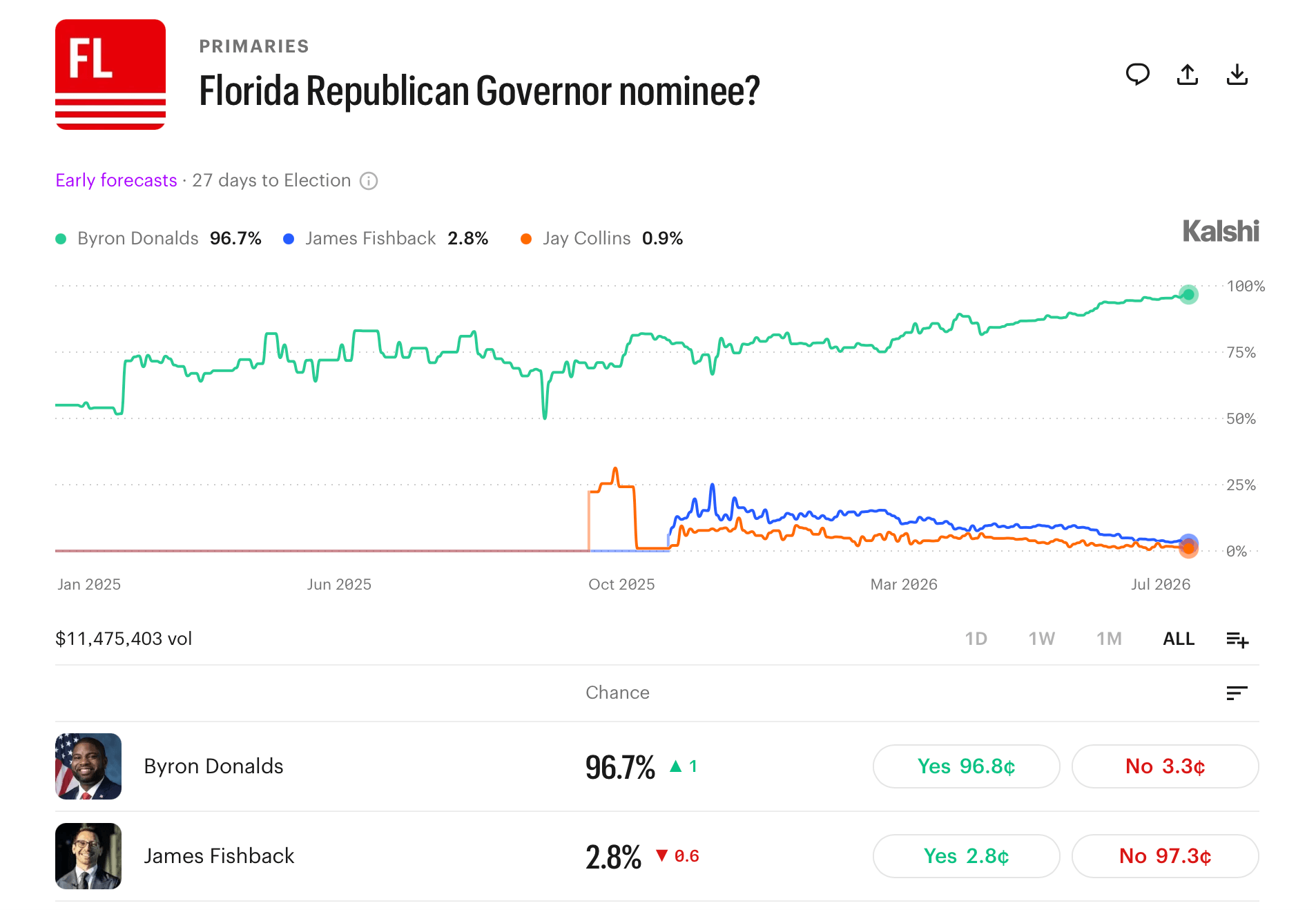 Florida Republican Governor nominee wager odds on July 22, 2026.
California’s gubernatorial primary between Becerra and Hilton has drawn nearly $11 million on Kalshi, and Florida’s Republican governor primary between Byron Donalds and James Fishback has pulled in $10.3 million, with Donalds favored at 96%. The Los Angeles mayoral matchup between Nithya Raman and Karen Bass has traded $9.9 million. Maine’s Democratic Senate primary, where Graham Platner is favored over Janet Mills, has drawn $6.2 million.
House, Senate and Governor Primaries Stay Active
Down the ballot, House primary markets are also active. Colorado’s 1st District Democratic primary between Melat Kiros and Diana DeGette leads House-level trading at $1.5 million, followed by New York’s 12th District contest between Micah Lasher and Alex Bores at $1.3 million and New York’s 13th District race between Darializa Avila Chevalier and Adriano Espaillat at $1.2 million.
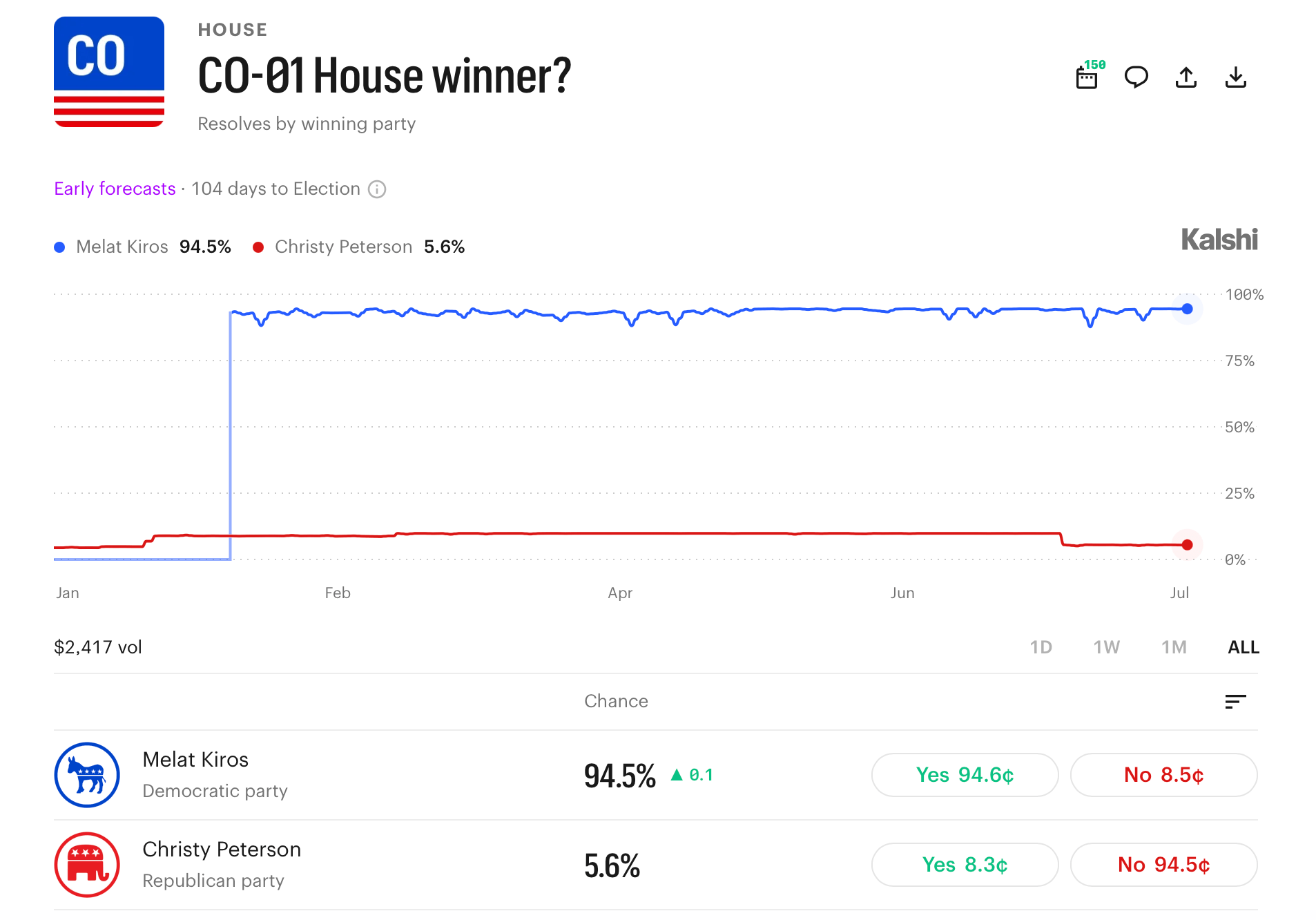 Colorado’s 1st District Democratic primary wager odds logged on July 22, 2026.
Illinois’ 9th District primary pitting Daniel Biss against Kat Abughazaleh has drawn $1.1 million, while Texas Representative Colin Allred’s primary against Julie Johnson in the 33rd District has traded $844,000. Michigan’s Democratic Senate primary between Abdul El-Sayed and Haley Stevens has drawn nearly $3 million, with El-Sayed favored at 79%, and Illinois’ Democratic Senate primary between Juliana Stratton and Raja Krishnamoorthi has traded $1.5 million.
Gubernatorial primaries are pulling comparable money. Wisconsin’s Democratic primary between Francesca Hong and David Crowley has drawn $1.9 million, with Hong favored at 77%. Colorado’s Republican primary between Victor Marx and Barbara Kirkmeyer has traded $1.4 million, and South Dakota’s Republican primary between incumbent Larry Rhoden and Toby Doeden has pulled in $1.3 million, with Rhoden favored at 94%. Oklahoma’s Republican primary between Mike Mazzei and Gentner Drummond has drawn over $900,000, alongside a similarly sized market in Maine’s Democratic primary between Hannah Pingree and Nirav Shah.
Traders Bet on the Shape of the Primary Season
Kalshi traders are also pricing broader structural questions about the primary cycle. A market asking how many House Democrats will lose their primary shows 82% odds that seven or more incumbents fall, on $93,655 traded. A parallel market on House Republican losses shows 45% odds for four seats lost. A separate market tracking whether progressive Democrats sweep contested Senate primaries sits at 54% odds to complete the sweep.
Prediction Markets Point to a Competitive Stretch Ahead
Taken together, the two platforms show traders treating House control as close to settled while keeping the Senate and dozens of primary contests genuinely contested. Southern Senate and governor primaries in Texas, Kentucky, California and Florida account for more than $70 million of Kalshi’s total volume, according to the platform’s own market data, making them the dominant liquidity drivers of the 2026 midterm cycle so far.
For investors, campaigns and policy watchers, these markets function as a real-time gauge of shifting expectations ahead of November. Unlike traditional polling, prediction markets require traders to back their views with capital, and the volume concentrated in races like Kentucky’s 4th District and the Texas Senate contests signals where political operatives and bettors expect the closest fights. As the primary season advances through 2026, both platforms are likely to see volume climb further in the toss-up Senate races in Ohio, Illinois and Kentucky, where the outcome remains split at even odds.



 English (US) ·