
 1 month ago
40
1 month ago
40
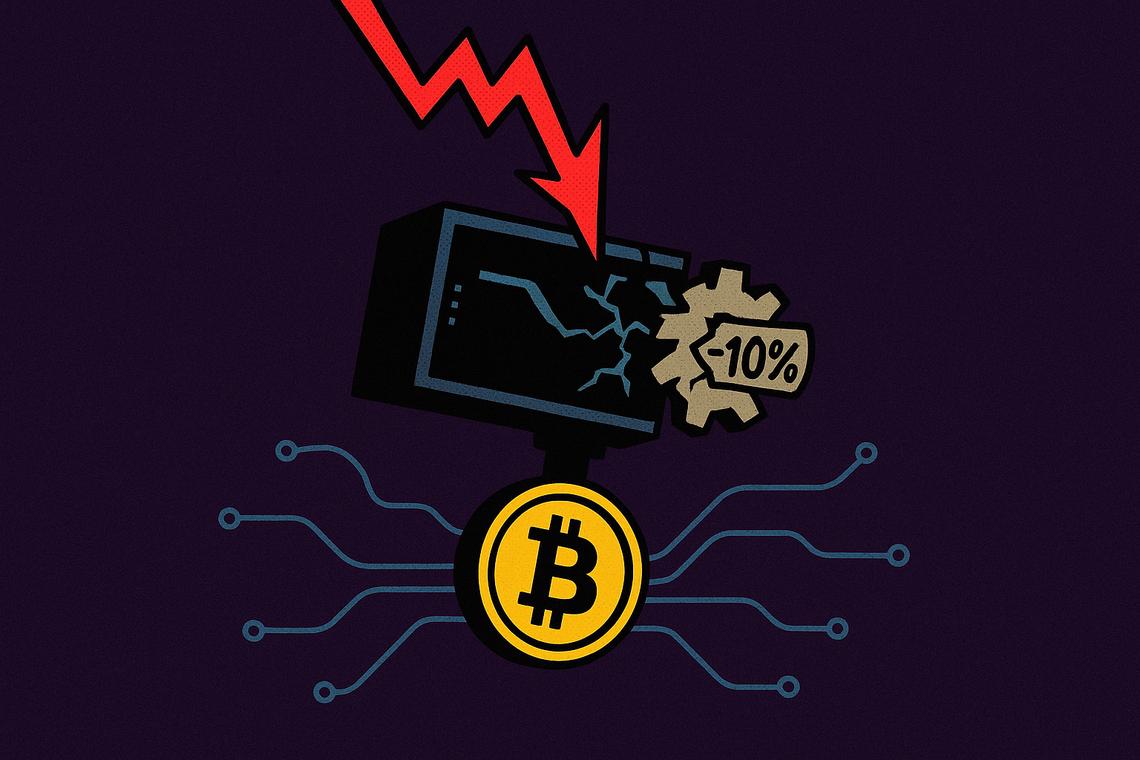
Something quietly shifted in the bitcoin mining network this year — and Wall Street is paying attention. JPMorgan analysts flagged a measurable increase in bitcoin mining sensitivity to price fluctuations, warning that a growing share of miners operating near breakeven has fundamentally changed how the network responds to market moves.
Key takeaways
- Mining difficulty’s beta relative to bitcoin price has climbed to 0.62 over the past six months, per JPMorgan.
- Bitcoin has traded below its estimated production cost of ~$78,000 for five consecutive months in 2026.
- Approximately 20% of miners are currently unprofitable, according to CoinShares Q1 2026 data.
- Publicly traded miners sold over 32,000 BTC in Q1 2026, exceeding their combined sales for all of 2025.
- Mining difficulty dropped 10% in the second week of June — the second such large decline this year.
Increased Sensitivity of Bitcoin Mining Network to Price Movements in 2026
The core finding from JPMorgan is straightforward but significant: bitcoin’s hashrate and mining difficulty are now reacting to price changes far more quickly than they used to. Over the past six months, the beta of mining difficulty relative to BTC price moves has climbed to 0.62 — a metric that quantifies just how tightly network computing power now tracks the market.
A beta of 0.62 means that for every meaningful shift in bitcoin’s price, the network’s aggregate hashrate follows with increasing urgency. That wasn’t always the case. Historically, miners absorbed price swings with relative resilience. The shift reflects something structural: the margin buffer that once cushioned the network has eroded.
Rising mining difficulty beta relative to bitcoin price
Nikolaos Panigirtzoglou, JPMorgan’s lead analyst on the report, framed it directly: “Mining economics have worsened this year with the bitcoin price staying well below its production cost for five months in a row.” That statement captures a slow-building crisis that network data is now starting to confirm.
The hashrate — the total computational power dedicated to mining and processing transactions on Bitcoin’s proof-of-work blockchain, measured in exahashes per second — has become a more reactive instrument. When prices fall, the weakest miners exit faster, hashrate contracts, and difficulty adjusts down. The feedback loop tightens.
Consequences of miners operating close to production costs
What makes this dynamic particularly consequential is its self-reinforcing nature. As more miners cluster near breakeven, even modest price declines can trigger meaningful shutdowns. That narrows the gap between a functioning, competitive network and one undergoing visible contraction. JPMorgan expects this heightened sensitivity to persist as long as bitcoin remains below the estimated production cost.
Economic Pressures on Miners and Impact on Network Activity
The numbers behind the stress are stark. Bitcoin has spent the past five consecutive months trading below its estimated production cost — a figure JPMorgan currently places at around $78,000 per coin. With bitcoin hovering near $64,700 at the time of the report, the gap between what it costs to mine and what miners can sell for has remained persistently wide.
Bitcoin price below estimated production cost for five months
That sustained compression has taken a real toll. Citing CoinShares’ first-quarter mining report, JPMorgan noted that roughly 20% of bitcoin miners are currently unprofitable. One in five operators is essentially running at a loss — an untenable position for any industry, but especially one requiring continuous electricity consumption and hardware maintenance.
This isn’t a brief dip. Five months below production cost represents one of the more prolonged periods of mining economic stress since the 2024 halving compressed block rewards. The halving cut miner revenue in half at the protocol level; the price environment then refused to compensate with the kind of rally miners had hoped for.
Mining profitability and miners’ liquidations
Financial pressure has translated directly into forced selling. Publicly traded mining companies liquidated more than 32,000 BTC in the first quarter of 2026 — a figure that exceeds their combined bitcoin sales across all of 2025. That acceleration signals something beyond routine treasury management. These are companies raising cash to survive or service costs they can no longer fund through operations alone.
The scale of that selling matters for the broader market too. When miners — historically among the most reluctant holders in the ecosystem — start liquidating at this pace, it adds consistent supply-side pressure to bitcoin’s price. It’s a feedback loop that can weigh on the very asset miners depend on.
Mining difficulty adjustment events in June 2026
The network itself is registering the strain. In the second week of June, mining difficulty dropped 10% — the second decline of that magnitude in 2026. Difficulty adjustments happen automatically roughly every two weeks to maintain a consistent block time, but drops of this size are not routine. They reflect a meaningful exit of hashrate from the network, typically driven by unprofitable miners switching off equipment.
Two such large drops in a single year is a telling signal. It suggests the sensitivity JPMorgan is measuring isn’t theoretical — it’s already showing up in the most fundamental technical metrics of the Bitcoin network.
Miners’ Strategic Shift to AI and HPC Hosting for Revenue Diversification
Faced with compressed margins and unpredictable bitcoin prices, miners are increasingly looking beyond the block reward. The pivot toward AI hosting and high-performance computing contracts has become one of the defining strategic moves in the sector.
Rationale behind adoption of AI and high-performance computing hosting contracts
The logic is clear. AI hosting deals offer stable, multi-year revenue streams with margins that look far more attractive than mining at sub-production-cost bitcoin prices. Mining economics are driven by variables miners cannot control — network difficulty, BTC price, the halving cycle. AI and HPC contracts, by contrast, tend to lock in predictable income, reducing exposure to crypto volatility.
The 2024 halving essentially forced this conversation. With block rewards cut in half and price not fully compensating, the long-term economics of pure-play bitcoin mining became harder to defend to investors. Diversification into AI hosting became less of an opportunity and more of a business model necessity.
Challenges and scale of AI-related deals announced by miners
The ambition is significant. Analysts estimate miners have announced tens of billions of dollars in AI and HPC-related deals collectively. But translating those announcements into operational reality is where complexity sets in. Building AI-ready facilities demands substantial capital investment and technical infrastructure that differs meaningfully from traditional mining operations. Execution risk is real, and the capital requirements are not trivial for companies already under financial pressure from low bitcoin prices.
The strategic tension here is worth noting. The same miners selling record volumes of BTC to stay solvent are simultaneously trying to raise capital and redirect infrastructure toward AI hosting. Doing both at once, without a price recovery in bitcoin to ease the cash flow strain, is a difficult balancing act — and one that will define which mining companies emerge from this cycle in a position of strength.
FAQ
Why is the bitcoin mining network more sensitive to price changes in 2026?
More miners are now operating near breakeven levels, meaning the network’s hashrate and mining difficulty respond more quickly to bitcoin price fluctuations. JPMorgan measured this sensitivity through a beta metric, which has climbed to 0.62 over the past six months.
What is the significance of bitcoin trading below its production cost?
Trading below the estimated production cost of approximately $78,000 has sustained financial pressure on miners for five consecutive months. This has prompted some operators to shut down equipment and liquidate BTC holdings, which in turn pushes hashrate lower and triggers mining difficulty adjustments.
How are bitcoin miners adapting to worsening mining economics?
Miners are increasingly pursuing AI and high-performance computing hosting contracts to diversify revenue and secure more stable, multi-year income streams that are less exposed to bitcoin price volatility and the effects of the 2024 halving.
What recent network adjustments reflect the increased sensitivity of bitcoin mining operations?
Mining difficulty dropped 10% in the second week of June 2026, marking the second large decline of that magnitude this year. These adjustments occur when significant hashrate exits the network — typically because unprofitable miners shut off equipment in response to falling prices.
Article produced with the assistance of artificial intelligence and reviewed by the editorial team.


 English (US) ·