
 8 months ago
104
8 months ago
104
- Kalshi now supports tokenized prediction market contracts on Solana, increasing anonymity and on-chain flexibility.
- The company aims to tap into crypto’s deep liquidity as prediction markets hit record trading volumes.
- With Polymarket expanding, Kalshi is pushing aggressively into the crypto space to stay competitive.
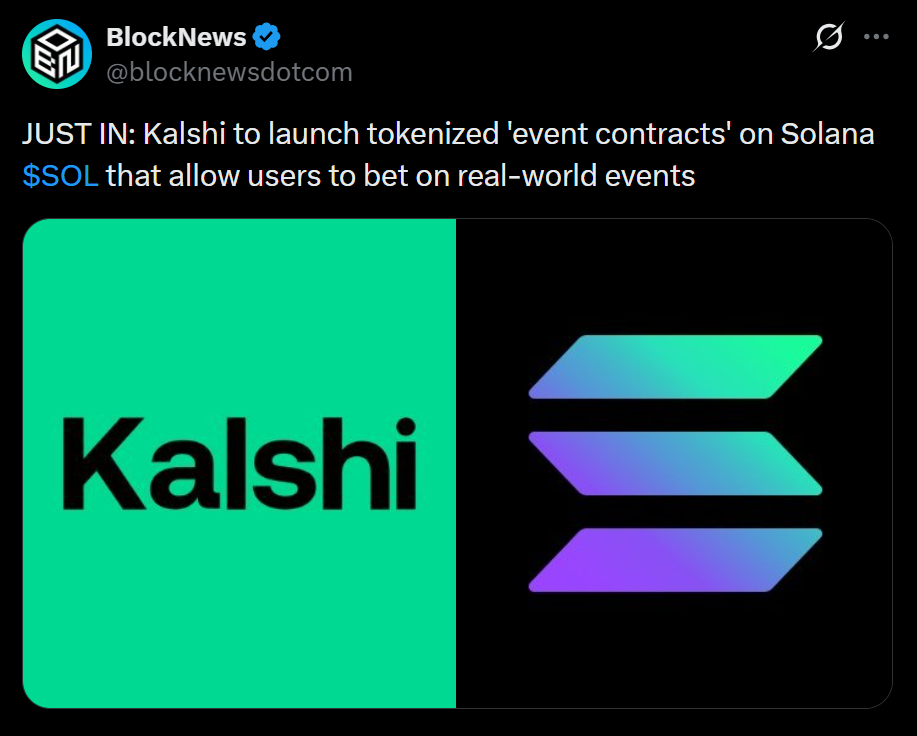
Kalshi is taking a major step into the crypto world, revealing exclusively to CNBC that users can now buy and sell tokenized versions of their prediction market contracts directly on Solana. The move puts Kalshi head-to-head with Polymarket, a platform that has long dominated the crypto-native prediction market space. With billions in liquidity flowing through decentralized markets, Kalshi is clearly aiming to pull in the same power users who have already fueled Polymarket’s explosive growth.
Tokenized Contracts Bring Anonymity and On-Chain Flexibility
Tokenization turns real-world financial assets — like stocks or treasuries — into digital tokens that live on a blockchain. In Kalshi’s case, the platform is creating tokenized versions of its existing event contracts, but the mechanics stay the same. The twist is that traders can now exchange the tokens themselves rather than the underlying contract, giving users far more anonymity and aligning Kalshi with the on-chain experience Polymarket users already enjoy. Support for these tokenized wagers is now fully live on Solana, with decentralized finance protocols DFlow and Jupiter acting as institutional bridges between Kalshi’s off-chain orderbook and Solana’s on-chain liquidity.
Prediction Markets Are Booming — and Kalshi Wants Crypto’s Liquidity
Demand for event contracts has surged this year. Combined global prediction market volume hit nearly $28 billion by October, with a record $2.3 billion traded in a single week. Kalshi sees an opportunity to absorb some of the $3 trillion in digital-asset liquidity by offering what crypto-native traders value most: anonymity, speed, composability, and access to deep liquidity pools. John Wang, Kalshi’s head of crypto, said the goal is simple — tap into crypto’s massive user base and unlock billions in potential liquidity that can feed Kalshi’s markets and help scale the platform.

Competition With Polymarket Intensifies
Founded in 2018, Kalshi made history by becoming the first federally regulated prediction market to offer event contracts on U.S. congressional races — a milestone that came after years of battling the CFTC. The company has since expanded to more than 3,500 event markets, raised over $300 million at a $5 billion valuation, and now operates in more than 140 countries. Still, Polymarket’s U.S. relaunch looms large. To stay competitive, Kalshi needs liquidity — and bringing in crypto-native traders is one of the fastest ways to get it. Wang emphasized that crypto users tend to trade higher volumes than traditional participants, meaning their arrival can significantly boost pricing accuracy and market depth across the platform.
The post Kalshi Announces Tokenized ‘Event Contracts’ on Solana — Here is How it Works first appeared on BlockNews.







 English (US) ·