
 3 months ago
56
3 months ago
56
- XRP escrow releases up to 1B tokens monthly, with most relocked and some used
- Critics argue ongoing releases contribute to gradual supply dilution
- Ripple still holds over 33B XRP in escrow, keeping supply dynamics in focus
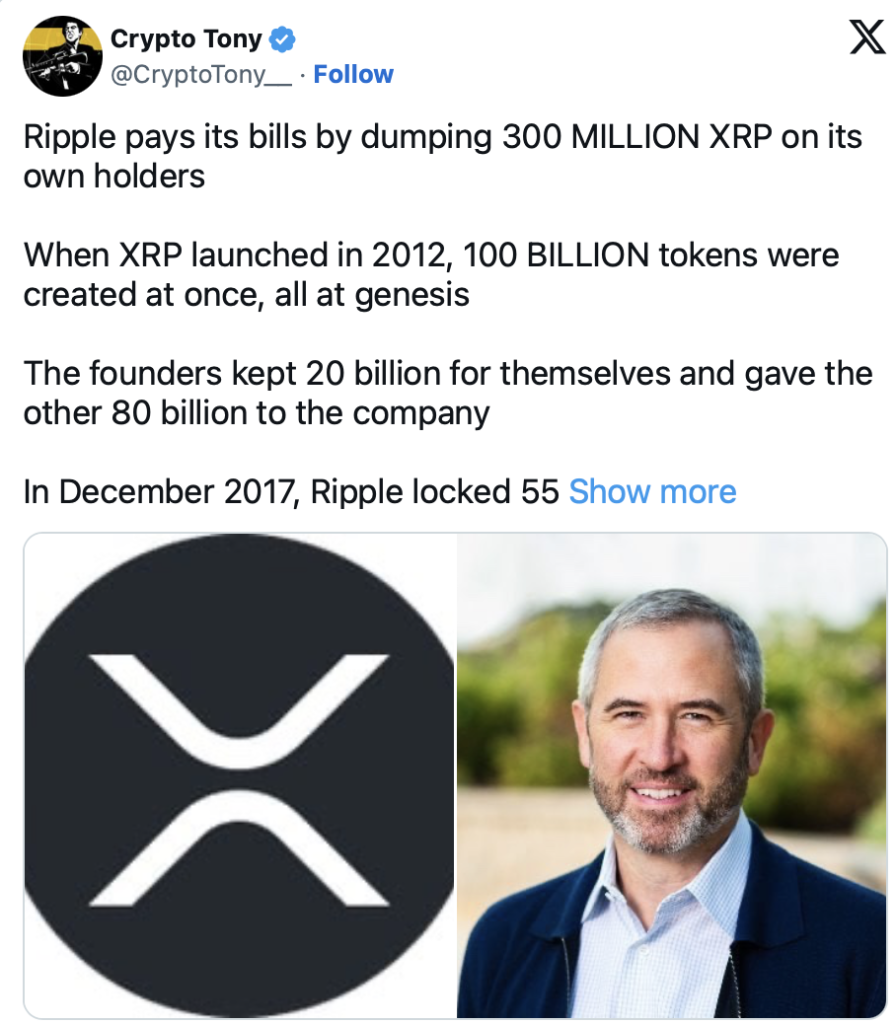
XRP’s supply structure has always been out in the open, nothing hidden there, at least technically. But every now and then, the conversation comes back, and this time it’s centered around how those monthly unlocks actually impact holders. A recent breakdown from crypto commentator Crypto Tony brought the topic back into focus, raising the idea that Ripple’s ongoing sales might be quietly diluting XRP over time.
It’s not a new argument, but it’s one that keeps resurfacing, especially when price action isn’t exactly inspiring confidence.
How the Escrow System Really Works
To understand the concern, you kind of have to go back to the beginning. When XRP launched in 2012, all 100 billion tokens were created at once, no mining, no gradual issuance. Ripple’s founders took 20 billion, while the remaining 80 billion went to the company itself.
For a while, there weren’t strict controls on how that supply could be used. Then, in 2017, Ripple placed 55 billion XRP into escrow accounts, introducing a structured release system. Each month, up to 1 billion XRP is unlocked automatically, and from there, things get a bit more nuanced.
Ripple doesn’t use all of it. Typically, around 60% to 80% gets locked back up, leaving roughly 200 to 300 million XRP available. That portion, according to the argument, is used to fund operations, partnerships, and broader company activities. It’s all transparent on-chain, but that doesn’t mean everyone agrees with the impact.
The Dilution Argument Gains Attention
Crypto Tony’s main point is pretty straightforward, even if it’s a bit controversial. By releasing and using a portion of XRP every month, Ripple is effectively increasing circulating supply, which, in theory, can dilute value for existing holders.
This isn’t entirely speculative either. Ripple’s leadership has acknowledged that XRP sales play a role in funding the company. It’s part of the model, not something hidden or accidental.
Where things get more complicated is how some of that XRP enters the market. In past cases, Ripple has used partnerships to distribute tokens indirectly. One example often mentioned is MoneyGram, which received XRP as part of a partnership and reportedly sold it rather than holding it. The SEC even referenced this setup in its complaint, describing it as a channel for distributing XRP into the market.
Historical Sales Add Another Layer
There’s also the historical side of things, which adds a bit more weight to the discussion. Ripple co-founder Jed McCaleb, who left the company years ago, held around 9 billion XRP at one point. Over time, he sold a significant portion, roughly $3.2 billion worth, across several years.
That steady selling didn’t happen overnight, but it did contribute to overall supply entering the market. For some, it reinforces the idea that XRP has faced ongoing sell pressure from multiple sources, not just the escrow releases.
A Complex Balance Between Funding and Market Impact
As of now, Ripple still holds over 33 billion XRP in escrow, according to public data. That means the system isn’t going away anytime soon. The question, really, is how the market interprets it.
On one hand, the escrow structure was designed to bring transparency and predictability, which it does. On the other, the consistent release of supply, even if partially relocked, creates an ongoing dynamic that some see as dilution.
It’s not a simple yes or no situation. XRP’s supply mechanics are clear, but their impact depends on demand, adoption, and how the broader market absorbs that supply over time.
Disclaimer: BlockNews provides independent reporting on crypto, blockchain, and digital finance. All content is for informational purposes only and does not constitute financial advice. Readers should do their own research before making investment decisions. Some articles may use AI tools to assist in drafting, but every piece is reviewed and edited by our editorial team of experienced crypto writers and analysts before publication.








 English (US) ·