
 4 months ago
81
4 months ago
81
- Solana RWA holders jump 440% YoY to around 218K users
- Tokenized stocks and funds attract familiar retail demand
- Growth driven by accessibility and distribution, not just capital
Solana’s real-world asset growth is starting to look less like a trend and more like a shift. A 440% increase in holders over the past year, now sitting at roughly 218,000 wallets, isn’t just capital moving around. It’s users showing up, and in crypto, that usually matters more than anything else.
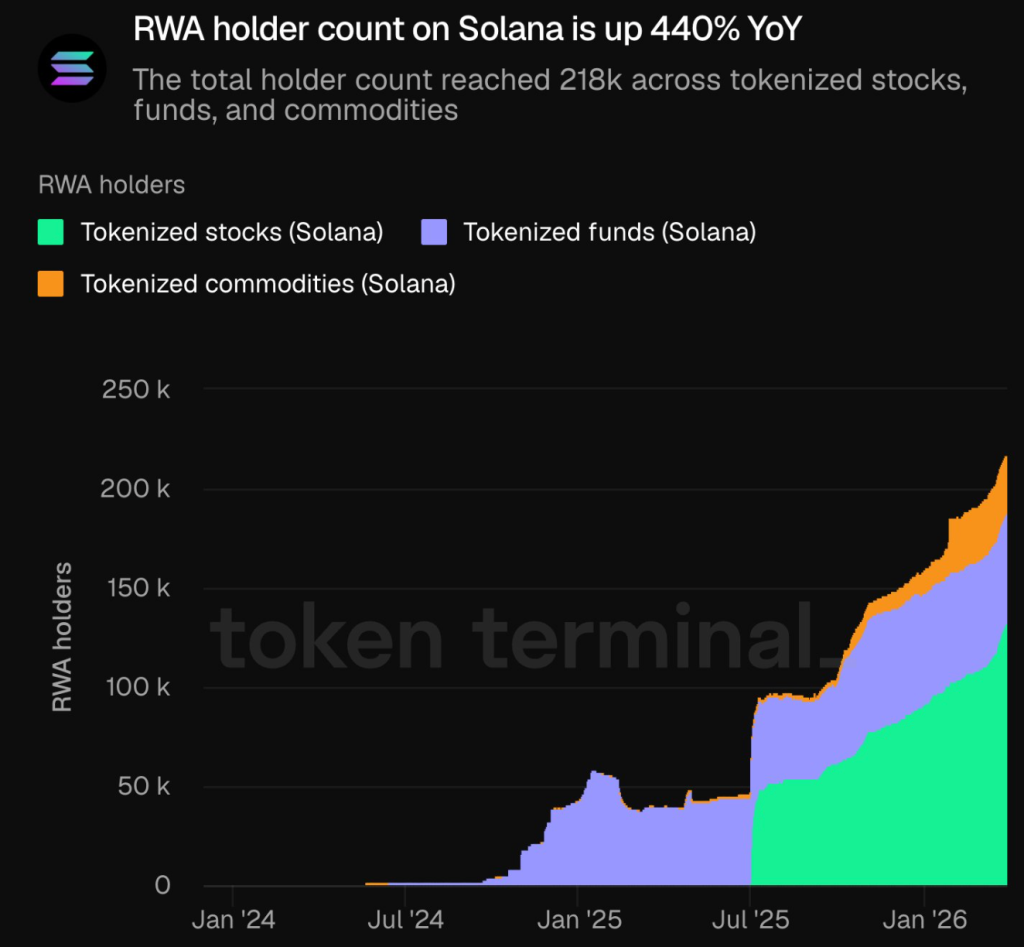
What’s interesting is how this growth is happening. It’s not being led by massive institutional inflows or headline-grabbing deals. It’s coming from smaller participants, retail users engaging with tokenized assets that actually make sense to them.
RWAs Are Finally Resonating With Users
This time feels different because of the assets themselves. Tokenized stocks, ETFs, and commodities don’t require a long explanation. People already understand them. Owning a fraction of a well-known company or index fund on-chain isn’t a new concept, it’s just a better delivery system.
That familiarity lowers the barrier significantly. Instead of learning DeFi mechanics or navigating complex yield strategies, users can interact with something they already recognize. And that simplicity seems to be driving adoption.
This Is a Distribution Story, Not a Capital Story
While Ethereum still leads in total capital across many sectors, Solana is winning on user count in this specific area. That distinction matters. It suggests the growth isn’t coming from a few large players, but from many smaller ones.
In other words, it’s distribution. More wallets, more interactions, more activity at the edges. And historically, that kind of growth tends to build stronger foundations over time, even if capital lags initially.
Infrastructure Is Actually Making a Difference
Solana’s usual advantages, speed and low fees, aren’t just talking points here. They directly impact how these assets are used. RWAs aren’t static, users buy, sell, transfer, and rebalance.
If that process is slow or expensive, adoption stalls. If it’s smooth and cheap, people keep using it. That’s a big reason why many tokenized stock projects are clustering on Solana right now. The experience just feels easier.
A Shift Toward Familiar Assets on Crypto Rails
There’s also a broader pattern forming. Instead of crypto-native assets driving the cycle, familiar financial products are starting to take the lead. Stocks, funds, and commodities are acting as entry points into blockchain systems.
That flips the usual narrative. Instead of asking users to learn crypto first, platforms are bringing familiar assets onto crypto rails and letting users meet them there.
Growth That Shows Up in Wallets First
What stands out most is where this growth is visible. Not in market cap headlines, but in wallet counts. That’s often the earliest signal of a shift.
If more users continue to onboard through RWAs, capital tends to follow. It doesn’t always happen immediately, but the pattern is hard to ignore.
A Different Kind of Expansion
Solana’s RWA surge isn’t just about scale, it’s about accessibility. It shows what happens when infrastructure, product design, and user familiarity align at the same time.
And if that continues, the next phase of growth in crypto might not start with institutions. It might start exactly where it is now, with users quietly showing up and using it.
Disclaimer: BlockNews provides independent reporting on crypto, blockchain, and digital finance. All content is for informational purposes only and does not constitute financial advice. Readers should do their own research before making investment decisions. Some articles may use AI tools to assist in drafting, but every piece is reviewed and edited by our editorial team of experienced crypto writers and analysts before publication.





 English (US) ·