
 1 month ago
34
1 month ago
34
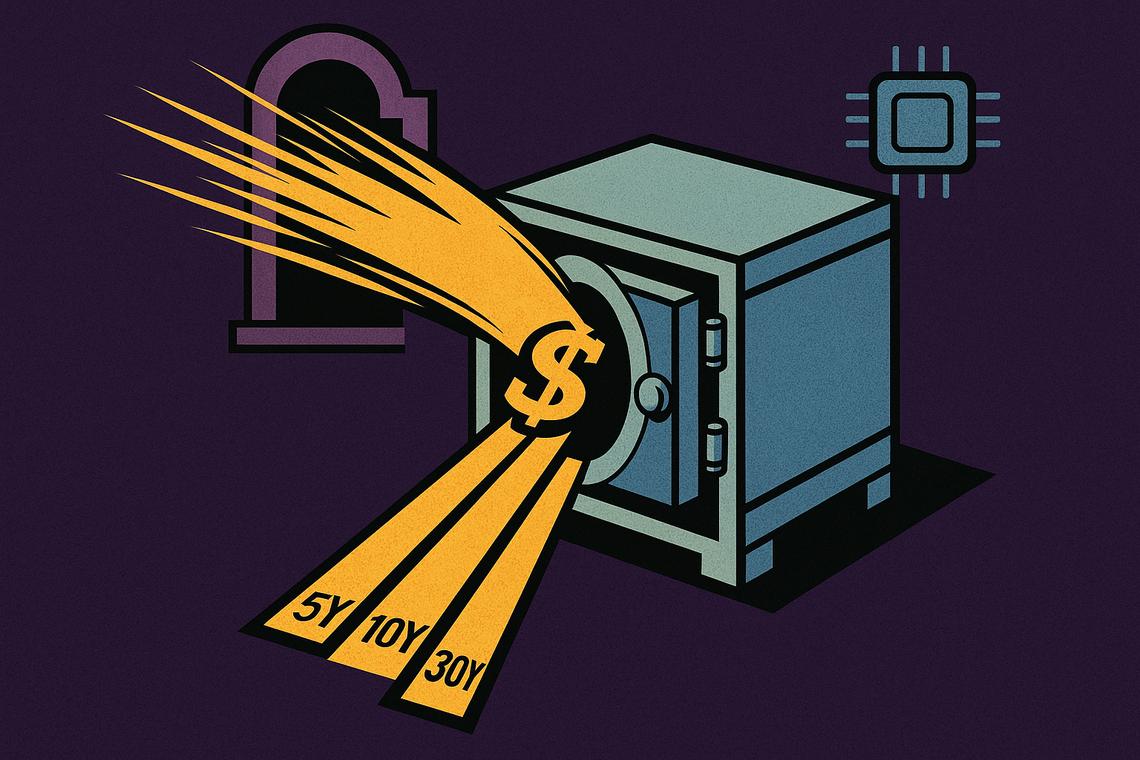
SpaceX has pulled off one of the most striking bond market debuts in recent memory, launching a $25 billion notes offering that drew nearly $85 billion in orders — a level of demand that says as much about investor confidence in Elon Musk’s rocket-to-AI empire as it does about the sheer scale of capital the company now needs to pursue its ambitions.
Key takeaways
- SpaceX launched a five-tranche senior unsecured notes offering targeting at least $25 billion, its first investment-grade dollar bond issuance.
- Orders nearly reached $85 billion, making the deal heavily oversubscribed.
- Proceeds will repay bridge loan borrowings and fund general corporate purposes, including AI infrastructure.
- The offering spans maturities of 5, 7, 10, 20, and 30 years, managed by five of Wall Street’s biggest banks.
- SpaceX disclosed over $100 billion in cash, days after its blockbuster IPO on June 12 raised nearly $86 billion.
SpaceX Launches $25 Billion Notes Offering
The SpaceX bond offering, launched just days after the company’s blockbuster IPO on June 12, represents an entirely different kind of financial milestone. Where the IPO turned Elon Musk into the world’s first trillionaire and briefly pushed SpaceX’s market value past Amazon, this bond deal marks the company’s arrival as a full-fledged player in the investment-grade debt market — a space typically reserved for blue-chip corporations with long, stable earnings histories.
The timing is deliberate. SpaceX disclosed over $100.8 billion in cash alongside the bond announcement, signaling financial strength even as it aggressively seeks new capital. The apparent contradiction — a cash-rich company raising tens of billions more through debt — makes complete sense when you consider where that money is headed.
Details of the Offering
The offering consists of five tranches of senior unsecured notes with maturities spanning 5, 7, 10, 20, and 30 years. That range of tenors is notable. By stretching debt obligations across multiple decades, SpaceX is locking in long-term financing at what it presumably considers favorable rates, while giving itself operational flexibility across very different business cycle horizons.
Five of Wall Street’s most powerful institutions are managing the sale: Bank of America, Citigroup, JPMorgan Chase, Goldman Sachs, and Morgan Stanley. The involvement of all five simultaneously underscores the significance of the transaction and the institutional weight behind it.
Use of Proceeds
Proceeds will go toward repaying borrowings under the company’s bridge loan facility and covering general corporate purposes. The bridge loan repayment likely relates to financing arranged in the lead-up to the IPO, making this bond deal a structural refinancing as much as a fresh capital raise. What happens to the remaining funds is where things get strategically interesting.
Significance of the First Investment-Grade Dollar Bond
This is SpaceX’s first investment-grade dollar bond issuance — a designation that carries real weight in global capital markets. It means credit rating agencies formally assigned the company investment-grade ratings last week, opening the door to a much wider pool of institutional buyers who are either required or incentivized to hold only high-quality debt.
Investment-Grade Rating Confirmation
The ratings represent an institutional stamp of approval that SpaceX’s finances can support sustained, large-scale borrowing. For a company that began as a scrappy rocket startup, reaching investment-grade status while simultaneously running one of the most ambitious AI buildouts in the technology sector is an unusual and remarkable combination.
The broader implication here is structural. Investment-grade status doesn’t just lower borrowing costs — it changes who can own the debt. Pension funds, insurance companies, and sovereign wealth funds that are restricted to high-quality fixed income can now participate directly in SpaceX’s financial story without touching the equity. That significantly expands the company’s financing universe going forward.
Demand and Oversubscription
The market’s response was unambiguous. Nearly $85 billion in orders flooded in for an offering targeting at least $25 billion — a subscription ratio that reflects extraordinary demand. For context, that level of oversubscription is typically associated with sovereign bond deals or the most sought-after corporate issuances from companies with decades of established credit history. SpaceX achieved it on its very first try.
Funding AI Expansion and Infrastructure
The real driver behind the bond offering isn’t debt management — it’s the cost of SpaceX’s AI ambitions, which require tens of billions of dollars in capital expenditure across multiple infrastructure categories. The company’s AI plans include buying more chips and funding future data centers, including the prospect of data centers in space.
Capital-Intensive AI Plans
SpaceX has already signed a computing power deal with open-source AI startup Reflection worth up to $6.3 billion, signaling the scale and speed at which it is moving to build out AI capacity. That kind of commitment requires a deep and reliable funding base — exactly what a successfully oversubscribed investment-grade bond offering provides.
The strategic logic is worth examining closely. SpaceX isn’t just a space company dabbling in AI. It is positioning itself as an integrated AI and space infrastructure business, which means the capital requirements look less like a startup’s burn rate and more like the infrastructure spending of a major technology or utility company. Debt financing, rather than equity dilution, is often the smarter tool for funding assets with long, predictable useful lives — like data centers and power infrastructure.
Investment in Data Centers, Hardware, and Power
SpaceX is investing heavily across three interconnected areas: data centers, computing hardware, and power infrastructure. These are not speculative research bets — they are the physical backbone of any serious AI operation at scale. Building or acquiring these assets takes years and costs enormous sums upfront, which is precisely why long-dated bonds with 20- and 30-year maturities make structural sense as the financing vehicle.
Major Banks Managing the Sale and Market Reactions
Wall Street’s five biggest deal-making institutions managing this offering collectively represent a statement about how seriously the financial establishment views SpaceX as a long-term institutional credit story.
Involvement of Global Banks
The choice of Bank of America, Citigroup, JPMorgan Chase, Goldman Sachs, and Morgan Stanley as joint managers is both a reflection of the deal’s size and a practical necessity. Distributing $25 billion in notes across global institutional investor bases requires the kind of reach and relationships that only a handful of banks can provide. The competition among those banks to lead a deal of this profile would have been intense.
Recent Share Price Movements
SpaceX shares fell roughly 16% during a third consecutive losing session around the time of the bond announcement, tied to a broader tech sector pullback. That kind of equity volatility would normally raise questions about the timing of a major debt offering. Instead, SpaceX’s stock rebounded on Tuesday, suggesting markets interpreted the bond deal — and the institutional confidence it represents — as a stabilizing signal rather than a sign of financial distress.
That rebound matters. It suggests that sophisticated investors are reading the $85 billion in bond orders not as desperation fundraising, but as validation of SpaceX’s financial architecture at a moment when AI infrastructure spending is becoming one of the most closely watched capital allocation stories in global markets. Whether SpaceX can convert that institutional goodwill into durable returns — across both its rocket business and its rapidly expanding AI footprint — is the question its new bondholders are now betting on, for the next 30 years.
FAQ
What type of bond offering did SpaceX launch?
SpaceX launched a five-tranche senior unsecured notes offering with maturities of 5, 7, 10, 20, and 30 years.
How much capital is SpaceX aiming to raise with this bond issuance?
SpaceX is aiming to raise at least $25 billion through this notes offering.
What will the proceeds from the bonds be used for?
The proceeds will be used to repay borrowings under bridge loan facilities and for general corporate purposes, including funding AI infrastructure investments.
Why is this bond offering significant for SpaceX?
It is SpaceX’s first investment-grade dollar bond issuance, reflecting formal confidence from credit rating agencies and opening the company’s debt to a much broader pool of institutional investors.
Article produced with the assistance of artificial intelligence and reviewed by the editorial team.






 English (US) ·