
 4 months ago
102
4 months ago
102
// News
Reading time: 2 min
Published: May 02, 2026 at 20:19

On May 2, 2026, a bipartisan compromise on the Clarity Act was officially released, resolving the most contentious debate between Silicon Valley and Wall Street: the question of stablecoin yield.
Senators Thom Tillis and Angela Alsobrooks announced a deal that effectively splits the difference between banking security and crypto innovation. Under the new text, stablecoin issuers are strictly prohibited from offering passive yield derived directly from their reserve holdings—a major win for traditional banks who feared a mass exodus of deposits into higher-yielding digital "savings accounts."
However, the "win" for the crypto industry is equally significant. The compromise explicitly protects activity-based reward programs. This means that while you can't get paid just for holding a stablecoin, platforms like Coinbase and Circle can still offer rewards for platform participation, governance, and ecosystem utility.
Coinbase has already signaled its immediate support for the text, viewing it as the "green light" needed to transition from a speculative environment to a fully regulated financial utility. By removing this legislative bottleneck, the Senate Banking Committee has cleared the path for a formal markup, bringing the U.S. closer to a definitive crypto law than at any point in the last decade.
Not just in the name of the bill
The market response was instantaneous. Bitcoin (BTC) surged past the $78,000 mark in Asian Saturday trading, hitting a high of $78,180. This 1% daily gain wasn't just driven by the legislative news; it was bolstered by a cooling geopolitical climate.
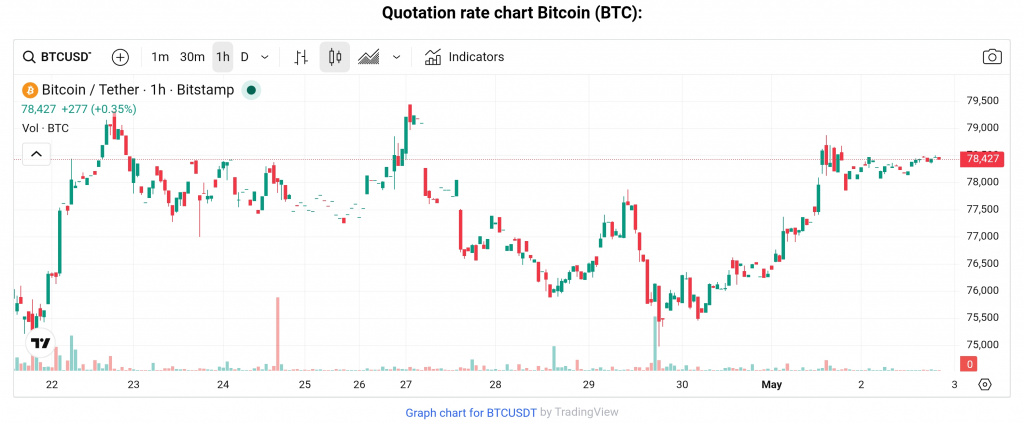
Reports that Tehran relayed a new ceasefire proposal to Washington via Pakistani intermediaries sent WTI crude prices tumbling by 3%, easing the inflationary pressures that have haunted Bitcoin’s recent recovery efforts.
In the landscape of 2026, the "Clarity" isn't just in the name of the bill — it’s in the growing realization that the most powerful digital assets are no longer fighting the system; they are officially becoming a regulated part of it.
Disclaimer. The data provided is collected by the author and is not sponsored by any company or token developer. This is not a recommendation to buy or sell cryptocurrency and should not be viewed as an endorsement by Coinidol.com. Readers should do their research before investing in funds.






 English (US) ·