
 5 months ago
84
5 months ago
84
- Trump says he will impose a 10% global tariff under Section 122
- Supreme Court limited IEEPA use but left other tariff powers intact
- Renewed trade tension could pressure risk assets, including crypto
In a lengthy Truth Social post, President Donald Trump sharply criticized the Supreme Court’s decision limiting his ability to impose tariffs under the International Emergency Economic Powers Act (IEEPA). He argued the ruling was “nonsensical,” claiming the Court blocked him from charging even a $1 tariff under IEEPA while still affirming his authority to restrict or embargo trade entirely.
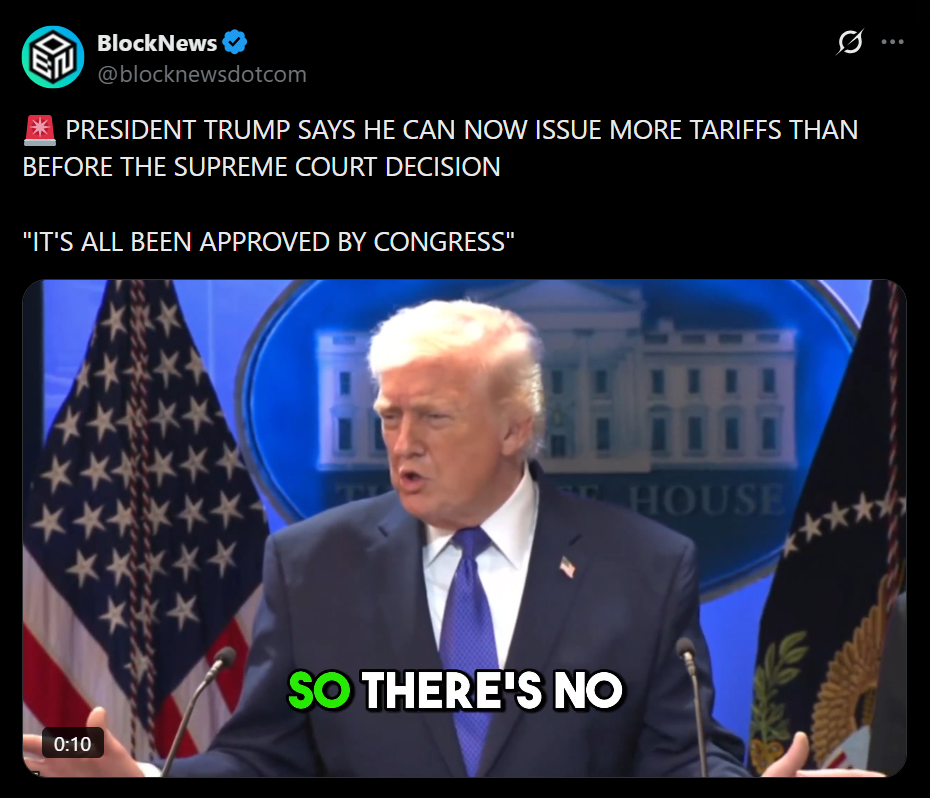
Trump framed the decision as a technical limitation rather than a strategic defeat. He emphasized that the Court did not overrule tariffs broadly, only a specific use of IEEPA, and pointed to Justice Brett Kavanaugh’s dissent as validation that other statutory tools remain available.
A New 10% Global Tariff Under Section 122
Trump announced that he will immediately impose a 10% “GLOBAL TARIFF” under Section 122 of the Trade Act of 1974. That provision allows temporary import restrictions for up to 150 days to address balance-of-payments concerns. He also confirmed that existing Section 232 national security tariffs and Section 301 trade measures will remain in full effect.
Additionally, the administration plans to launch new Section 301 investigations targeting what Trump described as unfair trading practices. In his view, the Supreme Court decision clarified and strengthened executive trade authority rather than weakening it.
What the Supreme Court Actually Said
The Court ruled 6-3 that IEEPA does not grant the president the power to impose tariffs. While the law permits regulation of imports during a national emergency, the majority concluded it does not extend to setting duties. The ruling leaves intact other trade statutes, including those Trump referenced.
Importantly, the Court did not address whether previously collected tariff revenue must be refunded, leaving potential financial implications unresolved.
Why Crypto Investors Should Pay Attention
Trade policy may seem distant from crypto markets, but macro uncertainty influences liquidity and risk appetite. Tariffs can affect global growth expectations, currency flows, and equity markets — all of which tend to spill over into Bitcoin and altcoins.
If broader markets interpret the renewed tariff push as escalation, risk assets could face short-term pressure. Conversely, if investors view the move as temporary or procedural, the reaction may remain muted.
Crypto has increasingly traded in line with macro trends. When policy uncertainty rises, volatility often follows.
The Bigger Picture
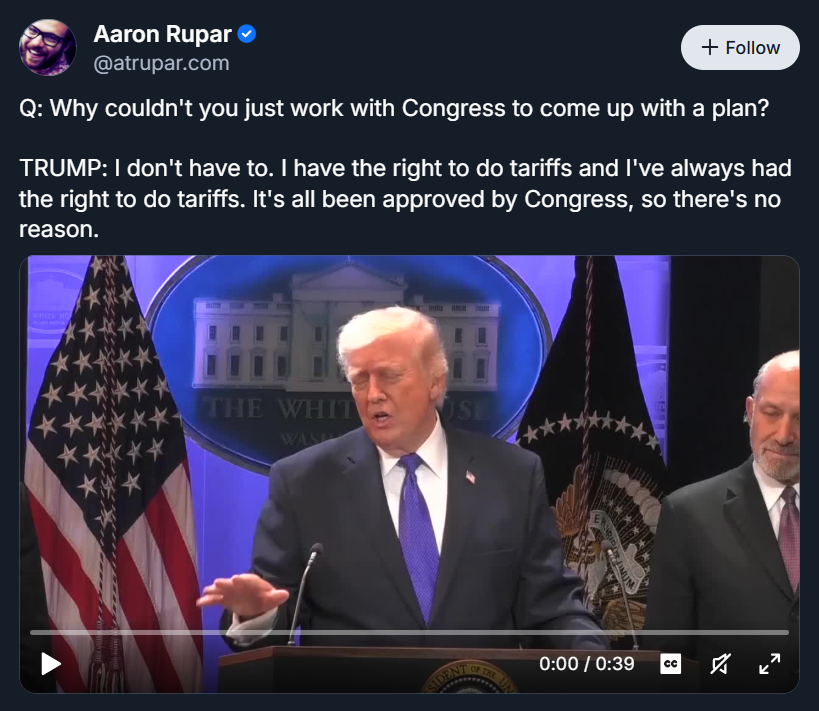
Trump’s message is clear: he intends to pursue tariffs aggressively using alternative legal pathways. The Supreme Court narrowed one door but left others open.
Whether this results in sustained trade tension or another negotiation cycle will shape how markets respond. For crypto, the key variable is liquidity. If macro stress tightens conditions, rallies could struggle. If uncertainty fades, digital assets may regain momentum.
For now, policy remains a live variable — and markets are listening.
Disclaimer: BlockNews provides independent reporting on crypto, blockchain, and digital finance. All content is for informational purposes only and does not constitute financial advice. Readers should do their own research before making investment decisions. Some articles may use AI tools to assist in drafting, but every piece is reviewed and edited by our editorial team of experienced crypto writers and analysts before publication.






 English (US) ·