
 4 weeks ago
61
4 weeks ago
61
Key Takeaways
- The Dollar Spot Index declined to 99.33, marking its weakest performance since the first week of June
- Disappointing employment figures, consumer spending, and price data triggered the selloff
- Markets now assign a 70% probability that the Federal Reserve will maintain current rates in September
- Japan’s currency hovered around 159.00 against the dollar following subpar GDP figures; BOJ rate increase possible in September
- India’s rupee experienced downward pressure after the central bank strengthened foreign exchange intervention protocols
The greenback tumbled to its weakest position in more than eight weeks during Monday’s trading session. The Dollar Spot Index shed 0.3% to reach 99.33, representing the currency’s lowest valuation since the beginning of June.
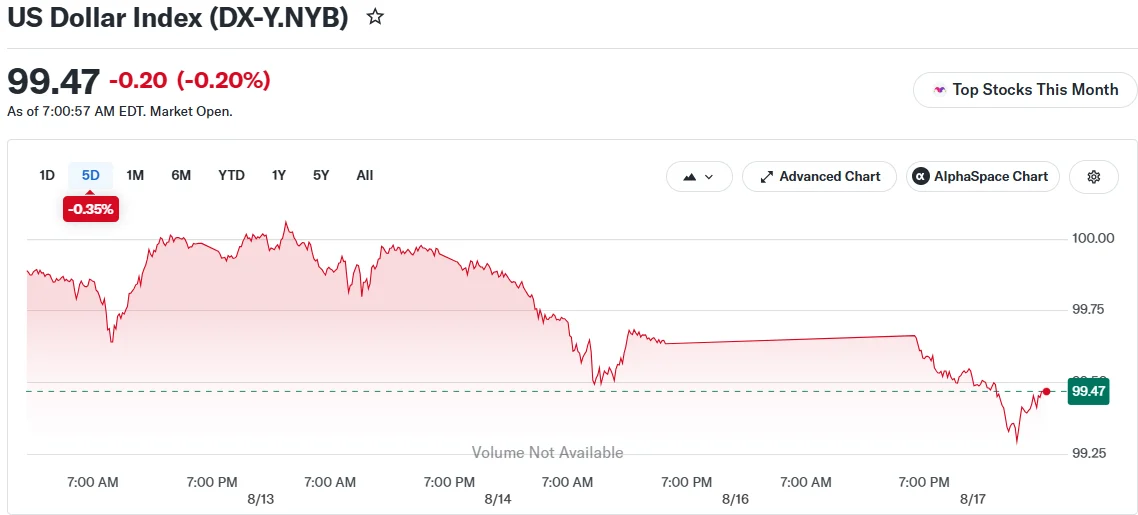 US Dollar Index (DX-Y.NYB)
This decline followed a series of underwhelming economic indicators from the United States. Employment data for July showed job losses, consumer spending figures dropped 0.6%, and inflation metrics from both consumer and producer perspectives registered either stagnant or aligned with projections.
This confluence of subdued economic performance effectively eliminated the rationale for Federal Reserve monetary tightening in the immediate future.
Financial markets currently assign a 70% likelihood that the central bank will maintain its existing rate structure when policymakers convene in September. Prior to the employment report released on August 7, market participants had placed odds above 50% on an additional rate increase.
The European common currency advanced to a two-month peak of $1.1614. The British pound reached a three-month summit of $1.3571. Both currencies gained ground as interest rate projections became less favorable for the dollar.
Federal Reserve Chairman Kevin Warsh has refrained from providing explicit policy guidance, placing greater emphasis on evolving economic indicators. Market analysts note this approach has heightened trader reactions to individual data releases.
Volkmar Baur, an analyst at Commerzbank, suggested that continued reduction in rate hike expectations could drive the dollar lower. His institution forecasts three central bank rate reductions throughout the following year.
Market participants are now directing attention toward Wednesday’s publication of minutes from July’s Federal Open Market Committee gathering. The central bank maintained its benchmark rate within the 3.5% to 3.75% range for the fifth consecutive meeting in July.
Japanese Currency Stable While Indian Rupee Faces Headwinds
Japan’s currency appreciated modestly by 0.1% to trade in the vicinity of 159.00 per dollar, maintaining proximity to the 160 threshold that has heightened concerns about potential government intervention in currency markets.
Economic expansion in Japan registered an annualized pace of 1.1% during the April-June period, falling short of the 2% consensus estimate. Subdued household spending and declining business investment contributed to the disappointing outcome.
Notwithstanding the economic shortfall, the yen received backing from speculation that the Bank of Japan might implement a rate increase as soon as September.
India’s currency bucked the broader trend observed in most international currencies. The USD/INR exchange rate climbed 0.2% as domestic companies purchased dollars, motivated by persistent energy security concerns stemming from Middle Eastern instability.
The Reserve Bank of India accelerated the cutoff date for financial institutions to secure deposits through its foreign-exchange swap mechanism to August 31, advancing the previous late-September timeline. This adjustment followed capital inflows through the facility surpassing $56 billion.
International Tensions Limit Dollar Weakness
Brent crude maintained levels around $89 per barrel as Persian Gulf tensions persisted. Diplomatic discussions between Washington and Tehran concerning the Strait of Hormuz reached an impasse during the weekend.
Iranian Foreign Minister Abbas Araqchi indicated that Tehran has not committed to restarting official negotiations. President Trump cautioned American citizens to anticipate increased fuel costs.
Sustained high oil prices continue to strain emerging market currencies dependent on energy imports, constraining a more widespread currency appreciation.
The Jackson Hole Symposium represents the next significant milestone for foreign exchange traders seeking clarity on Federal Reserve policy trajectory.
The post U.S. Dollar Hits Two-Month Bottom as Fed Rate Pause Probability Reaches 70% appeared first on Blockonomi.



 English (US) ·