
 4 months ago
88
4 months ago
88
MegaETH launched its MEGA token on April 30, 2026, turning one of crypto’s most talked-about Ethereum scaling projects into a live market asset.
The token began trading across major centralized exchanges, including Binance, KuCoin, Bitget, MEXC, Bybit, OKX, and Gate, while on-chain liquidity formed quickly on MegaETH-native venues such as Kumbaya.
Launch-day market data showed MEGA trading in a rough range of $0.16 to $0.22, with an implied fully diluted valuation near $1.65 billion based on a 10 billion token supply. The altcoin launched with a market cap of nearly $200 million.
The hype around MEGA comes from three things:
- MegaETH’s promise of real-time Ethereum performance.
- Its unusual tokenomics.
- Strong ecosystem push built around apps, NFTs, public-sale participation, and exchange listings.
What Is MegaETH?
MegaETH is an Ethereum Layer 2 network built for very fast transaction processing.
In simple terms, it wants to make Ethereum feel closer to a Web2 app. That means trades, games, payments, and on-chain apps should respond almost instantly, rather than waiting several seconds for block confirmations.
MegaETH does this through a custom execution environment called MegaEVM. It still works with Ethereum tools and Solidity smart contracts, but it changes parts of the execution model to support faster processing.
The network uses mini-blocks that can be produced roughly every 10 milliseconds. It also produces standard EVM blocks around every second, which helps keep compatibility with wallets, explorers, and developer tools.
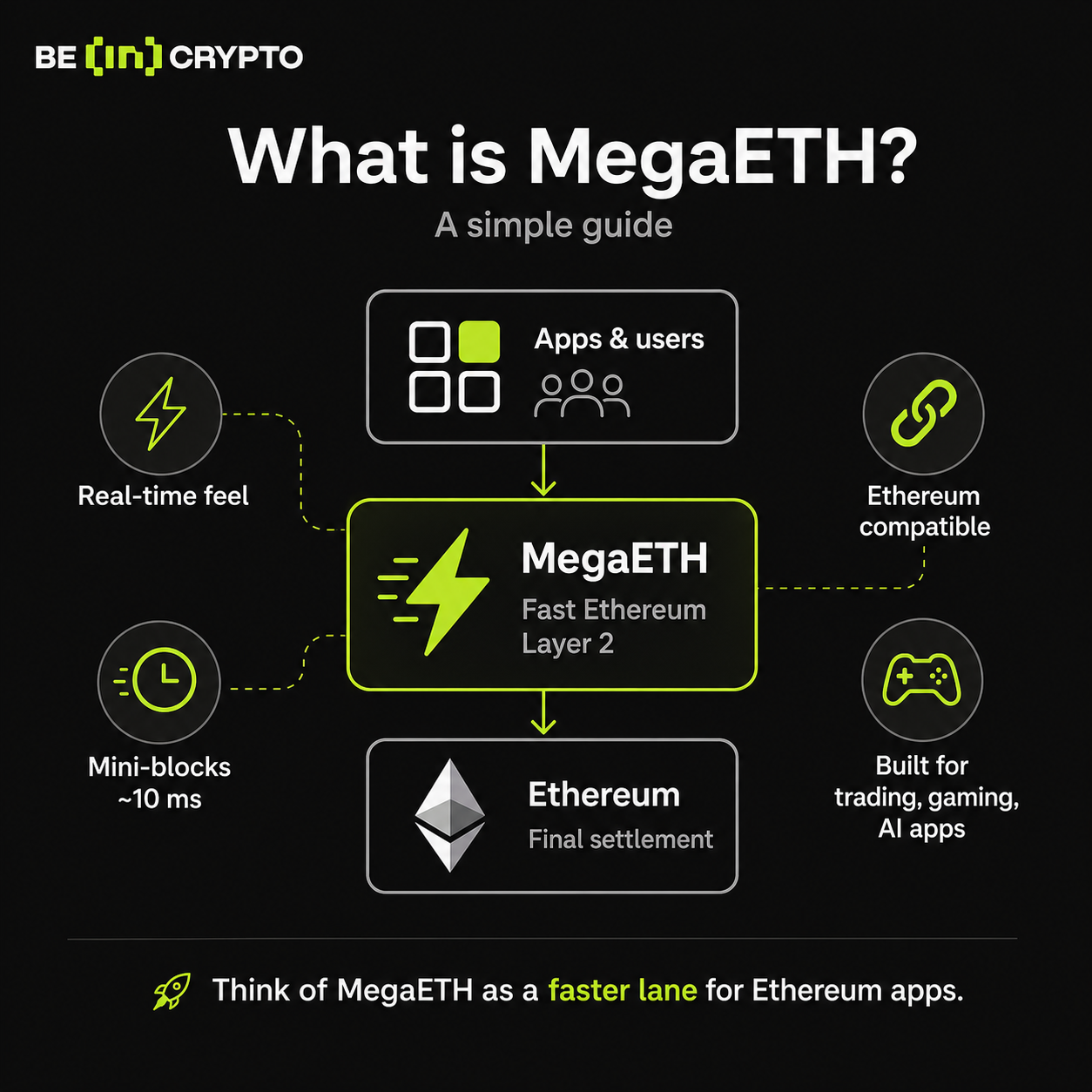
At the base layer, MegaETH settles to Ethereum. It also uses EigenDA for data availability and follows an OP Stack-aligned optimistic rollup model.
That makes it part of the Ethereum scaling family. However, it is more customized than a normal “copy-paste” Layer 2.
Why Is MegaETH So Hyped?
MegaETH became popular because it gives crypto users a simple promise: Ethereum, but much faster.
Most Layer 2 networks compete on cheaper fees, better liquidity, or ecosystem incentives. MegaETH went after speed as its main story.
The project markets itself as “real-time Ethereum.” That phrase matters because many crypto apps still feel slow compared with normal internet apps.
A fast chain can make a real difference for use cases like trading, prediction markets, gaming, AI agents, consumer apps, and high-frequency DeFi. These sectors need instant feedback. Waiting several seconds can break the experience.
MegaETH also attracted attention because of its backers and early supporters. The project raised capital from Dragonfly and also had high-profile names linked to its early funding rounds, including Vitalik Buterin, Joseph Lubin, Cobie, Figment, and Mert Mumtaz.
Then came the cultural layer.
MegaETH built a strong community around Fluffle NFTs, the MegaMafia builder group, and a public sale that drew heavy demand. The public sale reportedly attracted more than $1.39 billion in commitments and closed heavily oversubscribed.
That gave MEGA a strong pre-launch narrative before the token even started trading.
The MEGA Token Launch: Price, FDV, Listings
MEGA launched on April 30, 2026. It has been listed by 11 major centralized crypto exchanges on launch day, including Binance, KuCoin, OKX, MEXC, Bybit, and more.
The token traded in a wide early range. Later launch-day snapshots showed MEGA around $0.16–$0.20, with a 24-hour high near $0.2249.
Based on the full 10 billion token supply, that puts MEGA’s FDV around $1.65 billion in later launch-day tracking. The circulating supply was around 1.13 billion MEGA, implying a market cap of around $186 million.
The first trading day has been messy and volatile, which is normal for newly launched tokens. Indexers added markets at different speeds, volume moved between centralized exchanges and on-chain pools, and early price discovery changed quickly.
MEGA Tokenomics Explained Simply
MEGA has a fixed total supply of 10 billion tokens.
The most important part of the tokenomics is that more than half of the supply goes to KPI-based rewards. That means tokens unlock based on network milestones rather than only fixed calendar dates.
According to MegaETH’s MiCA white paper, the allocation is:
| Allocation | Tokens | Share |
| KPI rewards | 5.33 billion | 53.3% |
| VC allocation | 1.47 billion | 14.7% |
| Team and advisors | 950 million | 9.5% |
| Foundation / ecosystem reserve | 750 million | 7.5% |
| Sonar public sale | 500 million | 5.0% |
| Echo round | 500 million | 5.0% |
| Sonar bonus pool | 250 million | 2.5% |
| Fluffle round | 250 million | 2.5% |
The structure is unusual because MEGA tries to tie token distribution to real network activity.
That sounds cleaner than a normal unlock schedule. Still, it also gives the foundation an important early role in confirming whether milestones have been met.
MEGA is expected to support governance, incentives, future staking, future sequencer rotation, and potentially gas payments. Some of these features are live or partially active. Others are still planned.
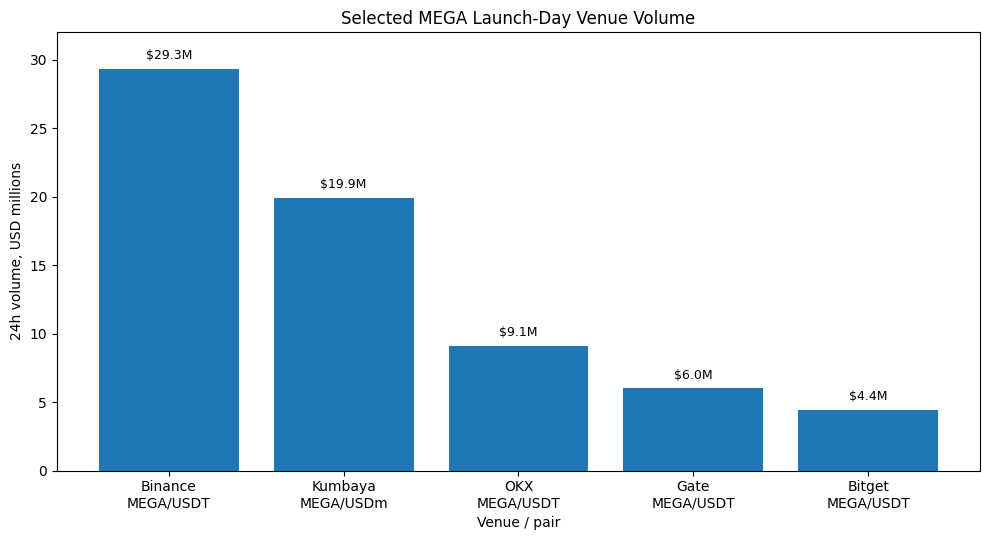 MEGA Token Launch-Day Volume Across Different Exchanges
MegaETH Timeline: How It Got to Launch
| Date | Milestone |
| June 2024 | MegaETH raised a seed round led by Dragonfly, with high-profile Ethereum and crypto backers involved. |
| December 2024 | MegaETH raised $10 million through Echo. |
| Late 2024 to early 2025 | The Fluffle NFT program became part of the community and token allocation story. |
| March 6, 2025 | Public testnet rollout began. |
| March 21, 2025 | MegaETH’s public testnet opened more broadly, with high-throughput and low-latency claims. |
| September 2025 | MegaETH introduced USDm in partnership with Ethena. |
| October 2025 | MegaETH announced native Chainlink Data Streams integration. |
| October 22, 2025 | MegaETH published its public sale framework. |
| October 27–30, 2025 | The Sonar public sale ran and closed heavily oversubscribed. |
| December 2025 to February 2026 | MegaETH shipped several mainnet upgrades. |
| February 2026 | MegaETH mainnet launched with more than 50 apps reported. |
| April 23, 2026 | MegaETH hit the KPI requiring ten MegaMafia apps live on mainnet. |
| April 30, 2026 | MEGA launched and began trading. |
The MegaETH Ecosystem
MegaETH’s ecosystem is built around several layers.
The first layer is the chain itself. This includes the sequencer, MegaEVM, Ethereum settlement, EigenDA, and the bridge infrastructure.
The second layer is liquidity and stablecoin infrastructure. USDm is the most important piece here. MegaETH introduced USDm with Ethena, and it plays a central role in the project’s economic model.
The third layer is data and interoperability. Chainlink Data Streams and CCIP are part of this stack. These tools help apps access fast price data and move assets across chains.
The fourth layer is applications.
MegaETH has pushed the MegaMafia builder network as a core part of its ecosystem. Projects linked to the ecosystem include Cap, Kumbaya, Showdown, Ubitel, WCM, Stomp, HitOne, Nectar AI, Brix, Pump Party, Prism, and others.
These names matter because MegaETH’s TGE was tied to live app deployment. The token launch did not happen only because a date arrived. It happened after MegaETH said the ecosystem had cleared a required app milestone.
That gave the launch a stronger “network is live” framing.
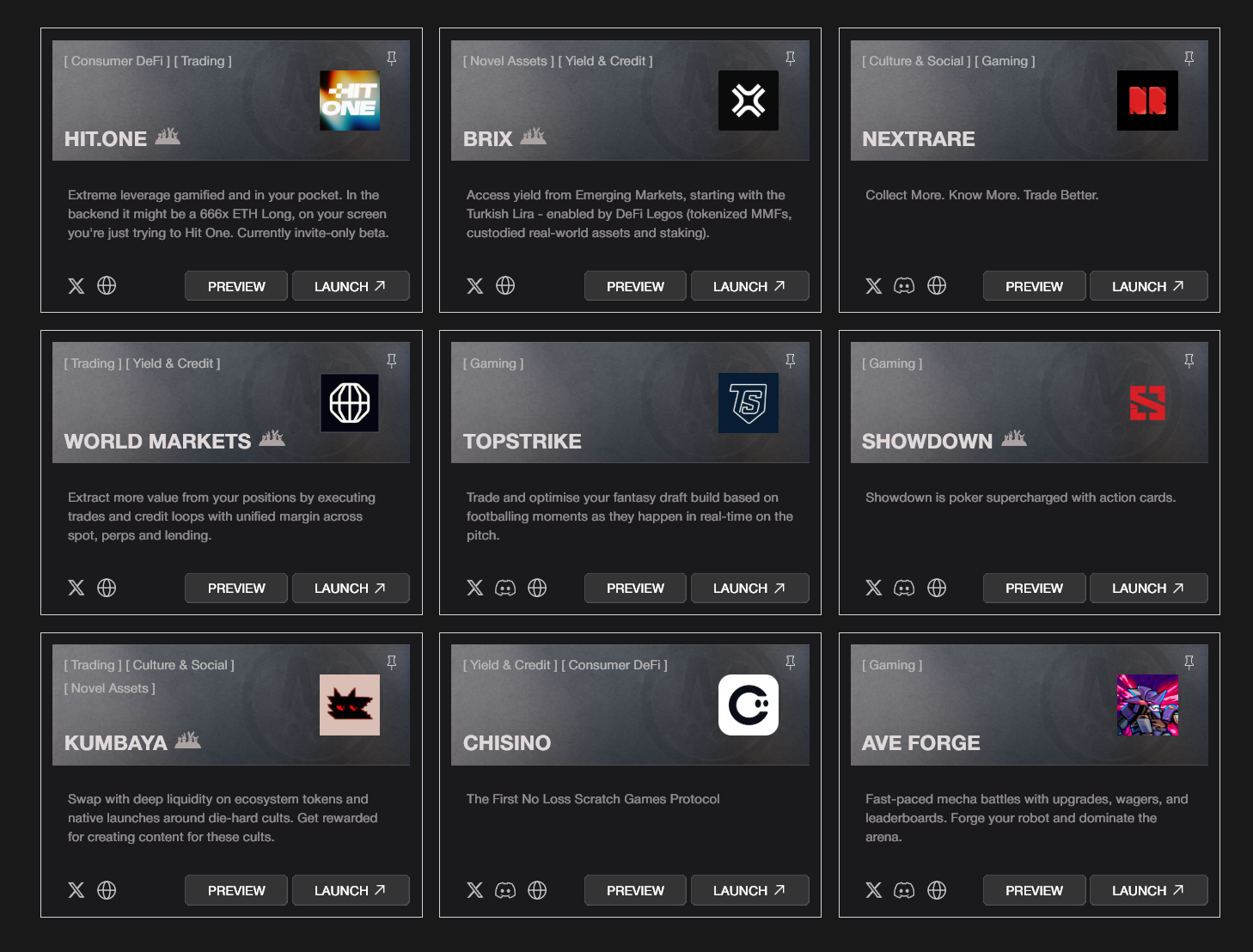 MegaETH Ecosystem
Why MegaETH Is Trending in Crypto Right Now
MegaETH is trending because it sits at the intersection of several active crypto narratives.
The first is Ethereum scaling. Ethereum still has the deepest developer ecosystem, but it struggles with speed and cost at the base layer. MegaETH offers a version of Ethereum that aims to feel much faster.
The second is high-performance infrastructure. Crypto has spent years talking about consumer apps, on-chain games, real-time trading, and AI agents. Most of those use cases need low latency. MegaETH is trying to serve that market.
The third is token design. MEGA’s KPI-based rewards give traders and users a clear story to follow. If the network grows, more milestones can unlock more incentives.
The fourth is launch momentum. A major public sale, strong community marketing, NFT allocation, and listings on large exchanges created a lot of attention at once.
That combination explains the hype. It does not guarantee long-term success, but it explains why MEGA became one of the most watched launches of April 2026.
What Makes MEGA Altcoin Different From a Normal L2 Token?
Most Layer 2 tokens rely on governance, incentives, and ecosystem grants.
MEGA includes those elements, but it adds two more ideas.
The first is KPI-based rewards. More than half the supply is tied to network milestones. This gives token holders a reason to track app growth, stablecoin usage, and network performance.
The second is the USDm economic loop. MegaETH wants USDm activity to support the wider network economy. In the project’s own framing, revenue or rewards linked to USDm can help fund MEGA buybacks, subject to legal limits.
This is one reason traders are watching the ecosystem closely. If USDm usage grows, MEGA may have a clearer value-capture story than many generic governance tokens.
That remains an execution challenge. The model has to prove itself through real usage.
The Main Risks
MegaETH is still early, and the risks are real.
The first risk is centralization. MegaETH currently relies on a single active sequencer. That sequencer orders transactions and plays a major role in the network’s performance.
There’s also admin control. Aave’s technical review noted that key roles were held through multisig arrangements. That is common for young networks, but users should understand the trust assumptions.
The fourth risk is token execution. MEGA’s long-term value depends on real app usage, USDm adoption, governance, staking, and future sequencer economics. Several parts of that story are still developing.
The final risk is market structure. Launch-day trading was volatile. The FDV was already large, while only a portion of the supply was circulating.
That does not make MEGA bad. It means buyers should treat the first days of trading carefully.
The post What Is MegaETH and Why Is the MEGA Token So Hyped? appeared first on BeInCrypto.





 English (US) ·