
 6 months ago
87
6 months ago
87
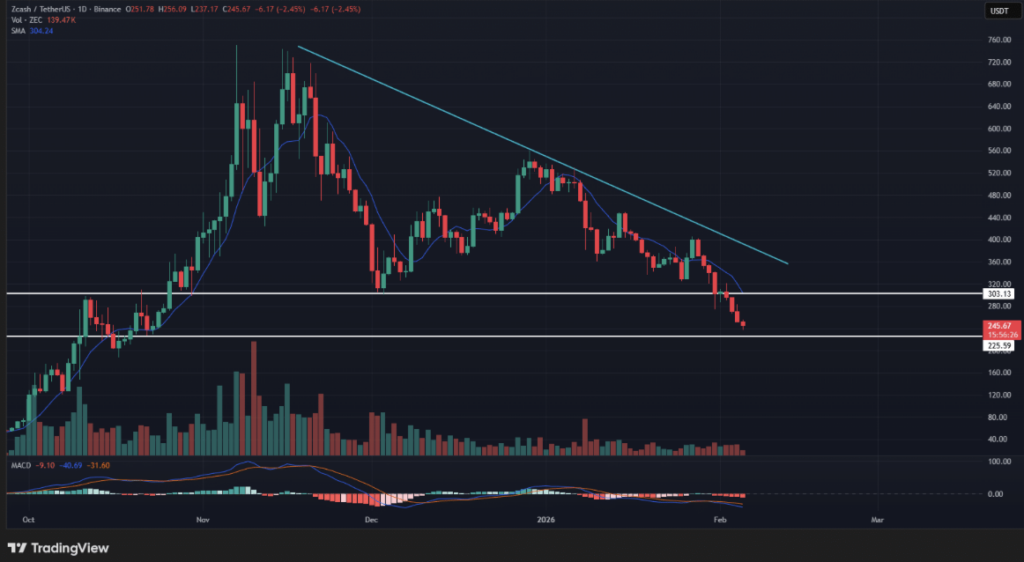
- ZEC remains in a bearish structure, with $300 now acting as major resistance
- Buyers defended the $238–$240 zone, triggering a short-term stabilization and higher low
- A bounce could target $260–$280, but a breakdown below $240 risks a slide toward $210–$200
Zcash has remained under heavy bearish pressure, with price continuing to print lower highs and lower lows. Every attempt at recovery has been capped by trendline resistance, and that structure hasn’t loosened up yet. At press time, ZEC was trading near $245 after breaking below the $300 support level, which has now flipped into resistance, a classic shift that usually keeps sellers confident.
As momentum weakened, the market drifted toward the $240 to $244 support zone, which has become the near-term downside target. If this area fails to hold, downside risk could expand toward the $200 to $210 psychological region, where deeper demand may finally show up. On the upside, resistance remains stacked between $260 and $280, while $300 is still the main structural barrier that bulls would need to reclaim to even start talking about a real recovery.
MACD compression and stretched price conditions hint that ZEC is oversold, but oversold doesn’t automatically mean “bottom.” Without stronger volume, and without macro support from the broader crypto market, relief rallies are still likely to fade and roll back into selling. And beyond pure chart mechanics, privacy-coin headwinds remain a problem, with regulatory scrutiny and competition from newer privacy solutions continuing to weigh on sentiment.
Capitulation move hits demand as buyers defend $240
On the lower timeframes, Zcash completed a sharp capitulation-style drop, sliding from around $270 into the $238 to $240 demand zone. Once price reached that region, downside momentum began to ease, and the market finally saw some reaction buying. This zone has historical relevance because it was built through prior accumulation, where reactive buyers and short-term traders absorbed sell pressure before.
As ZEC revisited the level, that same participant group appeared again, reinforcing the floor. At the lows, buyers printed a hammer candle with a long lower wick, rejecting prices below $240. That rejection mattered because it shifted short-term order flow. Instead of continuing to cascade lower, price stabilized, and forced selling started to cool off.
Two consecutive green candles then followed, forming a higher low around the $244 to $246 area. It’s not a full reversal signal, but it’s enough to show that sellers aren’t in complete control on the micro timeframe anymore.
RSI lifts slightly as selling momentum fades
Momentum indicators are starting to reflect the same thing. RSI hovered near oversold territory, signaling stretched downside conditions rather than fresh bearish expansion. The indicator has ticked up modestly, which suggests selling pressure is fading, at least temporarily.
Price holding above the $240 psychological level is another small but important detail. It implies dip demand is present, and that the worst of the forced selling may have already passed. If buyers can keep defending this zone, rebounds could gradually build toward the $260 to $280 resistance band.
But if $240 breaks cleanly, the downside scenario reopens fast. A failure there could accelerate losses toward $210, and from that point, the market starts talking about $200 again.
ZEC may bounce, but the larger trend is still bearish
Even with the bounce attempt, the broader trend remains bearish as long as ZEC stays below $300. The reaction at $240 highlights downside compression and leverage resetting, but it doesn’t guarantee a lasting recovery. For that to happen, bulls would need volume, follow-through, and ideally a stronger macro backdrop across crypto.
Until then, Zcash is in a familiar spot. A bounce is possible, maybe even likely, but the larger structure still favors sellers, and any rally that stalls under resistance could quickly turn into another leg lower.
Disclaimer: BlockNews provides independent reporting on crypto, blockchain, and digital finance. All content is for informational purposes only and does not constitute financial advice. Readers should do their own research before making investment decisions. Some articles may use AI tools to assist in drafting, but every piece is reviewed and edited by our editorial team of experienced crypto writers and analysts before publication.






 English (US) ·