
 2 hours ago
20
2 hours ago
20
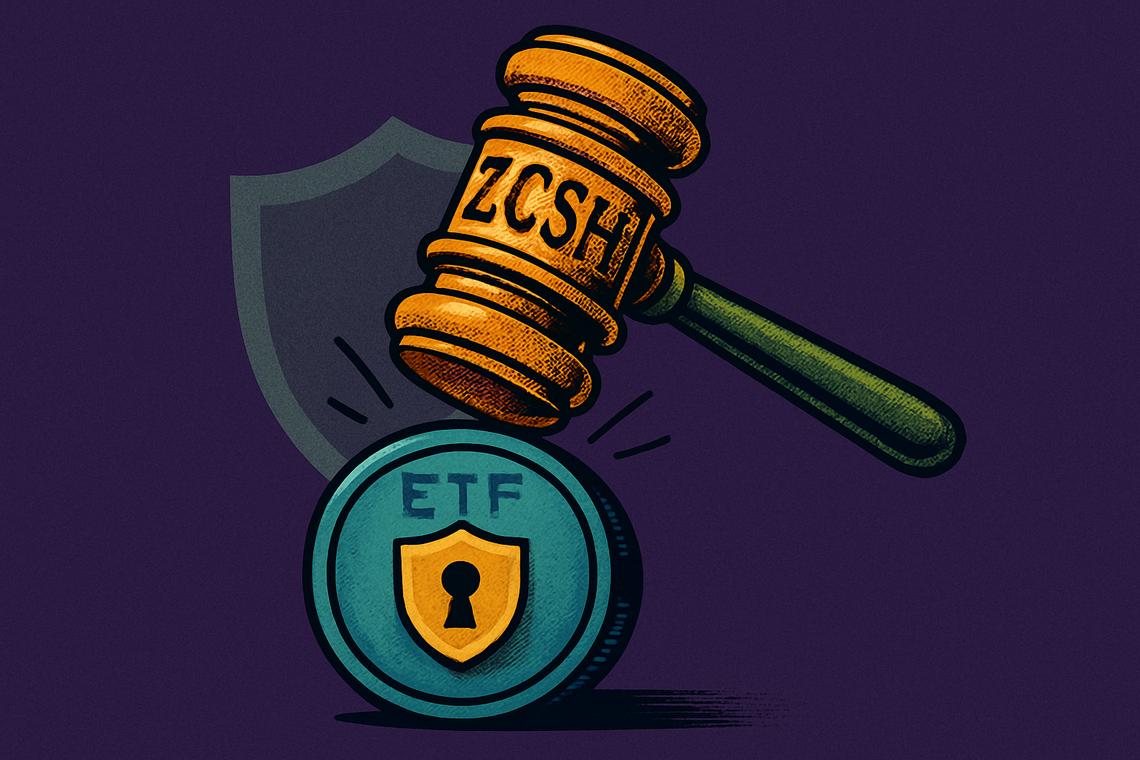
For years, exchanges treated privacy-focused cryptocurrencies as too risky to touch. Then, on August 25, 2026, Grayscale flipped that script by launching the first Zcash spot ETF on NYSE Arca, converting its nine-year-old Zcash Trust into a fund that gives ordinary investors direct exposure to one of crypto’s most debated asset categories. The listing, trading under the ticker ZCSH, marks the first time a US-regulated exchange-traded product has offered spot exposure to a privacy coin, and it arrives just as regulators, exchanges, and investors are rethinking what “financial privacy” even means in a surveillance-heavy digital economy.
Key takeaways
- Grayscale converted its nine-year-old Zcash Trust into ZCSH, the first US-listed spot Zcash ETF, holding roughly $304 million in assets under management.
- ZEC jumped 66% in the week surrounding the listing, touching an eight-year high above $850.
- Shielded transactions now make up roughly 90% of Zcash’s network activity, up from under 20% two years ago.
- The SEC reviewed the Grayscale Zcash Trust in January 2026 without taking enforcement action, clearing the path for the listing.
- ZCSH carries a 2.50% management fee, with all proceeds directed toward Zcash ecosystem development and marketing.
Grayscale converts Zcash Trust into first US spot Zcash ETF
ZCSH isn’t a brand-new product. It’s the reincarnation of the Zcash Trust, which Grayscale established back in October 2017, making it one of the oldest single-asset crypto vehicles in the country. For most of its life, that trust traded on OTC markets at steep discounts to net asset value — sometimes topping 40% — because shareholders had no way to redeem shares directly against the underlying ZEC.
The ETF conversion fixes that. Authorized participants can now create and redeem shares against the fund’s holdings, which forces the market price to track net asset value far more tightly. As of Monday before the listing, the Zcash Trust reported north of $313 million in assets, and by the time ZCSH began trading, Grayscale pegged the fund’s holdings at approximately $304 million in ZEC, custodied by Coinbase Custody International.
The fund charges a 2.50% annual management fee — notably higher than the sub-0.25% fees now common on Bitcoin and Ethereum ETFs. Grayscale has said all revenue from that fee will flow back into Zcash ecosystem development and marketing, an unusual structural commitment for a Wall Street product. An earlier amended filing also disclosed that a subsidiary of Grayscale’s parent company, Digital Currency Group, was weighing a purchase of roughly 200,000 ZEC through the trust, according to The Block.
ZEC price surges as ZCSH begins trading
The rally around the launch didn’t happen in a single burst. ZEC climbed from around $510 in stages, first on filing-driven anticipation, then on a short squeeze tied to the collapsing trust discount, and finally on the listing itself, before the token touched levels above $850 — its highest price since early 2018. Overall, ZEC surged 66% in the week surrounding the debut, an eight-year high that pulled in momentum traders and triggered liquidations on leveraged short positions across several derivatives venues.
Trading volume on centralized exchanges reportedly topped $1.2 billion in a single 24-hour window around the listing, several times the token’s average daily volume over the prior month.
Grayscale’s Head of Index, Steve Vanourny, framed the launch as a bet on rising demand for privacy tools rather than a short-term trading event. “As AI reshapes how financial activity can be monitored, we believe demand for genuine financial privacy will only grow,” Vanourny said in a statement. “With ZCSH, Grayscale is building on its history of industry firsts by giving investors a way to gain exposure to one of the market’s leading privacy-focused assets.”
How Zcash cleared a regulatory path Monero never got
The regulatory road to ZCSH wasn’t automatic, but it was smoother than most people expected. The SEC completed a formal review of the Grayscale Zcash Trust in January 2026 — an inquiry that began in late 2024 examining whether ZEC qualifies as a security — and closed it without taking enforcement action. That outcome wasn’t a formal blessing, but it created enough clearance for the NYSE Arca listing to proceed.
Just as important is the technical design that separates Zcash from other privacy coins. Zcash offers opt-in privacy: users choose between fully transparent transactions and shielded ones that use zero-knowledge proofs to hide every transaction in Monero incorporates privacy as a standard feature, unlike systems that expose sender, receiver, and amount data, with no transparent mode available. That distinction matters for compliance — exchanges can enforce know-your-customer checks on Zcash’s transparent addresses in a way they simply cannot with Monero.
The contrast in treatment has been stark. Binance delisted Monero in February 2024, and OKX followed months later, part of a broader wave of exchanges cutting ties with privacy coins under anti-money-laundering pressure. Zcash avoided that fate partly because the Electric Coin Company and the Zcash Foundation have engaged directly with regulators, including a SEC roundtable held in 2025 — the kind of structured dialogue Monero has never had. Fittingly, the ETF itself reflects that same compliance logic: Coinbase Custody International holds the fund’s ZEC exclusively in transparent, auditable addresses, even though most of the network the token runs on now operates in the shadows.
Shielded transactions now dominate the Zcash network
Here’s the twist that makes ZCSH more complicated than a typical crypto ETF: the network underneath it has become overwhelmingly private. As of July 2026, shielded transactions account for roughly 90% of all Zcash network activity, up from under 20% just two years earlier. That shift is largely credited to Zodl, the most popular Zcash mobile wallet, which switched to shielded-by-default in late 2025 — meaning users now have to opt out of privacy rather than opt into it.
The shielded pool has grown to roughly 4.2 million ZEC, about 30% of circulating supply, and that pool has kept expanding even through price downturns, suggesting the shift is driven by genuine usage rather than speculation. This is exactly why the ETF’s custody design matters: the fund holds transparent ZEC for regulators, while the broader network it tracks is increasingly opaque to blockchain analytics tools. In practice, roughly 90% of non-custodial Zcash activity is now invisible to chain-surveillance firms, creating a structural tension between what the ETF can show investors and what’s actually happening on-chain.
A regulatory paradox: privacy coins banned abroad, listed in New York
The timing here says a lot about where privacy coin regulation is heading — and where it isn’t. At least 10 countries restrict or outright ban privacy coins on exchanges.
The United States just moved in the opposite direction. Days before ZCSH began trading, the SEC proposed Regulation Crypto Assets on August 11, 2026 — a framework aimed at issuers and intermediaries rather than the underlying assets themselves. That framing helps explain how a tightening regulatory push and a privacy coin ETF debut happened almost simultaneously: under existing securities law, what matters is how an asset is offered and sold, not what it does at the protocol level. Grayscale’s registered, audited, custodied structure satisfies those requirements regardless of Zcash’s privacy features.
Still, the optics of the world’s largest crypto asset manager listing a privacy coin on the New York Stock Exchange, even as other jurisdictions ban the category outright, is hard for regulators elsewhere to ignore. It raises a real possibility that blanket privacy-coin bans enacted before opt-in architectures like Zcash’s were well understood could face renewed scrutiny — and it leaves open whether this SEC crypto review outcome opens the door for other privacy assets or stays a one-off tied specifically to Zcash’s compliance-friendly design.
What’s next: quantum resistance and AI-driven surveillance
Zcash’s current zero-knowledge proof system relies on elliptic curve assumptions that a sufficiently powerful quantum computer could eventually break — a vulnerability shared with Bitcoin and Ethereum, but with higher stakes for a privacy chain, since breaking the cryptography could retroactively unmask every shielded transaction ever recorded. The Zcash development team has been researching lattice-based proving systems designed to resist quantum attacks, though no deployment timeline has been set.
Grayscale’s own research argues that increasingly capable AI systems analyzing public blockchain data are eroding the practical privacy of transparent chains, even when nothing about a transaction looked sensitive at the time it happened. Zero-knowledge proofs offer privacy that’s mathematical rather than merely circumstantial — a distinction that becomes more valuable as automated surveillance tools improve and as AI agents begin executing far more on-chain transactions than human users ever did.
Whether that thesis translates into sustained institutional demand for the Grayscale Zcash ETF — rather than a one-week trading catalyst — is the question the market will spend the coming months answering.
FAQ
What is the significance of Grayscale’s ZCSH ETF launch?
It is the first US-listed spot Zcash ETF, marking a regulatory milestone for privacy coins and providing institutional access to privacy-focused crypto through a regulated vehicle.
How did the ZEC price respond to the ETF listing?
ZEC surged 66% around the listing, reaching its highest level since early 2018 above $850, driven by market anticipation, arbitrage activity tied to the trust conversion, and a spike in trading volume.
Why does the ETF hold ZEC in transparent addresses if the network activity is mostly shielded?
To satisfy regulatory requirements for transparency, the ETF’s custody uses transparent addresses, enabling auditability even though most Zcash network transactions are now shielded.
How does Zcash’s privacy technology differ from Monero’s in regulatory terms?
Zcash offers opt-in privacy with both transparent and shielded transactions, which makes compliance easier, while Monero enforces default privacy with no transparent option, complicating regulatory acceptance.
Article produced with the assistance of artificial intelligence and reviewed by the editorial team.



 English (US) ·