
 2 months ago
82
2 months ago
82
TLDR
- Crude oil benchmarks Brent and WTI each climbed approximately 3.5% following renewed military tensions
- Tehran announced the closure of the strategic Strait of Hormuz following an attack on a merchant ship
- Washington challenged Iran’s announcement, asserting the critical waterway continues operating
- Asian equity markets tumbled, with South Korea’s benchmark index plunging as much as 9%
- Maritime traffic data revealed merely six ships passed through the strait Sunday, a five-week low
Global crude oil markets experienced significant volatility Monday as renewed military confrontations between Washington and Tehran sparked concerns over supply security through one of the world’s most critical energy corridors.
Brent crude futures climbed 3.5% to reach $78.68 per barrel during Monday trading. The U.S. benchmark West Texas Intermediate similarly advanced 3.5% to settle at $73.89 per barrel. Both benchmarks had earlier touched intraday gains of 4.5% before moderating.
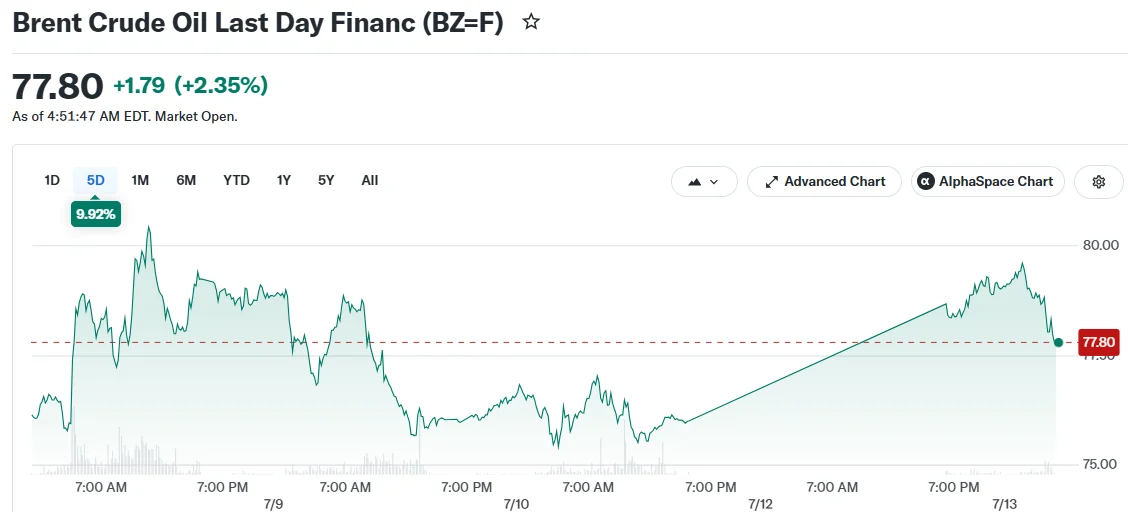 Brent Crude Oil Last Day Financ (BZ=F)
The energy market rally developed after Tehran launched coordinated missile and drone strikes targeting Gulf nations including Qatar and the United Arab Emirates over the weekend. These operations represented direct retaliation for recent American military actions against Iranian installations.
Tehran’s Revolutionary Guards subsequently announced the indefinite suspension of navigation through the Strait of Hormuz. This declaration followed an incident in which a civilian merchant vessel sustained damage from an attack and caught fire, compelling the crew to evacuate.
Implications of a Hormuz Blockade for Energy Markets
The Strait of Hormuz represents the planet’s single most critical petroleum shipping corridor. Approximately one-fifth of global oil consumption transits through this narrow passage, including exports from Saudi Arabia, Iraq, Kuwait and the Emirates.
A prolonged interruption would compel Asian petroleum refineries to secure alternative crude sources. Such a scenario would simultaneously drive up transportation expenses and maritime insurance premiums.
Vessel monitoring systems recorded only six ships navigating the strait throughout Sunday. This figure marks the weakest traffic volume observed in over a month.
The U.S. military’s Central Command published a statement on X asserting that the waterway remained “open to all vessels seeking to lawfully transit,” directly refuting Tehran’s closure announcement.
Maritime industry operators nevertheless adopted a cautious stance. Shipping movements through the region experienced sharp deceleration throughout the weekend, according to research from ANZ.
Equity Markets Respond with Sharp Declines
Asian financial markets experienced substantial pressure Monday. South Korea’s Kospi benchmark temporarily plummeted 9% during morning trading, pulled downward by significant tech sector liquidation.
SK Hynix shares collapsed more than 15% in Seoul trading. The memory chip manufacturer has now surrendered nearly 40% of its market capitalization since reaching all-time peaks last month. This decline followed strong performance of its American depositary receipts, which had surged almost 13% after completing a landmark $26.5 billion capital raise in New York.
Samsung Electronics declined more than 10%. Japanese semiconductor equipment manufacturers Advantest and Tokyo Electron similarly posted significant losses.
Market participants are simultaneously focused on the imminent corporate earnings reporting period. Financial disclosures from TSMC and ASML are scheduled this week, alongside quarterly results from JP Morgan, Bank of America and Goldman Sachs.
Market strategist Fawad Razaqzada warned the geopolitical situation could deteriorate rapidly, although energy analysts suggested crude prices remain unlikely to reach the extreme levels observed when hostilities initially intensified in February.
The International Energy Agency indicated last week that sustained interruptions to Hormuz maritime traffic could undermine anticipated global supply recovery. Worldwide petroleum production had rebounded by 4.1 million barrels daily in June as flows through the strategic waterway temporarily normalized.
The post Crude Oil Prices Jump 3.5% on Iran’s Strait of Hormuz Closure Threat appeared first on Blockonomi.



 English (US) ·