
 2 months ago
94
2 months ago
94
- The crypto market cap fell 5.8% last week, signaling weaker momentum across the sector.
- A $128.4 million USDC withdrawal from Aave raised concerns about declining risk appetite in DeFi.
- Falling stablecoin flows and declining Aave TVL suggest investors are becoming more defensive overall.
Watching stablecoin flows has quietly become one of the easiest ways to understand market mood in crypto. When stablecoins move aggressively into protocols and risk assets, traders usually interpret it as a risk-on environment. But when large amounts suddenly leave lending platforms and sit idle instead, the tone changes pretty quickly.
Right now, the market seems to be leaning toward caution.
From a technical perspective, the total crypto market cap dropped roughly 5.8% last week, marking its sharpest decline in more than two months. Bitcoin itself has also struggled to build momentum during May, sitting barely 1% higher for the month despite repeated breakout attempts. That backdrop already suggested weakening conviction across the market.
Then a massive stablecoin transfer suddenly grabbed attention.
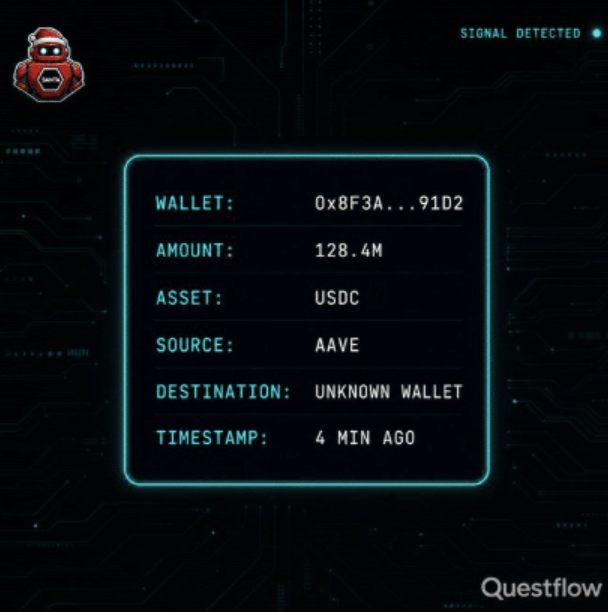
$128 Million USDC Withdrawal Sparks Market Discussion
According to analysts monitoring on-chain activity, someone recently pulled around $128.4 million worth of USDC out of Aave before moving the funds into an unknown wallet.
And because of the timing and sheer size of the transaction, traders immediately started treating it as something more significant than a normal DeFi rebalance.
Large withdrawals from lending protocols matter because platforms like Aave sit at the center of decentralized finance liquidity. They’re essentially where huge portions of idle crypto capital earn passive yield while remaining active inside the broader ecosystem.
So when large stablecoin balances suddenly leave those systems, it often signals that investors are becoming more defensive.
Instead of chasing yield or deploying aggressively into risk assets, capital starts moving into holding patterns — sitting inside fresh wallets or remaining parked on the sidelines while traders wait for clearer market direction.
That shift may already be happening now.
Aave’s TVL Decline Adds to Defensive Market Signals
The broader liquidity picture around Aave also supports the more cautious interpretation.
Data from DeFiLlama shows Aave’s total value locked dropped by more than $170 million this week alone, bringing the protocol’s TVL down to roughly $14.75 billion. While still substantial, that figure remains far below the levels seen during mid-April when Aave held more than $25 billion locked inside the platform.
That’s a pretty major difference in a relatively short period.
When declining TVL combines with large stablecoin withdrawals and falling crypto market capitalization overall, it usually reflects cooling risk appetite across the sector. In simpler terms, investors appear less interested in aggressively deploying capital right now and more focused on protecting liquidity until conditions stabilize.
And honestly, that’s fairly common during uncertain macro periods.
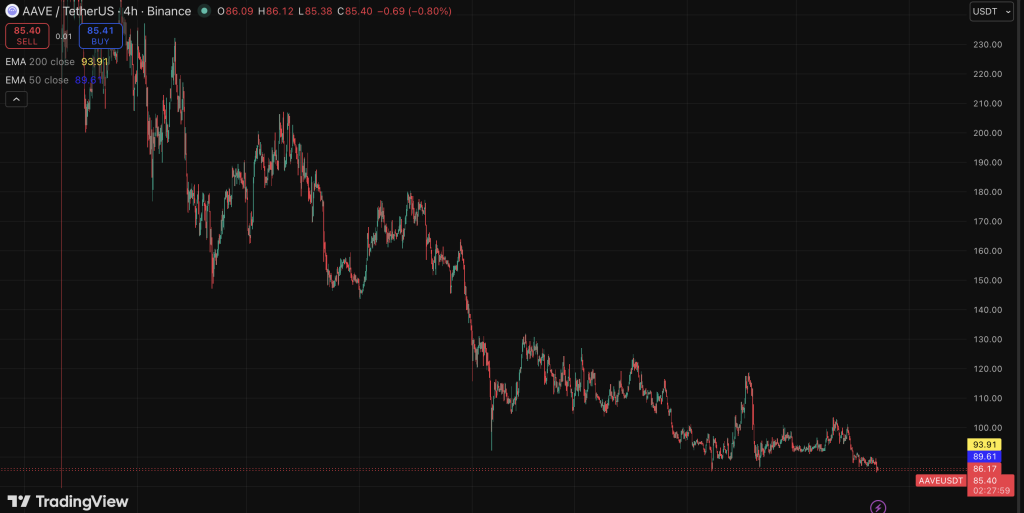
Stablecoin Trends Suggest Liquidity Is Tightening
The stablecoin market itself also offers another warning sign.
From a technical standpoint, falling stablecoin market capitalization often signals thinning liquidity across crypto markets as money exits speculative positions and rotates into more defensive holdings. If stablecoin growth slows while major lending protocols see outflows, it usually points toward weakening participation and reduced upside conviction overall.
That’s why analysts viewed the $128 million USDC withdrawal from Aave as important. It wasn’t just the size — it was how neatly the move fit into the broader pattern developing across the market.
Capital appears increasingly cautious.
If this trend continues, crypto could move deeper into a full risk-off phase where liquidity tightens further, speculative activity cools down, and volatility becomes more dangerous for overleveraged traders. In those environments, markets often experience sharper shakeouts because fewer buyers step in aggressively during pullbacks.
Is Crypto Entering Another Cooling Phase?
For now, the market doesn’t necessarily look panicked, but it definitely looks more defensive than it did earlier this year.
Investors seem increasingly hesitant to deploy large amounts of capital into DeFi strategies while macro uncertainty, weaker momentum, and declining participation continue hanging over the market. Stablecoin flows suggest many participants are choosing patience over aggression right now.
That doesn’t automatically mean a major collapse is coming. Sometimes markets simply consolidate while waiting for stronger catalysts to return. But if outflows continue accelerating and liquidity keeps leaving major DeFi platforms, the risk of broader downside pressure probably increases.
At the moment, crypto feels caught in that uncomfortable middle zone — not full panic, but definitely not full confidence either.
And stablecoin movements are making that pretty clear.
Disclaimer: BlockNews provides independent reporting on crypto, blockchain, and digital finance. All content is for informational purposes only and does not constitute financial advice. Readers should do their own research before making investment decisions. Some articles may use AI tools to assist in drafting, but every piece is reviewed and edited by our editorial team of experienced crypto writers and analysts before publication.





 English (US) ·