
 3 months ago
56
3 months ago
56
- Early NFT boom failed to maintain true on-chain storage standards
- New models like Unipeg use blockchain activity to generate permanent assets
- NFT 2.0 narrative focuses on ownership without reliance on external systems
The original NFT boom might have gotten one key thing wrong, and it wasn’t speculation like most people assume. According to a growing argument led by voices like @unipegv4, the real issue was that most projects quietly abandoned true on-chain storage, drifting away from what made early NFTs actually meaningful in the first place.
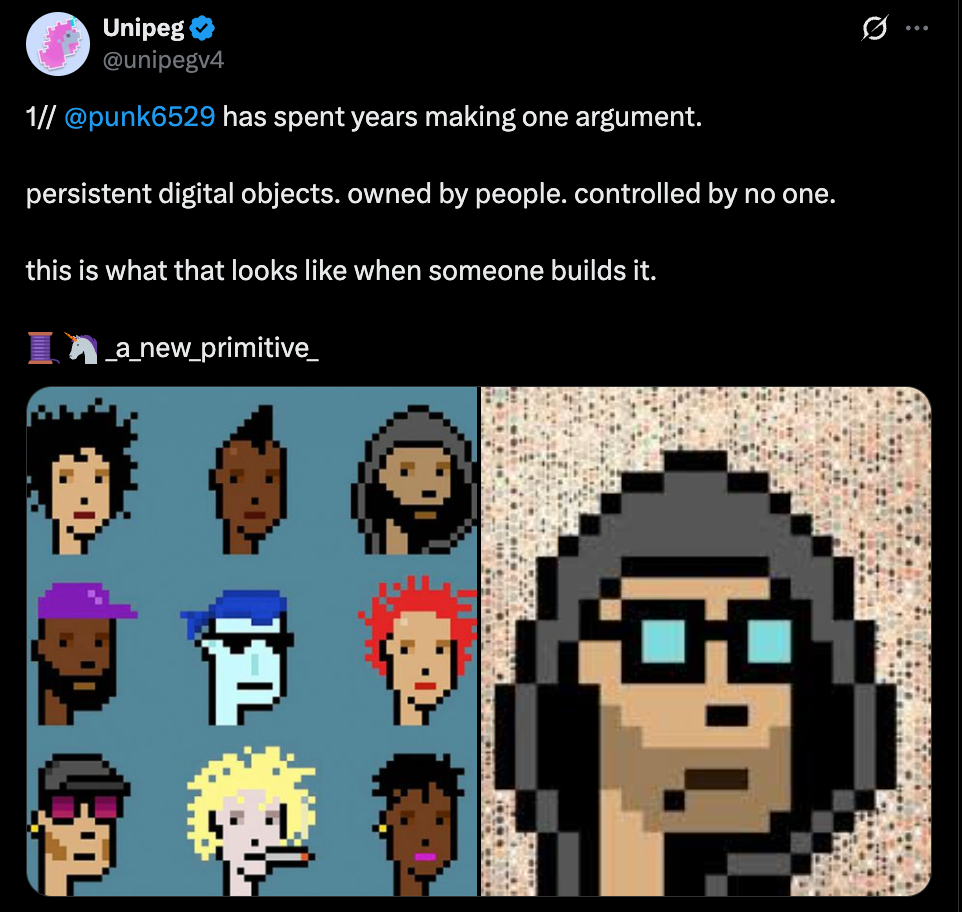
CryptoPunks and Autoglyphs weren’t just valuable because they were early, they mattered because the objects themselves lived fully on-chain, something that later projects didn’t consistently maintain.
When Convenience Replaced Permanence
As the NFT market exploded, speed and cost efficiency started to take priority, and that shift changed the foundation. Instead of fully on-chain assets, many collections relied on off-chain storage, metadata links, and hosted servers, which technically worked, but introduced a hidden dependency most people ignored.
The result is a strange reality where some NFTs “exist” only as long as someone keeps paying for hosting, which, when you think about it, kind of breaks the whole idea of permanent digital ownership.
A New Primitive Through Uniswap v4
This is where Uniswap v4 hooks start to come into the conversation, and why some are calling it a turning point. The idea isn’t just incremental improvement, it’s about introducing a new primitive that changes how digital objects can be created and stored.
Unipeg builds on this by generating images directly from market activity, writing the hash permanently into the contract, and deriving everything from blockchain data that will continue to exist as long as Ethereum runs. No servers, no maintenance, just the chain itself acting as the source of truth.
NFT 2.0 Starts to Take Shape
The broader NFT 2.0 narrative is forming around this exact distinction, permanence versus dependency. Instead of focusing on aesthetics or hype cycles, the attention is shifting toward infrastructure that guarantees objects exist without relying on third parties.
Projects like $UPEG and $PEPI are being watched closely in this space, not because they promise quick returns, but because they experiment with architectures that align more closely with the original vision of NFTs.
A Reset for Digital Ownership
The first NFT cycle proved that people care about owning digital objects, even if the implementation wasn’t always perfect. What’s happening now feels more like a reset, where the focus is shifting back to fundamentals, how those objects are created, stored, and preserved over time.
If the idea of an open metaverse is going to hold up, it likely depends on assets that exist independently of any company or server. That’s the direction being explored now, and whether it sticks or not will depend on how well these new models perform when tested at scale.
Disclaimer: BlockNews provides independent reporting on crypto, blockchain, and digital finance. All content is for informational purposes only and does not constitute financial advice. Readers should do their own research before making investment decisions. Some articles may use AI tools to assist in drafting, but every piece is reviewed and edited by our editorial team of experienced crypto writers and analysts before publication.







 English (US) ·