BTC $82,782
  ETH $2,433
  USDT $0.9994
  BNB $725.80
  XRP $1.31
  USDC $0.9999
  SOL $105.59
  TRX $0.3309
  FIGR_HELOC $1.08
  ZEC $1,166
 Near Intents blocks $50M in Bitget hack laundering attempts
The cross-chain protocol froze $503,000 during execution and waived its share of Bitget's bounty after a $387.5 million breach.
Key takeaways
- Most flows blocked. Near Intents said it stopped more than $50 million in attempted transfers after the Bitget hack.
- Some funds slipped out. About $166,000 passed through and $503,000 was frozen mid-execution.
- No bounty taken. Near Intents waived a 5% freeze bounty and an extra 5% recovery share.
What happened
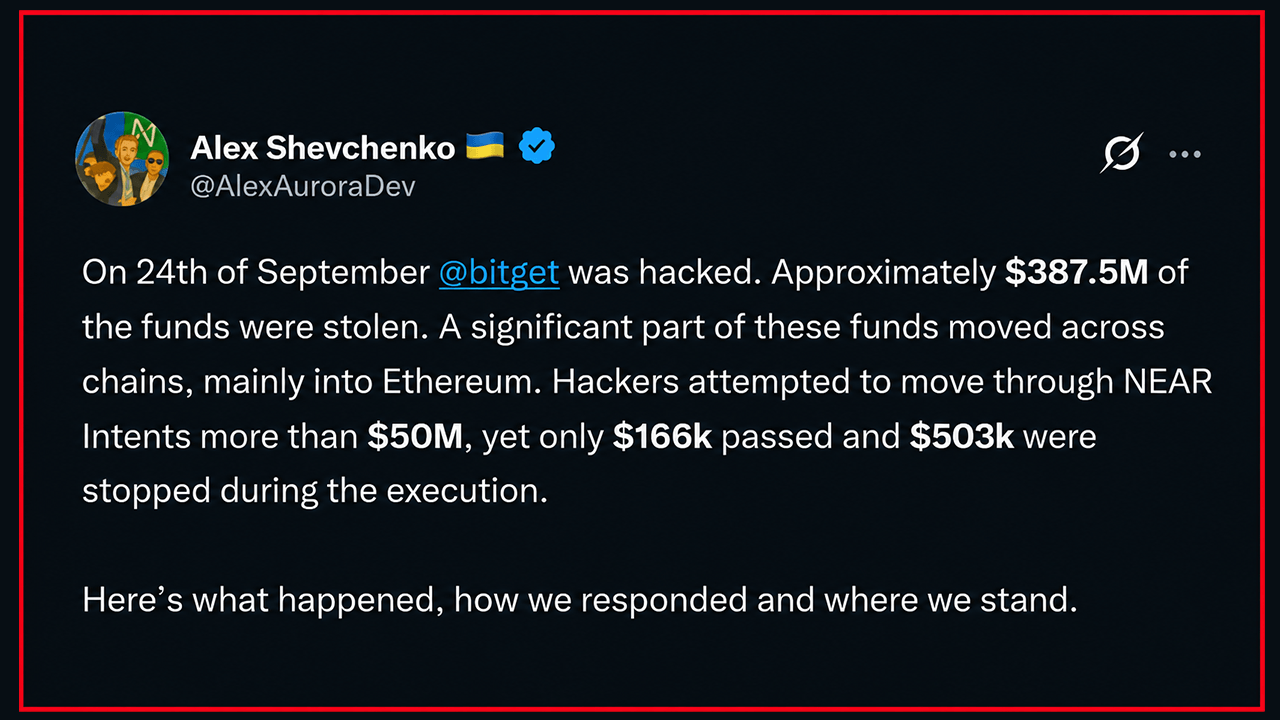
Attackers stole $387.5 million from Bitget on Sept. 24 and moved a large share of the funds across chains to Ethereum. Alex Shevchenko, general manager of Near Intents, said the attackers then tried to route more than $50 million through the cross-chain protocol. Its SHIELD risk system detected the flows, declined to quote some transfers and halted others already underway.
Near Intents froze $503,000 during execution, while about $166,000 got through. The protocol waived the 5% bounty Bitget offered for freezing attacker funds and an additional 5% for recovery, which it said leaves more money for the exchange to recover. Shevchenko said the frozen funds would be returned through an appropriate legal process.
Why it matters
The move sets Near Intents against THORChain. Bitget CEO Gracy Chen called on THORChain to refuse services to addresses linked to the attack, but THORChain said it does not censor by design and that its network halts are a broad emergency security mechanism, not a selective freeze of specific funds or an individual swap.
Shevchenko argued that permissionless systems do not necessarily have to be neutral, saying that crypto cannot demand recognition of digital property rights while building infrastructure optimized for monetizing stolen property.
What the data shows
- Bitget reported a $387.5 million loss in the Sept. 24 breach.
- NEAR Intents said it blocked more than $50 million in attempted transfers, with duplicate transactions filtered out.
- $503,000 was frozen mid-execution and roughly $166,000 passed through.
- Circle and Tether blacklisted a wallet tied to the exploiter, freezing $318,013 of USDT and USDC.
- Near Intents handles over $100 million in daily cross-chain volume, and Shevchenko put possible attribution error at up to 10%.
Background
- Bitget CEO Gracy Chen thanked the Near Intents team and said she would follow up through the appropriate legal and recovery process.
- The frozen $503,000 stays restricted pending legal and recovery proceedings.
What is still unclear
- Shevchenko cautioned that the figures are rounded estimates, with potential attribution errors of up to 10%.
- The blocked transfer attempts subsequently went to other providers, according to Shevchenko.
Questions readers ask
How much did Near Intents block from the Bitget hack?
It said it blocked more than $50 million in attempted transfers, with duplicate transactions filtered out. It froze $503,000 during execution and about $166,000 got through.
Did Near Intents claim Bitget's bounty?
No. It said it would forgo the 5% bounty for freezing attacker funds and an additional 5% for their recovery, leaving more money for Bitget to recover.
Why did THORChain not freeze the funds?
THORChain said it does not censor by design, and that its past network halts are a broad emergency security mechanism rather than a selective freeze of specific funds or an individual swap.