BTC $65,015
 EQQQQ $655.75 Last updated 8 Nov 2026, 12:03 UTC
 ETH $1,822
 MGLOEURO $111,813
 USDT $0.9993
 BNB $591.18
 USDC $0.9996
 XRP $0.9605
 SOL $71.45
 TRX $0.3071
Technology · Explained
Solana retires mainnet beta label with 1.0 as SOL touches four-month low
The Solana Foundation replaced the six-year-old beta tag with a shared protocol version, a naming change that leaves user assets untouched.
Key takeaways
- Naming only. Existing SOL, wallets, accounts and transaction history are unaffected; no migration or wallet update is needed.
- Versioning gap closed. Agave and Firedancer keep their own release schedules but can now be mapped to one shared protocol version.
- Market backdrop. SOL slipped to $67.41 before recovering toward $71, while US spot Solana ETFs recorded a sixth straight week of outflows.
What happened
The Solana Foundation on Nov. 16 retired the "mainnet beta" designation the network had carried since its launch and introduced Solana 1.0, a shared version number for the protocol's underlying rules. Blockonomi reported that the announcement landed during Breakpoint 2026 in London. According to Decrypt, the shift is chiefly about how developers and validator operators coordinate software releases rather than any new gain in throughput or other user-facing capability.
Solana runs two major validator clients: Agave, built by Anza, and Firedancer, developed independently by Jump Crypto. Each ships its own code and version numbers, which previously made it difficult to determine whether different releases supported the same set of network features. Under the new scheme, an Agave build and a Firedancer build can back the same protocol version without sharing a software version number. The Foundation said it coordinated the change with both teams.
The Foundation stressed that declaring a protocol version does not switch on every associated improvement at once. Operators still have to confirm that their particular software supports a planned upgrade and follow its activation instructions. Its upgrade tracker continues to list Agave 4.4 for November and Agave 4.5 for December, each with separate release and activation steps. Documentation, block explorers and websites will move to the new mainnet naming over time, and the governance process for proposals remains separate from the version announcement.
For ordinary users, the practical effect is nil. The Foundation said SOL balances, accounts, assets, applications and transaction history all stay as they were, and that no token swap, wallet move or installation is required. Developers and infrastructure providers have more to do: application teams were advised to review API, SDK and service changes, while validator and RPC operators must check client compatibility for each rollout.
First $103.17Latest $70.41-31.8% over the period
Points are daily observations, not closing prices.
Why it matters
Solana's reliance on multiple independently built clients is a resilience strategy: a flaw in one codebase need not take down every validator. But diversity only helps as far as operators actually spread across implementations, and it complicates coordination when network-wide rules change. A protocol-level version gives teams from different codebases a single yardstick, which Bitcoinist noted should make it easier for separate development groups to work toward the same technical standards.
The retirement of the beta label is largely symbolic, presenting a chain that has processed real transactions since its first block as a mature production network. It does not lower fees or raise speed, and the Foundation's own messaging frames the release as bookkeeping for the protocol rather than a feature drop. The market response was driven by other factors, with the token under pressure on the same day.
What the data shows
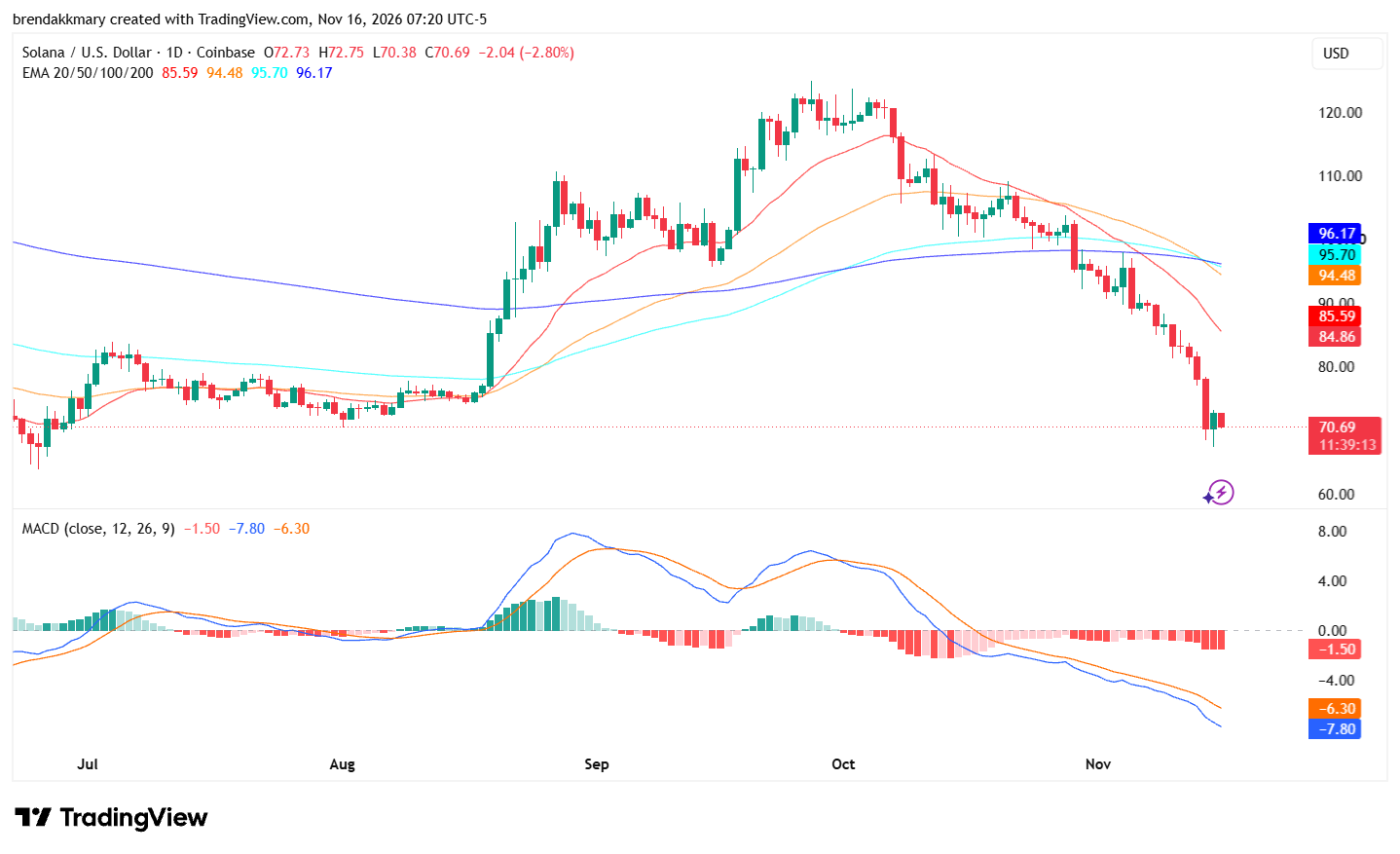
SOL fell to $67.41, its weakest level in roughly four months, before recovering to about $71.02 on Monday, Blockonomi reported. Bitcoinist put the token near $70, down around 3% over 24 hours. US spot Solana ETFs recorded $32.05 million in net outflows last week, per SoSoValue, their sixth consecutive week of withdrawals since October.
Technical readings cited by Blockonomi placed SOL beneath its 50-day, 100-day and 200-day exponential moving averages around $94.62, $95.80 and $96.14, with a broken ascending trendline near $91.06 overhead. The report identified immediate resistance at $78.35 and the recent low at $67.41 as support. The daily RSI sat near 20, an oversold level, while the MACD stayed negative.
Ecosystem metrics from DefiLlama showed about $4.66 billion deposited in Solana-based decentralized finance applications, roughly $14 billion in circulating stablecoins on the network, and $1.28 billion in DEX volume over the preceding 24 hours, according to Bitcoinist.
Background
Solana's mainnet beta went live on March 16, 2020, and the experimental-sounding name stayed even as users traded tokens and shipped applications on the chain. Two infrastructure milestones preceded the rebrand. Alpenglow's Votor consensus system went live on Oct. 21, replacing the onchain voting mechanism used since launch with direct validator messages combined into certificates; its guide targets finality of about 150 milliseconds, against roughly 12.8 seconds under TowerBFT. Finality marks when a transaction is considered settled, not the gap between blocks. Firedancer reached mainnet in 2025.
Reliability has been a recurring theme. The network went offline for nearly five hours in February 2024, following an outage of almost 19 hours a year earlier, which Decrypt cited as a reason for caution around claims of robustness.
What is still unclear
Alpenglow's Rotor phase, designed to change how block data propagates, remains unscheduled, so its timing and effect are not yet defined. How much protection client diversity delivers also depends on how widely Firedancer is actually deployed among validators, a distribution the reports do not quantify.
What to watch
Adoption of the new mainnet naming across explorers, documentation and tooling will roll out gradually, and the Agave 4.4 and 4.5 releases carry their own activation requirements. On the market side, the reports flagged weekly ETF flows, the $67.41 support low and resistance at $78.35 and $91.06 as reference points, while noting that flow data alone does not indicate future prices.
Questions readers ask
Do Solana holders need to do anything because of Solana 1.0?
No. The Foundation said balances, accounts, assets, applications and transaction history are unchanged, and no migration, transfer or wallet update is required.
Does Solana 1.0 make the network faster?
Not by itself. The label gives the protocol a shared version number; the finality improvements came from the Alpenglow upgrade in October, and feature activation still follows each client's own schedule.
Why does Solana need a protocol version separate from client versions?
Because Agave and Firedancer are developed independently with their own release numbers, a shared protocol version lets operators tell which network rules a given software build supports.
Sources · 5 publishers
-
 Solana 1.0 Replaces Beta Label as SOL Slides to Four-Month Low
-
 Solana drops ‘mainnet beta’ label and adopts protocol version 1.0
-
 Solana Officially Exits Beta After Six Years With New Network Versioning System
-
 Solana Drops 'Mainnet Beta' After Six Years: Here's What 1.0 Is All About
-
 SOL Eyes New Bullish Era as Solana Ditches ‘Beta’ Label After Six Years and Embraces Protocol Version 1.0