BTC $64,537
 EQQQQ $655.75 Last updated 8 Nov 2026, 12:03 UTC
 ETH $1,809
 MGLOEURO $111,813
 USDT $0.9993
 BNB $590.99
 USDC $0.9996
 XRP $0.9538
 SOL $71.63
 TRX $0.3032
Stablecoins · Explained
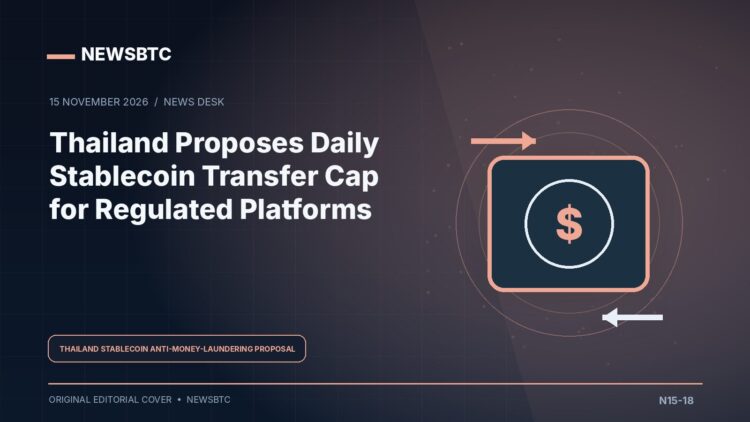
Thailand proposes 5 million baht daily stablecoin cap for licensed platforms
Draft rules would require both wallets in a transfer to belong to the same verified customer, with feedback open until November 26.
Key takeaways
- Not yet in force. The November 12 draft is out for public comment until November 26, 2026; the final text and exemptions will determine who is actually covered.
- Same-owner requirement. Inbound and outbound transfers must involve wallets or accounts verified as the customer's own, and each direction is capped separately at 5 million baht per operator per day.
- Carve-outs exist. Transfers between a customer's own accounts at two supervised operators, certain Bank of Thailand-approved businesses, stablecoin-baht market makers and licensed ICO flows would fall outside the cap.
What happened
Thailand's Securities and Exchange Commission has opened a public consultation on draft rules that would reshape how customers move stablecoins through regulated digital-asset operators. Both NewsBTC and Blockonomi reported on the proposal on November 16, noting that the regulator published the draft on November 12 and is accepting feedback through November 26, 2026.
At the centre of the draft is a cap: transfers into and out of a customer's account at a digital-asset operator would generally be limited to 5 million baht per day in each direction, applied separately for inbound and outbound flows and separately with each operator. The draft would also require that the sending or receiving wallet be verified as belonging to the same customer, effectively barring transfers to or from accounts held by other people.
Beyond the limits, operators would need controls consistent with the Travel Rule, which involves sharing sender and recipient information on transfers. The draft calls for screening of wallets, ongoing transaction monitoring and blockchain analytics tools capable of flagging high-risk or watchlisted addresses. Platforms would also be expected to check that a customer's transfer values are consistent with that person's income and financial position, and to watch for mule accounts or links to illegal activity.
The proposal extends past transfer rules. Exchanges would have to publicly identify their market makers and the assets those firms support, and screen and monitor them. Brokers would have to disclose their liquidity providers and any conflicts of interest, and liquidity providers could not be based in jurisdictions without measures aligned with Financial Action Task Force standards. Off-platform trades arranged by brokers and dealers would carry a minimum size of 3 million baht, require published prices, and brokers would be barred from matching such trades between their own customers, though matched orders could still be routed through a domestic or overseas exchange.
First $0.0801Latest $0.1041+29.9% over the period
Points are daily observations, not closing prices.
Why it matters
Stablecoins have become a practical tool for businesses moving money across borders, particularly where conventional transfers are slow or costly, and the commercial case behind that growth has been covered by NewsBTC in its reporting on stablecoin payments. For companies in that category, same-owner wallet verification and daily limits add compliance work that has to sit alongside existing customer checks. The tension the consultation is meant to examine is straightforward: rules aimed at illicit finance can also slow lawful operations if identity matching proves difficult or exemptions are drawn too narrowly. The regulator, for its part, has an interest in knowing who is using supervised firms' systems. Both reports stress that the draft targets the point where blockchain assets meet licensed intermediaries, and that it would be wrong to describe it as a universal limit on stablecoin movement across every blockchain.
What the data shows
Blockonomi put the 5 million baht threshold at roughly $148,000, while a CoinDesk social media post cited in its report described it as about $140,000, an illustration of how the dollar equivalent shifts with exchange rates. The SEC's release does not name specific stablecoins; the rules would apply to stablecoin transfers handled by licensed digital-asset businesses. Exemptions listed in the draft include transfers between a customer's own accounts at two SEC-supervised operators, provided both follow the Travel Rule; operators using accounts in their own name for business purposes; businesses supervised by the Bank of Thailand and approved case by case to use stablecoins under a set model; market makers for stablecoin-baht trading pairs; and transfers tied to initial coin offerings conducted through licensed portals. If an operator fails to collect or disclose required information, the SEC could order it to remedy the problem within a set period.
Background
The proposal reflects a widening regulatory focus on the boundary between blockchain technology and licensed access. NewsBTC's coverage of USDC on Solana through Samsung Wallet makes a similar distinction: the asset can move freely on-chain, but the channels through which regulated firms touch it are where supervisors concentrate their attention. Thailand's draft follows that logic, concentrating on activity conducted through supervised operators rather than on the network itself. The regulator has framed the measures as a way to reduce the risk that licensed crypto businesses facilitate money laundering, cybercrime or circumvention of cross-border transfer rules, and to improve traceability when an intermediary is involved. Both outlets advised businesses to read the official draft rather than rely on shortened social-media summaries when judging whether their own transaction flows would be caught.
What is still unclear
The practical scope depends heavily on the final regulation and on whether participants satisfy the relevant conditions, and the reports leave several questions open. It is not yet clear how operators would verify same-owner wallets in cases where identity matching is hard, how the regulator would treat flows that mix exempt and non-exempt activity, or how the Bank of Thailand case-by-case approvals would operate in practice. The draft as reported also does not set out the penalties for breaching the cap, beyond the SEC's power to order an operator to correct missing disclosures within a set period.
What to watch
The consultation closes on November 26, 2026, and the text that follows will show whether the exemptions are wide enough for legitimate payment flows. Watch for how the regulator defines verification requirements, whether the 5 million baht threshold or the direction-by-direction calculation changes, and how the disclosure and minimum-size rules for market makers and off-platform trades are finalised. Evidence that the controls cut risk without obstructing ordinary payments would be the measure of whether the balance the SEC says it wants is actually achieved.
Questions readers ask
Is Thailand imposing a nationwide limit on stablecoin transfers?
No. The draft applies to stablecoin transfers handled by digital-asset operators supervised by the Thai SEC. Each direction is capped separately at 5 million baht per customer per day with each operator, and several categories of transfer are exempt.
When would the rules take effect?
They have not taken effect. The draft was published on November 12, 2026, and comments are open until November 26, 2026. The final regulation, including its exemptions, has yet to be issued.
Do the rules name specific stablecoins?
According to the reports, the SEC's release does not identify particular tokens. The requirements would apply to stablecoin transfers conducted through licensed digital-asset businesses in Thailand.