BTC $77,352
 ETH $2,282
 MGLOEURO $111,813
 USDT $0.9987
 BNB $700.67
 XRP $1.29
 USDC $0.9994
 SOL $93.09
 TRX $0.3216
 FIGR_HELOC $1.07
Altcoins · Explained
XRP wallet creation doubles autumn average as price stays near $1.25
Santiment recorded 7,934 new XRP Ledger wallets on Nov. 1, the sixth-highest daily total of 2026, while XRP traded near $1.25 and US demand signals stayed soft.

Key takeaways
- Wallet surge. Santiment counted 7,934 new XRP wallets on Nov. 1, the sixth-highest daily total in 2026 and more than double the autumn average.
- Price disconnect. XRP traded near $1.25 after losing almost 16% in October, while the Coinbase Premium Index fell to about -0.16%.
- ETF slowdown. US spot XRP ETFs drew about $18.83 million in October, down from $121.40 million in September, according to reported SoSoValue figures.
What happened
The XRP Ledger recorded a sharp increase in wallet creation on Nov. 1, with Santiment counting 7,934 new addresses. According to reports from U.Today and Bitcoinist, that was the sixth-largest daily count of 2026 and more than double the autumn average of 3,500 wallets. The activity stood out because it occurred on a weekend, a period the U.Today report described as traditionally quieter for blockchain networks.
The wallet spike followed a security breach at Binance on Oct. 29. U.Today reported that attackers linked by the FBI to the North Korean group TraderTraitor took assets worth $6.36 billion from the exchange's hot wallets, including 233 million XRP tokens valued at about $297 million. According to that report, users responded by moving tokens from the centralized platform into self-custody and creating fresh addresses to spread risk.
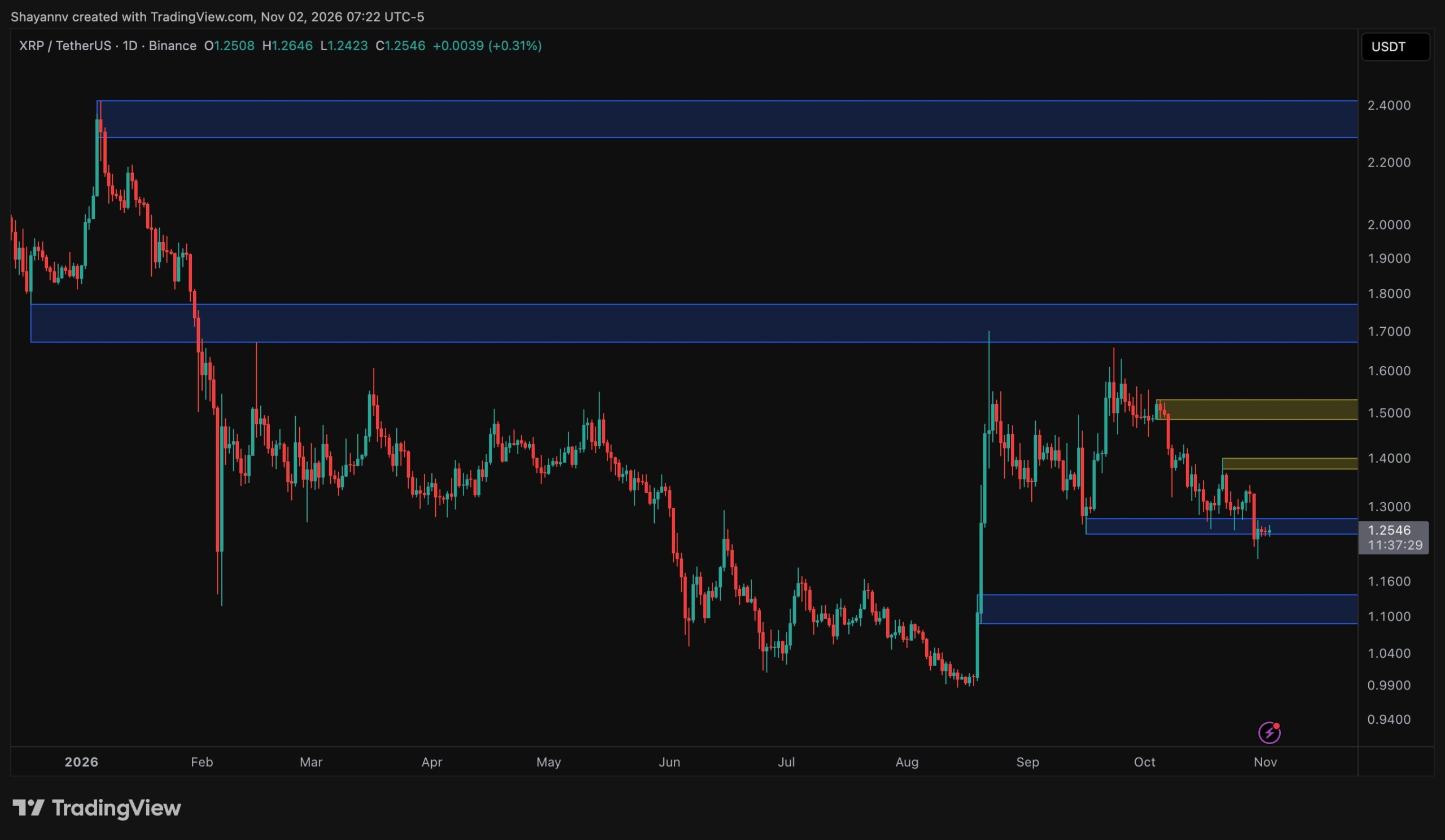
XRP's price did not collapse after the incident. U.Today reported that the asset found support at $1.20 and was consolidating near $1.25, which the report said suggested holders viewed the breach as an exchange-specific problem rather than a threat to the XRP Ledger itself. Bitcoinist, meanwhile, noted that XRP remained under pressure despite the wallet growth.
First $1.52Latest $1.26-17.1% over the period
Points are daily observations, not closing prices.
Why it matters
The contrast between rising wallet counts and muted price action is the central issue. Bitcoinist argued that growing blockchain participation does not always lead to stronger cryptocurrency prices, and the latest data offer a clear example: network engagement rose while XRP traded near $1.25 after falling almost 16% in October. Demand indicators also remained soft. The Coinbase Premium Index dropped to about -0.16%, its lowest reading in eight months, a signal that US buyers were exerting weaker relative pressure than traders on Binance. Reported ETF flows added to the cautious picture, with October inflows well below September's level. For a major asset like XRP, those US and institutional signals matter because they can show whether regulated and domestic investors are adding exposure.
What the data shows
Santiment's Nov. 1 count was 7,934 new wallets, versus an autumn average of 3,500, according to the reports. That placed the day sixth among 2026 daily readings. XRP lost almost 16% in October and was trading near $1.25 at the time of the reports, with $1.20 cited as support. The Coinbase Premium Index stood at approximately -0.16%, described as an eight-month low. On the fund side, reported SoSoValue figures showed about $18.83 million of net inflows into US spot XRP ETFs in October, down from $121.40 million in September; Oct. 29 alone accounted for about $8.43 million of inflows. Santiment also identified $1.30 as a recovery level and $1.20 as a downside reference.
Background
Bitcoinist said it had previously examined declining XRP network activity and noted that weaker wallet growth can reflect changing participation. The new figures suggest that engagement may be recovering, but the outlet said sustained activity would be needed to confirm a broader trend. The Binance breach provides the immediate context for the latest surge: U.Today described the wallet openings as a reaction to the Oct. 29 attack and a sign of growing distrust of centralized custodians, even as the largest exchanges remain targets for sophisticated attacks.
What is still unclear
Wallet creation is not the same as user growth. Bitcoinist noted that existing users can create additional addresses for security, transfers or other purposes, so 7,934 new wallets do not necessarily represent thousands of new investors. It is also unclear whether the surge will last beyond the initial response to the Binance breach. On the market side, Bitcoinist cautioned that a negative Coinbase premium does not automatically mean XRP will keep falling, because exchange liquidity, arbitrage activity and broader market conditions can affect the reading.
What to watch
Three indicators are likely to shape the next phase. The first is whether daily wallet creation stays elevated; Santiment's reference points were growth above roughly 4,000 addresses alongside a move above $1.30, versus fewer than 3,000 wallets and a drop below $1.20. The second is the Coinbase Premium Index, which could show whether US buying pressure is improving. The third is November ETF flow data, after October's slower pace. Bitcoinist said it would watch whether new wallet creation remains elevated, whether the premium improves and whether November brings stronger ETF inflows. Those are analytical markers, not guaranteed outcomes.
Questions readers ask
How many new XRP wallets were created on Nov. 1?
Santiment counted 7,934 new XRP wallets, the sixth-highest daily total of 2026 and more than double the autumn average of 3,500, according to the reports.
Why did XRP wallet creation rise?
Reports linked the timing to the Oct. 29 Binance breach. U.Today described a shift toward self-custody, while Bitcoinist said analysts believe the incident may have encouraged holders to move funds into personal wallets. Existing users can also create additional addresses, so the figure does not necessarily mean thousands of new investors.
Did XRP's price rise with wallet growth?
No. XRP was trading near $1.25 at the time of the reports after losing almost 16% in October. The Coinbase Premium Index was about -0.16%, and October ETF inflows were lower than September's, according to reported figures.