BTC $81,108
  ETH $2,377
  USDT $0.9990
  BNB $713.38
  XRP $1.27
  USDC $0.9997
  SOL $102.07
  TRX $0.3317
  FIGR_HELOC $1.08
  ZEC $1,090
 Bitcoin (BTC) drops below $84,000 on renewed U.S.-Iran tensions
The leading cryptocurrency fell from a seven-day high above $87,000 as geopolitical risk weighed on risk assets and traders braced for key U.S. economic data.
Key takeaways
- Bitcoin (BTC) fell below $84,000 on September 28, dropping from a seven-day high above $87,000 recorded in the prior week.
- The decline coincided with renewed U.S.-Iran geopolitical tensions that reduced market appetite for risk assets.
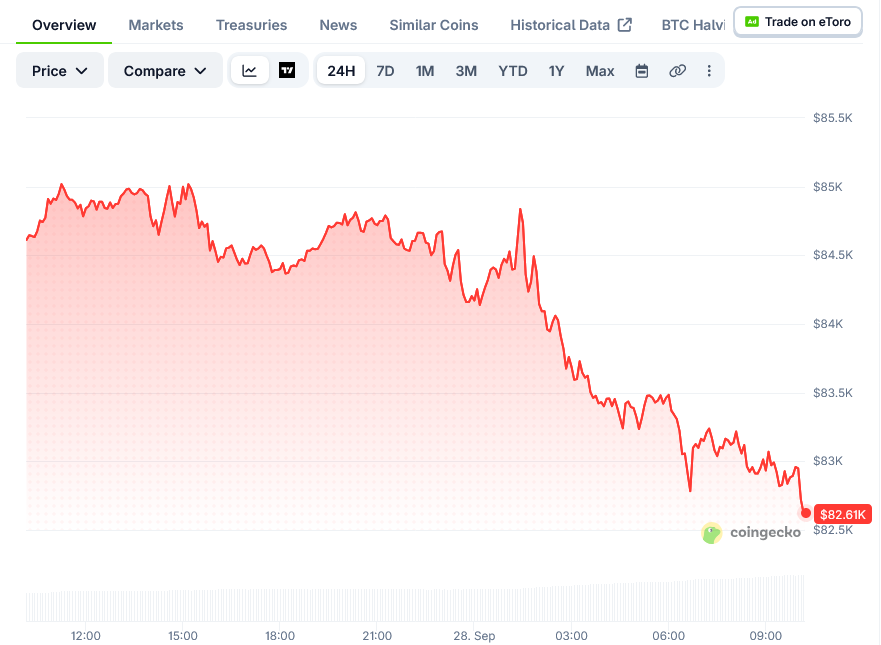
- The cryptocurrency traded as low as $82,705 early in the session before recovering slightly toward the $84,000 level.
What happened
Bitcoin (BTC) fell below the $84,000 mark on September 28, reversing a rally that had pushed it to a seven-day high above $87,000 in the prior week. The cryptocurrency traded as low as $82,705 early in the session before recovering slightly, with market data showing it near $82,600 at the time of reporting, down 2% over the previous 24 hours. The decline coincided with renewed U.S.-Iran geopolitical tensions that reduced appetite for risk assets across global markets.
Why it matters
The drop highlights how sensitive cryptocurrency markets remain to broader macroeconomic and geopolitical risks. Analysts note the pullback follows a sharp four-day rally and a wave of liquidations exceeding $500 million, which clashed with 10-year Treasury yields at their highest level since 2007 and elevated oil prices that keep inflation concerns alive. A potential additional Federal Reserve rate hike remains in play, adding pressure to risk assets. At the same time, U.S. spot Bitcoin ETFs saw $2.39 billion in net inflows during the September 21, 25 trading week, with BlackRock's IBIT accounting for roughly $1.16 billion of that total, indicating sustained institutional demand even during the pullback.
What is still unclear
- The exact share of the Bitcoin drop driven by U.S.-Iran tensions, as opposed to broader macroeconomic factors including rising Treasury yields and high oil prices, is not broken out in available market analysis.
Questions readers ask
Why did Bitcoin drop below $84,000 on September 28?
Bitcoin fell after hitting a seven-day high above $87,000 the prior week, as renewed U.S.-Iran tensions reduced risk appetite. Analysts attribute the move to a risk-off squeeze following a recent rally, profit-taking, and over $500 million in liquidations, compounded by rising Treasury yields and elevated oil prices that stoked inflation concerns.
What are the key support and resistance levels for Bitcoin right now?
Immediate support for Bitcoin sits at $82,222, with additional support levels at $81,236 and the 20-day moving average near $80,691. Resistance is concentrated between $86,000 and $87,000, the range where the cryptocurrency traded before the recent pullback.
Did U.S. spot Bitcoin ETFs see inflows during the recent price drop?
Yes, U.S. spot Bitcoin ETFs recorded $2.39 billion in net inflows during the September 21, 25 trading week, with every session posting positive flows. BlackRock's IBIT accounted for roughly $1.16 billion of that total.