BTC $77,426
 ETH $2,252
 MGLOEURO $111,813
 USDT $0.9995
 BNB $701.62
 XRP $1.25
 USDC $1.00
 SOL $95.72
 TRX $0.3046
 FIGR_HELOC $1.05
Bitcoin · Explained
Bitcoin white paper turns 18 as focus shifts to security funding
The nine-page 2008 proposal has grown into a Wall Street asset and a government reserve, while its fee-based security model remains unresolved.
Key takeaways
- 18 years on. The nine-page paper was published on Oct. 31, 2008, and its anniversary falls on Oct. 31, 2026.
- Institutional reach. Spot ETFs, corporate treasuries, El Salvador's legal-tender law and a U.S. strategic reserve show how far bitcoin has moved from its mailing-list origins.
- Security question. Transaction fees were 0.67% of miner revenue in the 90 days to Oct. 4, 2026, leaving open how security will be funded as issuance declines.
What happened
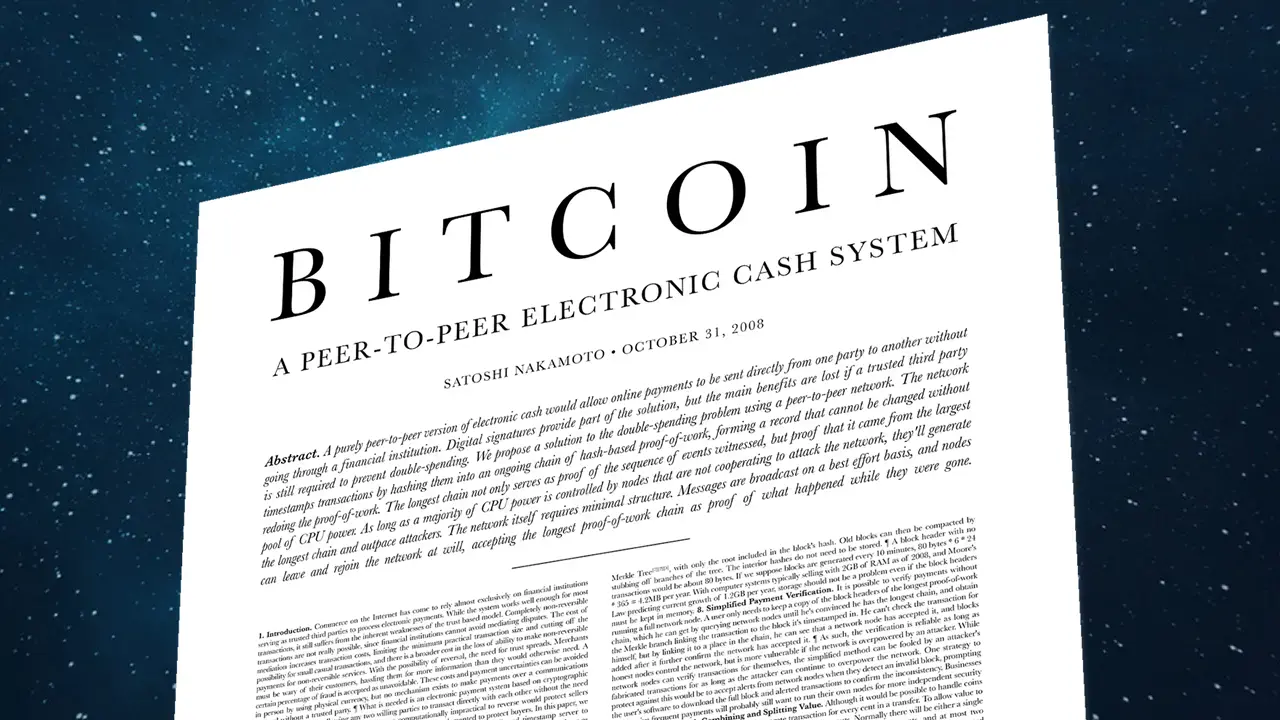
Bitcoin's founding document reaches its 18th anniversary on Oct. 31, 2026. The nine-page paper, "Bitcoin: A Peer-to-Peer Electronic Cash System," was published on Oct. 31, 2008, by an author writing as Satoshi Nakamoto and announced on a cryptography mailing list. It proposed sending digital money without a bank or trusted third party and addressed double-spending through a shared transaction history maintained by a network.
The years since have taken the idea well beyond that mailing list. Bitcoin.com News noted that Wall Street now sells access to bitcoin and Washington has ordered a national reserve. Spot Bitcoin exchange-traded products won SEC approval on Jan. 10, 2024, and Blackrock's iShares Bitcoin Trust reported about $64.7 billion in net assets by Oct. 26, 2026. Strategy, then Microstrategy, announced a $250 million bitcoin purchase in August 2020 and made bitcoin its principal treasury asset. El Salvador made bitcoin legal tender in September 2021; a March 6, 2025, executive order directed a Strategic Bitcoin Reserve, initially using eligible forfeited bitcoin.
The anniversary also highlights an unresolved question. Bitcoinist reported that it has renewed attention on how the network will fund security as new issuance declines. The paper expected transaction fees to replace new coins as miners' compensation, but did not establish how much fee demand would develop.
First $84.8KLatest $77.5K-8.6% over the period
Points are daily observations, not closing prices.
Why it matters
Bitcoin was built to reduce reliance on financial intermediaries, but its institutional adoption has often added them back. A spot fund provides price exposure through an asset manager, broker and custodian, not the control that comes with holding keys. Bitcoin.com News described trust as having shifted toward public rules, software and incentives rather than disappearing. The contrast between a system designed to avoid a middleman and one held in funds and reserves is central to the anniversary.
The security model is the other reason the date matters. Miners spend computing power under proof-of-work and receive block subsidies plus fees. The subsidy halves every 210,000 blocks, so fee revenue becomes more important over time. Cambridge Centre for Alternative Finance research cited by Bitcoinist found fees were 0.67% of miner revenue in the 90 days ending Oct. 4, 2026, and below 5% for most of Bitcoin's history. That does not establish an imminent crisis, but it shows the fee-funded model remains far from replacing issuance.
What the data shows
Cambridge's fee data provides a baseline for the security debate. Fees were 0.67% of miner revenue in the 90 days to Oct. 4, 2026, and stayed under 5% for most of the network's history. The April 2024 Runes protocol launch showed congestion can cause a large fee spike, but short bursts do not necessarily provide predictable income. Difficulty adjustments keep block production steady when computing power changes; they do not add revenue.
Background
The paper's roots predate the crisis that shaped its timing. Lehman Brothers filed for bankruptcy on Sept. 15, 2008, as governments and central banks rescued institutions. Bitcoin's lineage runs through the cypherpunk movement, and the paper cited Wei Dai's b-money, Adam Back's Hashcash and digital-timestamp work by Stuart Haber and W. Scott Stornetta. Nakamoto combined those tools with incentives for agreeing on transaction history.
The first block came on Jan. 3, 2009, with a Times headline embedded: "The Times 03/Jan/2009 Chancellor on brink of second bailout for banks." The first software release was announced on Jan. 8. Hal Finney later recalled receiving 10 bitcoins as a test and reporting bugs. On May 22, 2010, Laszlo Hanyecz reported exchanging 10,000 bitcoins for pizza. Mt Gox shut down in 2014 after thefts, and a 2017 scaling fight produced Bitcoin Cash while Bitcoin adopted Segregated Witness. The white paper did not spell out every rule; the software did.
What is still unclear
Two issues remain unresolved. The paper outlined fee-funded security but did not say whether transaction demand would support it consistently. Bitcoin.com News also noted the risk that quantum computers could break the elliptic curve cryptography protecting bitcoin by deriving private keys from public keys using Shor's algorithm. The reports do not put a timeline on that risk.
What to watch
Watch how fee revenue develops as the block subsidy declines and whether bitcoin gains more everyday payment use. Bitcoinist noted Jack Dorsey argued in April 2025 that bitcoin needs payment utility beyond its store-of-value appeal. Watch the policy split too: El Salvador's legal-tender route and Washington's reserve model treat bitcoin differently. Technical work on quantum resistance is another area to follow.
Questions readers ask
Why is the Bitcoin white paper's anniversary significant?
It marks 18 years since the Oct. 31, 2008, publication of the nine-page proposal that described a peer-to-peer electronic cash system without a trusted third party. The date also highlights how far bitcoin has moved into institutional finance and how its security funding remains unresolved.
What did the white paper say about miner fees?
It anticipated that transaction fees would eventually replace newly issued coins as miners' compensation. It did not establish how much fee demand would develop, and Cambridge data cited by Bitcoinist shows fees remain a small share of miner revenue.
What risks are still discussed?
Bitcoin.com News flagged quantum computing as a risk to the elliptic curve cryptography that protects bitcoin, and both reports note the open question of whether fee revenue can support security as the block subsidy declines.