BTC $80,288
 ETH $2,328
 USDT $0.9991
 BNB $739.57
 XRP $1.29
 USDC $0.9996
 SOL $100.71
 TRX $0.3290
 FIGR_HELOC $1.06
 ZEC $1,204
Hacks & Security · Explained
Electrum patches flaw that turned a fee bump into bitcoin theft
Malicious servers could swap an unconfirmed payment so that a user's later fee increase authorized a transfer to an attacker, developers say.
Key takeaways
- Upgrade required. Every Electrum version before 4.8.3 is affected; users should download the update from electrum.org and verify its signatures.
- Fee bump risk. A routine Replace-by-Fee approval could authorize the substituted transaction rather than the intended payment.
- Limited disclosure. Developers have not said how many servers were involved, how much was taken or whether more victims exist.
What happened
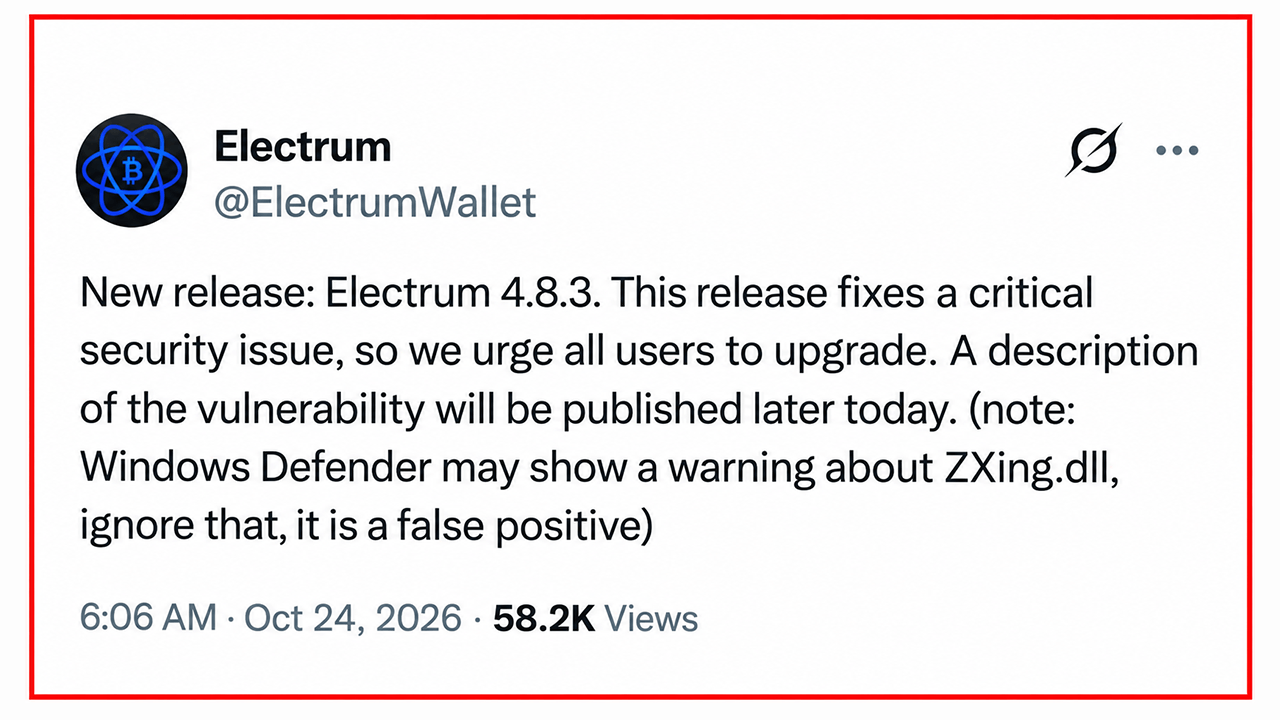
Electrum has released version 4.8.3 to close a high-severity flaw in how earlier versions handled unconfirmed bitcoin transactions. The project's October 24 advisory, documented as GHSA-6jp4-8v48-cc5v and reported by Crypto.news and Bitcoin.com News, says malicious servers exploited the bug in the wild. Electrum is a lightweight wallet that relies on outside servers for wallet history and for broadcasting payments. Older releases verified confirmed transactions but could accept pending transactions from a main server without checking their signatures. An attacker could stop a genuine payment from reaching the Bitcoin network, then present a replacement that sent funds to an attacker-controlled address. The substitute had invalid signatures but appeared as an ordinary pending payment.
The risk arose when a user tried to raise the fee. Bitcoin's Replace-by-Fee feature lets a pending payment be replaced by one paying more. By approving that adjustment, a victim could sign a valid transaction that paid the attacker. Developers received two private reports: dannydeezy on October 11 described a wallet entry that did not match the payment submitted, and Raju-K12 on October 18 reported losing funds after a fee increase. In both cases the attacker's address matched the final four characters of the intended destination. One fraudulent transaction had a zero fee, which developers suspected was intended to prompt a fee bump.
The fix, commit 90fe308, requires Electrum to verify signatures on unconfirmed transactions that spend coins belonging to the wallet. Invalid replacements are rejected before entering local history. The change was incorporated into 4.8.3 on October 23, and binaries were released on October 24. It does not make Electrum a full node: incoming unconfirmed transactions are not covered by the new checks, while confirmed payments continue through existing verification. Developers urged users of older versions to update from the official Electrum website. They said users connected only to trusted or self-hosted servers are not exposed to this particular attack.
First $84.4KLatest $80.3K-4.9% over the period
Points are daily observations, not closing prices.
Why it matters
The case shows a wallet can be abused without its private keys being taken. A user could make the correct initial payment and later be asked to authorize a second transaction under the cover of a fee increase. NewsBTC observed that checking an address once does not authenticate every signing request that follows. It also highlights the trade-off of lightweight wallets: skipping a full node means trusting remote servers for some information, so the client must handle that data carefully. The patch blocks this specific deception but does not remove the need to review each transaction.
What the data shows
The first report involved a two-of-three multisignature wallet using two Trezor devices. Its legitimate transaction contained 31 inputs and one output. Investigators found that all 62 signatures were valid for the original payment but invalid for the substitute. The fake transaction sent nearly all the bitcoin to a lookalike address and returned a small amount to the wallet. The original transaction remained valid but had never reached the public Bitcoin network. The disclosure gives no total loss figure, no count of participating servers and does not say whether more victims have been identified.
Background
Electrum has encountered malicious-server attacks before. Crypto.news reported in December 2018 that hostile servers displayed fake software-update instructions, and a 2019 campaign used bogus wallet updates and denial-of-service activity to steer users toward compromised software. Those efforts relied on deceptive downloads, whereas the newly patched flaw manipulated pending transaction data inside a legitimate wallet. A 2020 interview about Electrum servers examined lightweight-wallet trade-offs, and Electrum's documentation says the client usually connects to about 10 servers but selects one main server for wallet history and broadcasting.
What to watch
Users who have not upgraded should obtain 4.8.3 only from electrum.org and verify the release signatures, Bitcoin.com News and NewsBTC reported. Until then, developers recommend checking the full destination address and amount before signing, including during a fee replacement. An unexplained pending transaction should not be treated as proof that a recipient was paid; the priority is to establish what was actually broadcast and authorized. Updating cannot reverse a transfer already confirmed to the wrong recipient.
Questions readers ask
Which Electrum versions are affected?
Every version before 4.8.3, according to the developers. The project advises downloading the update from electrum.org and verifying its signatures.
How did attackers turn a fee increase into theft?
A malicious server could withhold a genuine unconfirmed payment and show a replacement with an attacker's address. The replacement had invalid signatures but older Electrum versions displayed it; approving a fee increase could then sign a valid transaction paying the attacker.
Does the patch cover every unconfirmed transaction?
No. The new checks apply to unconfirmed transactions that spend coins from the user's wallet. Incoming unconfirmed transactions remain outside those checks, and confirmed payments keep existing verification.