BTC $75,957
 ETH $2,244
 MGLOEURO $111,813
 USDT $0.9991
 BNB $694.37
 XRP $1.16
 USDC $0.9997
 SOL $90.07
 TRX $0.3181
 FIGR_HELOC $1.02
Bitcoin · Explained
Moscow Exchange to start bitcoin trading pilot on Dec. 1
Russia's largest exchange plans a pilot market for bitcoin, ether and USDT using its stock-market and clearing systems.
Key takeaways
- Pilot launch. Moscow Exchange plans to open a Dec. 1 pilot for bitcoin, ether and USDT on its existing stock-market and clearing infrastructure.
- Retail limits. Non-qualified investors must pass a test and are capped at 300,000 rubles a year through each intermediary; qualified investors face no cap.
- Sanctions question. Moscow Exchange and its clearing arm are under U.S. sanctions, and the treatment of USDT held through the clearing structure remains publicly unresolved.
What happened
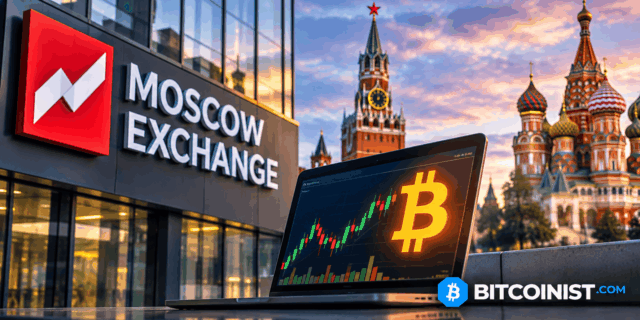
Moscow Exchange said in a Nov. 2 release that it will open a pilot digital-currency market on Dec. 1, with bitcoin, ether and Tether's USDT available from the start. The Russian venue, the country's largest trading platform, described the project as its first organized market for digital currencies. It said participants will be onboarded as they are ready and that existing members, their clients and businesses already using digital currencies have shown interest.
The market will run on the exchange's existing stock-market technology and keep stock-market hours, 6:50 a.m. to 11:50 p.m. Moscow time, the exchange told Vedomosti. The National Clearing Centre, its clearing arm, will handle clearing. From the first day, clients will be able to settle same day or next day, and swaps will be offered for liquidity management. Custody will be provided through partner digital depositaries, a new entity type under Russian rules. BTC, ETH and USDT will trade in addressed and addressless modes, and the exchange plans to add Russian and international instruments over time.
Access will be tiered. Non-qualified investors must pass a test and may buy no more than 300,000 rubles of digital currency a year through a single broker, about $3,700, according to Bitcoin Magazine. Qualified investors face no cap. The Bank of Russia said on Nov. 6 that its final asset rules take effect Nov. 17 and permit exchanges to list bitcoin, ether and USDT; it said testing and risk familiarization apply to both investor groups. The central bank's list was based on market capitalization, average daily volume and at least five years of foreign-market pricing history. CryptoSlate noted that Dec. 1 is Moscow Exchange's gradual pilot start, not a universal retail launch.
First $81.7KLatest $75.8K-7.2% over the period
Points are daily observations, not closing prices.
Why it matters
Placing bitcoin on the same platform Russians use for major equities could lower operational barriers for banks and brokerages. Brokers can connect as they do for stocks, trades can net through the same clearing system, and investor classifications carry over from the equity market, according to Bitcoin Magazine. That structure may let financial firms offer crypto without building separate custody and matching systems.
The project also fits a policy goal of moving activity that Russians already conduct on offshore exchanges and peer-to-peer desks onto domestic supervised rails where the state can see and tax it. Moscow is betting that a familiar exchange tied to existing brokers can pull that volume back. At the same time, purchase caps, testing and sanctions mean the launch is not unrestricted adoption. Bitcoinist noted that infrastructure alone does not create demand; volumes, participation and liquidity will determine whether the venue becomes important.
What the data shows
Moscow Exchange published its plan on Nov. 2. The Bank of Russia announced final asset rules on Nov. 6, effective Nov. 17. The exchange's pilot begins Dec. 1. Trading hours are 6:50 a.m. to 11:50 p.m. Moscow time. The non-qualified cap is 300,000 rubles per calendar year through each intermediary, which Bitcoin Magazine approximated at $3,700. The U.S. Treasury sanctioned Moscow Exchange and the National Clearing Centre in June 2024. The main provisions of 282-FZ took effect Sept. 1, and an intermediary-entry procedure took effect Oct. 5 without finalizing retail asset eligibility, CryptoSlate reported.
Background
Russia's framework rests on Federal Law No. 282-FZ, whose main provisions took effect Sept. 1. The law still prohibits using crypto for domestic payments, though importers and exporters may use it to settle cross-border trade. Russian officials have spent the past year building the supporting system: lawmakers gave securities regulators oversight of crypto last month, and the central bank licensed Sberbank for crypto work weeks earlier, according to Bitcoin Magazine.
Sanctions complicate the picture. Treasury blocked Moscow Exchange and the National Clearing Centre in June 2024 as part of measures against Russia's financial system over the war in Ukraine. That makes the clearing house that would hold customers' USDT a sanctioned entity. Tether routinely freezes wallets tied to addresses on the Treasury's sanctions list, raising questions about how the stablecoin issuer would treat USDT held through the Moscow clearing structure. Neither the exchange nor Tether has publicly addressed the issue, Bitcoin Magazine reported. The choice of USDT, a dollar-pegged token, is also notable for a market partly intended to operate outside the dollar system; bitcoin and ether have no issuer that can freeze balances.
What is still unclear
Several questions remain open. It is not clear whether the testing requirement and annual caps will push retail traders to stay offshore, or whether foreign liquidity will use a sanctioned venue at all. The treatment of USDT held through the National Clearing Centre is unresolved publicly. CryptoSlate also noted that the sources did not date when testing would become available. The exchange has said the instrument list will grow, but it has not specified a timetable in the reports.
What to watch
Three indicators will show whether the launch matters in practice: how many brokers join the platform, how much liquidity is available when trading begins, and how much interest qualified investors show, Bitcoinist reported. The pace of pilot onboarding and any expansion of the instrument list will also be worth tracking. For now, the Dec. 1 opening is a pilot with a modest retail ceiling, not a full retail rollout.
Questions readers ask
When will Moscow Exchange start crypto trading?
Moscow Exchange plans to begin a gradual pilot on Dec. 1, with bitcoin, ether and USDT as the first instruments. Participants will join as they are ready, and the exchange says the list will expand over time.
What limits apply to non-qualified investors?
Non-qualified investors must pass a test and may purchase no more than 300,000 rubles of digital currency per year through each intermediary. Qualified investors face no purchase cap but must still complete testing and risk familiarization, according to the Bank of Russia.
Can crypto be used for payments in Russia?
Federal Law No. 282-FZ still bans using crypto for domestic payments. Importers and exporters may use it to settle cross-border trade.