BTC $78,282
 ETH $2,317
 MGLOEURO $111,813
 USDT $0.9990
 BNB $700.08
 XRP $1.28
 USDC $0.9995
 SOL $92.84
 TRX $0.3188
 FIGR_HELOC $1.03
Markets · Explained
Bitcoin rebounds from $76K as ETF outflows and liquidations weigh on market
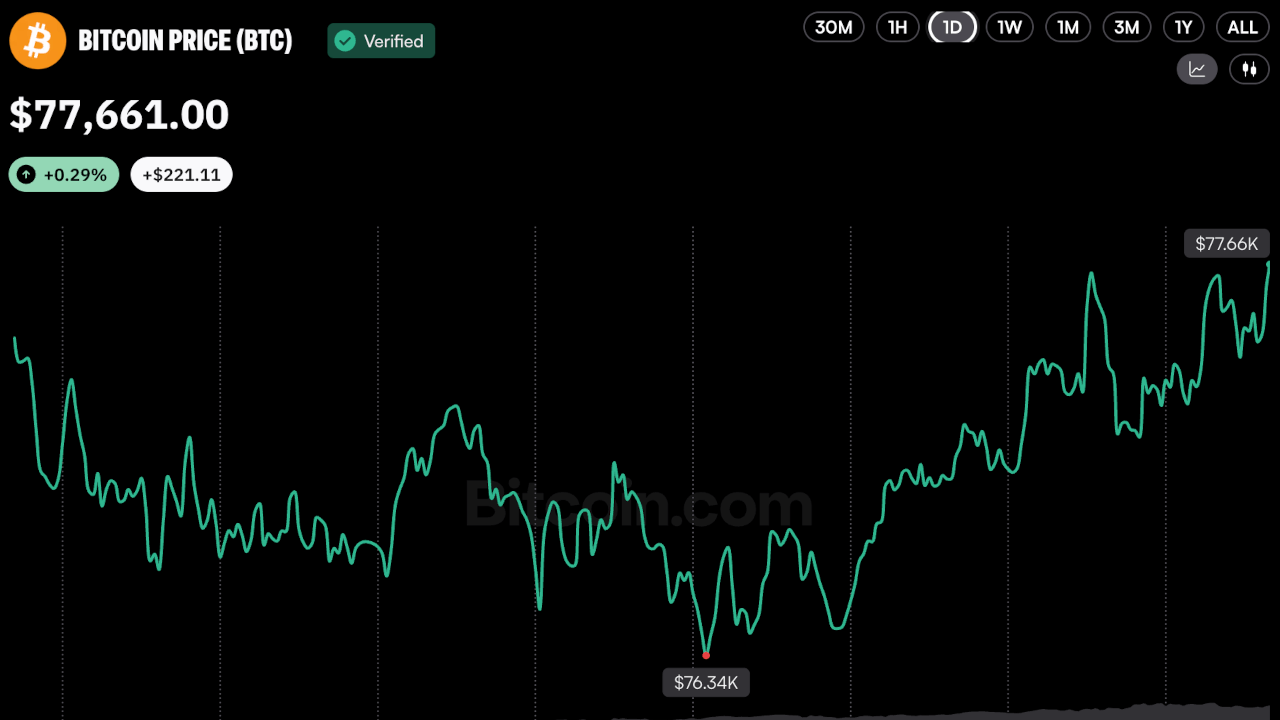
Bitcoin recovered above $77,700 after an intraday slide to $76,268, as spot ETF withdrawals and a post-hack sell-off tested demand.
Key takeaways
- ETF outflows. US spot Bitcoin ETFs lost about $1.16 billion across the three trading sessions ending Nov. 3, according to Farside Investors.
- Liquidations climb. Bitcoin liquidations rose from about $69 million to $96 million, with long positions accounting for roughly $76.5 million.
- Election uncertainty. Democrats' midterm gains raised questions about the legislative path for crypto market-structure rules.
What happened
Bitcoin traded erratically on Tuesday, sliding from above $78,000 to an intraday low of $76,268 before a relief rally lifted it back above $77,700, according to Bitcoin.com News. The move came as investors weighed the aftermath of a major exchange hack and the outcome of US midterm elections.
The recovery lost some momentum after the initial bounce, with the price easing back toward $77,200 before trading near $77,660, up about 0.3% over the prior 24 hours, Bitcoin.com News reported. The session followed a day in which US spot bitcoin ETFs recorded roughly $400 million in net outflows.
Derivatives markets reflected the turbulence. Bitcoin liquidations climbed from about $69 million roughly 24 hours earlier to $96 million, with long positions accounting for about $76.5 million, according to Bitcoin.com News. Liquidations across the wider crypto market exceeded $365 million, including $286 million in long positions.
CryptoSlate reported that bitcoin briefly fell below $76,000 as election results emerged before recovering above $78,000 on Wednesday, after Democrats won both chambers of Congress. The Democratic victories in Tuesday's midterms dealt President Donald Trump a political setback.
First $85.8KLatest $78.2K-8.8% over the period
Points are daily observations, not closing prices.
Why it matters
The price swings highlight how bitcoin is being pulled between political expectations and concrete flows from exchange-traded funds. CryptoSlate reported that US spot Bitcoin ETFs lost $1,157 million over the three trading sessions ending Nov. 3, based on Farside Investors data. The withdrawals began with $643 million on Oct. 30, followed by $399 million on Nov. 2 and $116 million on election day, with BlackRock's IBIT accounting for $95 million of the Nov. 3 redemptions.
Those outflows add to selling pressure from existing holders, many of whom bought at higher prices. Glassnode estimated in its Oct. 28 market report that about 4 million BTC held by long-term investors last moved between $85,000 and $118,000, meaning some of those holders could look to recover their initial investments as prices approach those levels. Glassnode identified $84,000-$85,000 as a difficult resistance zone that has repeatedly rejected rallies through 2026.
The election result also matters for regulation. Bitunix analysts warned that Democratic control could reshape Washington's approach to crypto oversight, potentially shifting congressional priorities from advancing industry legislation toward investigations of conflicts of interest, exchange oversight and broader financial risks. The industry's flagship market-structure bill, the CLARITY Act, had already stalled: on Sept. 15 the Senate rejected a procedural motion to advance it by 49 votes to 50, short of the 60 needed.
What the data shows
A pre-election Bloomberg survey cited by CryptoSlate found a median year-end bitcoin forecast of $76,450 under a Democratic sweep, compared with $84,100 under divided congressional control and $90,800 if Republicans had retained both chambers. Ryan Kirkley, co-founder and CEO of Global Settlement Network, argued before the vote that bitcoin could recover toward $85,000-$90,000 regardless of the outcome, provided ETF flows stabilized, liquidity improved and confidence returned to the broader economy.
On the technical side, Glassnode estimated the aggregate cost basis of US spot Bitcoin ETF holdings at approximately $81,500 in its October report, a level bitcoin would need to reclaim before testing the $84,000-$85,000 resistance zone. Glassnode placed the short-term holder cost basis near $75,800. In its Nov. 3 outlook, 21Shares identified a support area around $75,800-$76,200, with the 200-day moving average near $73,000 below it.
Background
The volatility followed a sharp deterioration in crypto social sentiment. According to blockchain analytics firm Santiment, bitcoin's bullish-to-bearish social commentary ratio fell from about 1.8 on Oct. 20 to 0.51 as Democrats moved toward control of Congress. The decline accelerated after Binance suffered a security breach in late October, when the ratio briefly collapsed to 0.37 before recovering for several days. Santiment attributed the renewed pessimism to perceptions that Republicans are more supportive of crypto, though it suggested extreme pessimism could set up a contrarian recovery.
Binance has said it fully replenished assets lost in the hack, which Bitcoin.com News described as the largest in crypto exchange history, with $6.3 billion taken from platform wallets. CryptoSlate put the breach at roughly $6 billion. Beyond politics and exchange security, Bitcoin.com News noted that reports of renewed military exchanges between US and Iranian forces added to cautious sentiment, raising concerns about energy supplies, oil prices and inflation.
What is still unclear
Whether investors are pricing longer-term technological risks into bitcoin remains an open question. Swapspace CEO Evan Ceolini told Bitcoin.com News that Google's Quantum AI Willow demonstration did not establish an immediate threat to bitcoin's security, but that growing institutional awareness of quantum risk does not mean it is fully reflected in spot prices. He said there is no clear evidence of a specific, measurable discount for governance or upgrade risk, describing it as a recognized but difficult-to-quantify long-term risk.
What to watch
The next test will come from ETF flows after the election, particularly whether investors reverse three consecutive sessions of withdrawals or keep selling as bitcoin attempts to reclaim $80,000. CryptoSlate noted that a sustained move above $87,500, accompanied by repeated ETF inflows and rising trading volumes, would offer stronger evidence that buyers can absorb the supply waiting overhead. Bitunix also pointed to declining Treasury yields and a weaker US dollar after the election as potential support for risk assets, while noting the new Congress does not take office until January 2027.
Questions readers ask
How far did bitcoin fall before rebounding?
Bitcoin slid to an intraday low of $76,268 on Tuesday before recovering above $77,700, according to Bitcoin.com News. CryptoSlate reported it briefly fell below $76,000 as election results emerged before recovering above $78,000 on Wednesday.
How much did US spot bitcoin ETFs lose?
Farside Investors data cited by CryptoSlate showed about $1,157 million in net withdrawals across the three trading sessions ending Nov. 3.
What drove the liquidations?
Bitcoin liquidations rose to $96 million from about $69 million, with long positions accounting for about $76.5 million, as volatility tied to the Binance hack fallout and US midterm elections hit derivatives markets.