BTC $74,433
 EQQQQ $655.75 Last updated 8 Nov 2026, 12:03 UTC
 ETH $2,089
 MGLOEURO $111,813
 USDT $0.9992
 BNB $687.08
 USDC $0.9996
 XRP $1.07
 SOL $85.25
 TRX $0.3163
Bitcoin · Explained
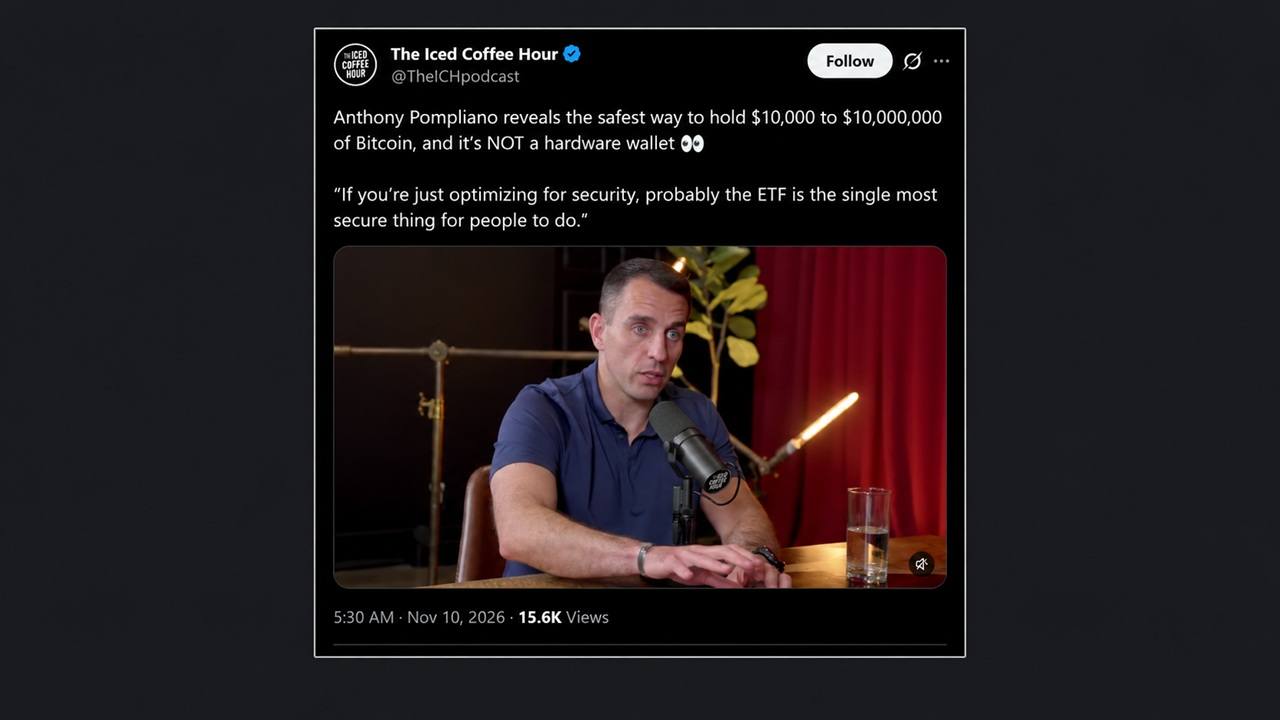
Pompliano calls spot bitcoin ETF safest for $10,000-$10 million BTC holders
The investor says an ETF is the most secure option for holders of $10,000 to $10 million in BTC, as hardware-wallet firms report security problems.
Key takeaways
- Security trade-off. Pompliano frames the ETF as protection against lost keys, phishing and counterfeit devices, not as a way to preserve direct ownership.
- Hardware wallet woes. Trezor, Keystone and Foundation have disclosed device, verification-key or customer-data problems in the past month, according to Bitcoin.com News.
- Custody risk remains. ETF holders rely on custodians; OneKey's Yishi Wang flagged BlackRock's IBIT and Coinbase concentration after Binance's $6.3 billion hack.
What happened
Anthony Pompliano has argued that a spot bitcoin exchange-traded fund can be the safest place for investors holding between $10,000 and $10 million in BTC. In remarks reported by Bitcoin.com News and ZyCrypto, the investor and podcast host was asked how someone with a meaningful bitcoin position should store it. He pointed away from the cold-storage devices favored by many bitcoiners and said that, when security is the priority, "the ETF is the single most secure thing" for such holders.
The difference is custody. A self-custody wallet leaves private keys with the owner; an ETF gives those keys to a regulated custodian and gives the investor a brokerage position. ZyCrypto reported that Pompliano described ETFs as a simple, regulated route through existing brokerage accounts that stresses regulatory safeguards and market integrity. It also said he called them the most secure and convenient choice for that holdings range, while noting that ETF exposure is indirect and offers less control than direct ownership.
His comments landed during a rough stretch for hardware-wallet companies. Bitcoin.com News reported that Trezor warned customers about a malicious hardware implant in a Safe 5 device bought from a former reseller, a case tied to a $93 million Ledger security scandal involving the same distributor. Keystone said it would destroy 18,835 wallets after attackers stole the key used to verify its devices as genuine, and Foundation disclosed a customer data breach. The report also cited investor Evan Luthra's account of five masked men forcing their way into his car in Oxford, assaulting him and taking more than $2 million in crypto in about 30 minutes.
First $81.8KLatest $73.9K-9.6% over the period
Points are daily observations, not closing prices.
Why it matters
The remarks challenge bitcoin's self-custody ethos, which holds that control of private keys is central to ownership. Pompliano's argument is narrower: for a holder worried about loss, an ETF may remove failure points such as lost seed phrases, phishing links and fake devices. The trade-off is that ETF investors rely on a custodian and can face counterparty and market-hours risk. The reports also cite Peter Schiff's October warning that ETF investors could not sell until markets reopened during a weekend slide. Self-custody advocates focus on control, warning that bitcoin held through a broker can be frozen, delayed or restricted.
What the data shows
Several numbers frame the debate: the $10,000 to $10 million holding range, the $93 million Ledger-linked scandal, Keystone's 18,835 wallets, Binance's $6.3 billion hack, IBIT's roughly 815,000 BTC, Coinbase's 99% cold-storage claim and more than $2 million taken from Luthra. Bitcoin.com News also reported $1.28 billion in outflows from U.S. spot bitcoin ETFs last week, the biggest weekly outflow in roughly four months.
Background
Hardware wallets became the default answer for bitcoiners seeking to avoid exchange risk, but recent disclosures have complicated that story. ETF custody has concentration questions of its own. Bitcoin.com News reported that, after Binance's $6.3 billion hack, OneKey founder Yishi Wang warned North Korean hackers could target BlackRock's iShares Bitcoin Trust next. He noted the fund held about 815,000 BTC with Coinbase as sole custodian, calling it a single point of failure. Coinbase said more than 99% of customer assets are in cold storage and its institutional custody vault runs offline.
What to watch
Watch for further hardware-wallet disclosures and any new details on physical-security cases tied to leaked buyer data. Custody concentration at IBIT and Coinbase will remain a focus, as will flows into and out of U.S. spot bitcoin funds.
Questions readers ask
Did Pompliano say ETFs are safer than hardware wallets?
He said that if the goal is security, a spot bitcoin ETF is probably the single most secure option for people holding $10,000 to $10 million in BTC. The reports frame his view as prioritizing protection from loss over direct control.
What risks do bitcoin ETFs carry?
ETF investors do not hold the private keys or the underlying bitcoin. They depend on a custodian, cannot move the bitcoin onchain or use it for payments, and can trade only when markets are open. The reports also raise custody concentration concerns around IBIT and Coinbase.
Why is this debate controversial?
It conflicts with bitcoin's long-standing self-custody principle that control of private keys is essential to ownership. Hardware-wallet incidents show risks in self-custody, while ETF critics point to custodian, counterparty and market-hours risks.