BTC $79,824
 ETH $2,313
 MGLOEURO $111,813
 USDT $0.9986
 BNB $738.68
 XRP $1.30
 USDC $0.9993
 SOL $99.96
 TRX $0.3276
 FIGR_HELOC $1.02
Bitcoin · Explained
Santiment says 30,000 bitcoin wallets vanished, possibly signaling bottom
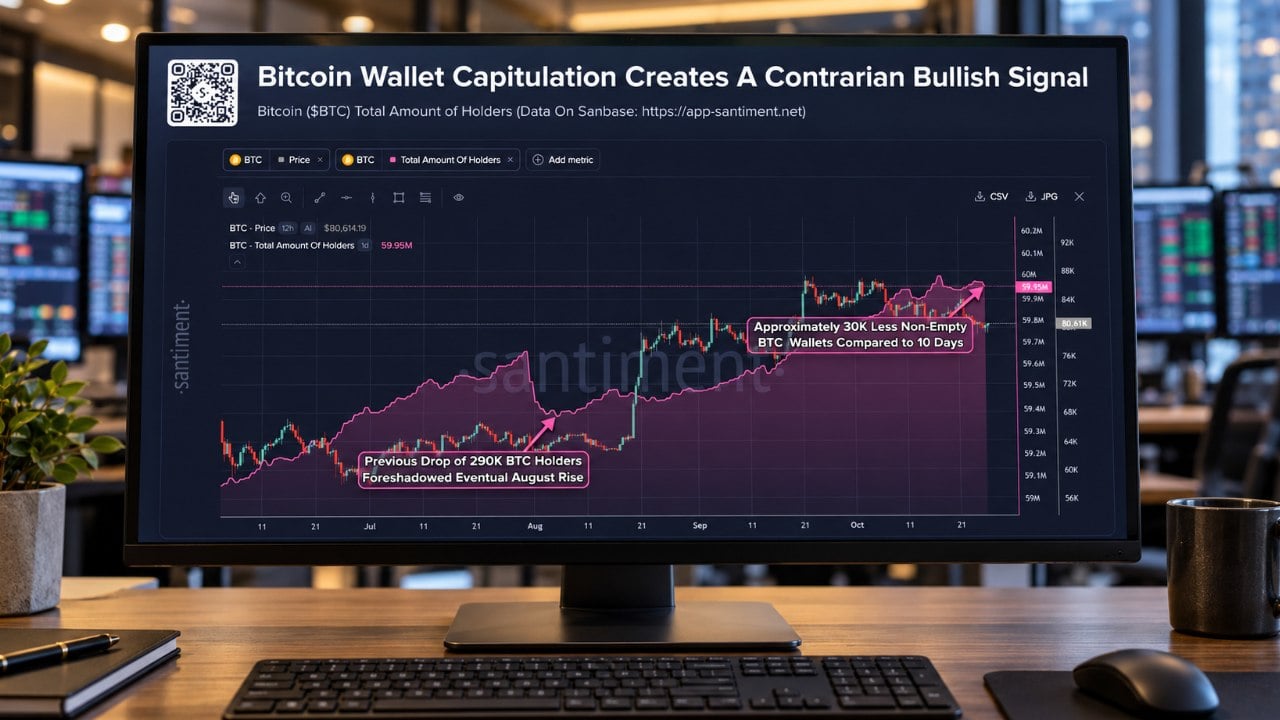
Santiment links a 30,000 drop in nonempty bitcoin wallets since Oct. 16 to retail capitulation, but price confirmation at $80,000 is still needed.
Key takeaways
- Wallet retreat. Nonempty bitcoin wallets fell by about 30,000 in the period from Oct. 16 to Oct. 26, according to Santiment.
- Confirmation levels. Santiment ties a stronger bottom case to holding $80,000 and reclaiming about $82,500; a sustained break below $79,000 would delay it.
- Mixed demand. Spot bitcoin ETFs saw Monday inflows but remained negative for October, while corporate buyers were active.
What happened
Santiment said on Oct. 26 that the number of nonempty bitcoin wallets has fallen by roughly 30,000 since Oct. 16, taking the total to about 59.95 million. The decline followed weeks in which bitcoin's price moved within a narrow range and struggled to regain momentum near $80,000, according to reports from Bitcoin.com News and CryptoPotato. Santiment described the drop as possible retail capitulation, meaning smaller holders may be giving up and selling during weakness.
The analytics firm treats such departures as a contrarian signal. In its view, widespread pessimism among small holders can be more constructive for prices than a rush of buyers chasing a rally. Santiment pointed to an earlier contraction in smaller-holder groups that came before bitcoin recovered above $85,000. In September, it identified 69,494 addresses leaving two balance groups during July and August: wallets holding 0.1 to 1 BTC and wallets holding 1 to 10 BTC.
The latest assessment lands as bitcoin trades near a closely watched level. Bitcoin.com News reported that by Oct. 24, bitcoin had fallen below its 50-day moving average after roughly two months in which that indicator acted as support. Separately, CryptoQuant contributor Darkfost noted in an Oct. 21 assessment that the Bull Score Index had declined from 80 to 60. That index combines 10 measures, including demand, network activity, liquidity and profitability.
First $84.4KLatest $79.4K-5.9% over the period
Points are daily observations, not closing prices.
Why it matters
Wallet counts are being watched because they can offer a read on retail behavior when price action is weak. Santiment's interpretation is that an exodus of small wallets may mark a local bottom, but the firm also frames the signal as one that needs price confirmation. It said bitcoin must hold $80,000 and reclaim roughly $82,500 to strengthen the contrarian case. A sustained break below the recent $79,000 area would delay that setup and suggest capitulation may still have further to run. CryptoPotato reported that analyst Doctor Profit has described the $80,000 to $81,500 range as a major support zone tied to average entry prices of bitcoin treasury companies and spot ETF investors.
What the data shows
Beyond the wallet count, the reports included several market data points. U.S. spot bitcoin ETFs began the week with $110.34 million in inflows on Monday, but October flows remained negative at more than $200 million in net outflows, according to CryptoPotato. On the corporate side, Strategy did not add bitcoin and instead increased STRC repurchases, while Strive bought 6,182 BTC for $511.4 million and now holds about 43,000 BTC. The Smarter Web Company added another 20 units, bringing its treasury to 2,850 BTC.
Background
Earlier Santiment updates showed why the wallet data can be ambiguous. In early October, the firm said wallets holding 10 to 10,000 BTC had added more than 85,000 BTC over about three weeks, while wallets holding less than 0.01 BTC kept increasing. At the time, Santiment viewed that small-holder accumulation as an obstacle to a stronger recovery. CryptoPotato also reported that Doctor Profit sees the recent downturn as a correction rather than the start of a new bear market, and that longer-term investors who bought between $60,000 and $70,000 appear reluctant to exit while short-term holders sell. Not all analysts share the bottom view. Ali Martinez flagged a historical pattern in which bitcoin lost value in the fourth quarter of the last three U.S. midterm election years: 16.7% in 2014, 42.16% in 2018 and 14.75% in 2022. He said a repeat in 2026 could mean more downside before the year ends.
What is still unclear
The wallet metric carries important limits. Address balances change when coins move, so funded addresses are not the same as individual investors. One person can control multiple addresses, an emptied address can receive funds again, and coins can be consolidated or moved outside the tracked balance ranges. Those factors mean the 30,000 decline may reflect selling, consolidation or other address management rather than a clean count of investors leaving.
What to watch
Traders will watch whether the wallet decline continues while bitcoin holds $80,000 and whether it reclaims about $82,500. A sustained move below $79,000 would undercut the bottom thesis, according to Santiment's framework. ETF flows and corporate purchases may also matter, given the mixed demand picture in October. The historical fourth-quarter pattern highlighted by Martinez adds another point of uncertainty for the final months of 2026.
Questions readers ask
What did Santiment say about bitcoin wallets?
Santiment said nonempty wallets fell by roughly 30,000 since Oct. 16 to about 59.95 million, which it viewed as possible retail capitulation.
What price levels matter for the bottom signal?
Santiment said holding $80,000 and reclaiming about $82,500 would strengthen the case; a sustained break below $79,000 would delay it.
Does fewer wallets mean fewer investors?
Not necessarily. Addresses can be controlled by the same person, emptied and reused, or changed by consolidation, so wallet counts are not a direct measure of investor numbers.