BTC $74,419
 EQQQQ $655.75 Last updated 8 Nov 2026, 12:03 UTC
 ETH $2,073
 MGLOEURO $111,813
 USDT $0.9992
 BNB $685.46
 USDC $0.9996
 XRP $1.06
 SOL $84.62
 TRX $0.3174
Markets · Explained
Glassnode says bitcoin is 'running on empty' as capital exits
The analytics firm says recent buyers are underwater, stablecoin and ETF flows are negative, and US demand is weak, while some large wallets accumulate.
Key takeaways
- Underwater buyers. About 35% of short-term holder coins are in profit, and roughly two-thirds of those coins were bought above the current price in bands reaching $83,600.
- Capital outflows. Stablecoin supply fell $14.2 billion in 30 days, US spot bitcoin ETFs lost $1.6 billion over 20 sessions, and the Coinbase Premium stayed negative.
- Mixed signals. Long liquidation levels near price have been cleared and bids outweigh asks, but open interest rebuilt during the decline and only two wallet cohorts are accumulating.
What happened
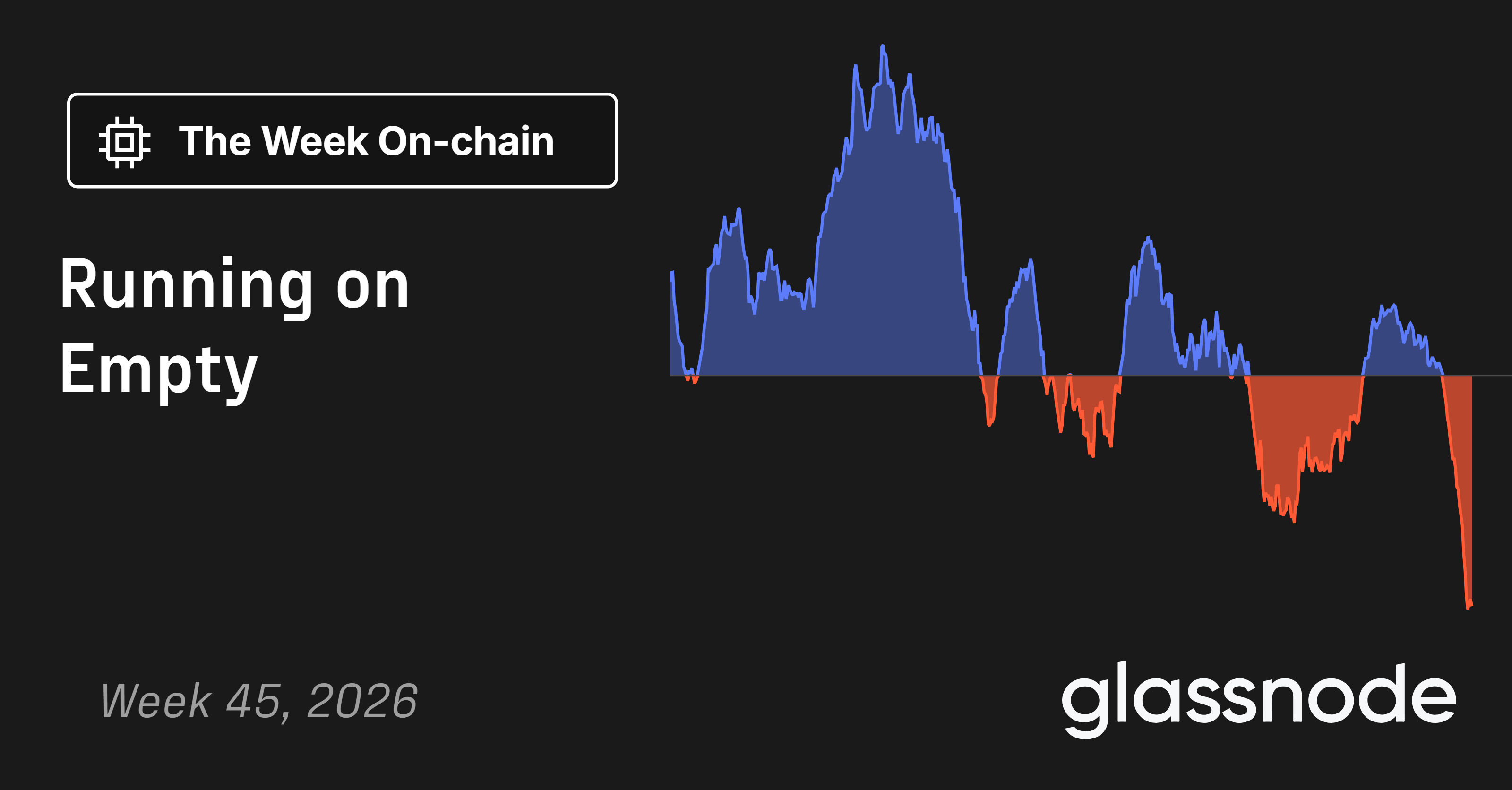
Glassnode's Nov. 11, 2026, report, titled "Running on Empty," said bitcoin had slipped into the $73,000, $76,000 band it flagged a week earlier and traded near $74,000. That put it below the short-term holder cost basis of $75,600, the average price paid by investors who bought within the past 155 days. At September's high, nearly all of those coins were in profit; now about 35% are, and sellers are generally taking small losses.
The cost basis distribution shows where recent buyers entered. About two-thirds of short-term holder coins sit above the current price in three bands bought between August and October, up to $83,600, and Glassnode said many holders may exit at breakeven on a rally. Below the market, the only dense block is between $62,000 and $66,000, acquired around the August low. September's high was the first higher high since the 2025 all-time high, and price remains above the June low of $58,500. Reclaiming the True Market Mean at $77,500 would put about half of short-term holder coins back in profit.
Glassnode also pointed to capital leaving. Stablecoin supply fell $14.2 billion over 30 days, the fastest contraction since June 2022, and Tether traded slightly below $1. US spot bitcoin ETFs saw $1.6 billion in net outflows over 20 sessions, crossing the $1.5 billion mark Glassnode uses to define an outflow stretch on Nov. 9. The Coinbase Premium stayed negative on a 30-day average through the slide and was the deepest discount since February after stripping out Tether's effect. Bitcoin has trailed stocks since Nov. 9; it fell after the Nov. 10 CPI release and was still down about 5%, while the S&P 500 and Nasdaq 100 recovered above election-day closes. A move above its election-day close of $77,800 would bring it back in line.
Bitcoin.com News reported that the assessment came alongside defensive options activity and cautious prediction-market probabilities, describing an uncertain market rather than an inevitable collapse.
First $81.8KLatest $74.5K-8.9% over the period
Points are daily observations, not closing prices.
Why it matters
The report frames the recovery problem as one of liquidity and demand, not just price. Overhead supply from recent buyers can limit rallies, while shrinking stablecoin balances and ETF redemptions reduce available capital. The negative Coinbase Premium indicates US buyers are not paying up. Still, Glassnode noted counterweights: most long liquidation levels near price have been cleared, resting bids within 5% of price outweigh asks, and two wallet cohorts have resumed accumulation.
What the data shows
Bitcoin.com News cited Coinglass figures showing bitcoin options open interest at 439,966 BTC, about $33 billion, with calls at 55.72% and puts at 44.28%, a put-to-call ratio of 0.79. In 24-hour volume of 45,210 BTC, puts were 50.32% and calls 49.68%, with activity concentrated in Nov. 12, 13 contracts struck between $72,000 and $75,500. Deribit's largest open contracts included a Nov. 13 $81,000 call at 8,305.9 BTC and a Dec. 25 $80,000 call at 8,113.9 BTC. Polymarket's November bitcoin price market, with $5.17 million in volume, assigned a 91% probability to touching $75,000 and 1% to $100,000; Kalshi's November maximum-price market gave 19% to exceeding $82,500. Bitcoin.com News noted that the contracts settle differently.
Background
Glassnode had identified the $73,000, $76,000 range as the level to watch the previous week. It said most of bitcoin's midterm decline occurred before the vote, and the sell-off beginning Nov. 5 hit stocks and bitcoin together. Since Nov. 9, equities recovered while bitcoin did not. The report compared the rates gap with 2022, when the two-year yield gap over the Fed rate peaked at 244 basis points.
What is still unclear
Whether the accumulation is durable is unclear. Glassnode said the 100, 1,000 BTC and 1,000, 10,000 BTC cohorts also bought in late September and the move did not last, while every other cohort is still reducing holdings. Resting bids can also be pulled, the firm noted.
What to watch
Glassnode listed several signs that would show demand returning: the 30-day stablecoin change turning back to growth, ETF inflows resuming, and the Coinbase Premium turning positive and holding for weeks. It also said smaller wallet cohorts joining the two larger buyers would show a broader return. Technical markers include $75,600, $77,500 and $77,800 above the market, and the June low at $58,500 below it.
Questions readers ask
What does Glassnode mean by short-term holder cost basis?
It is the average price paid by investors who bought bitcoin within the past 155 days; Glassnode put it at $75,600, above the market at the time of the report.
Why is stablecoin supply relevant?
Glassnode describes stablecoins as the cash of the crypto market; a shrinking supply means holders are redeeming for dollars, leaving less capital on hand for purchases.
What did derivatives and prediction markets show?
Bitcoin.com News reported that 24-hour options volume leaned slightly toward puts, while open interest remained call-heavy. Polymarket and Kalshi markets assigned low odds to large near-term upside moves.