BTC $74,000
 EQQQQ $655.75 Last updated 8 Nov 2026, 12:03 UTC
 ETH $2,056
 MGLOEURO $111,813
 USDT $0.9993
 BNB $680.95
 USDC $0.9997
 XRP $1.06
 SOL $83.83
 TRX $0.3172
ETFs · Explained
Bitcoin ETFs post $1.1 billion 2026 outflows after $25 billion inflow year
US spot bitcoin funds have swung from roughly $25 billion of inflows in 2025 to more than $1.1 billion of net withdrawals in 2026, with BlackRock's IBIT leading
Key takeaways
- Annual reversal. 2026 net outflows top $1.1 billion after the funds were up $1.43 billion for the year three weeks earlier and after about $25 billion of inflows by early November in 2024 and 2025.
- IBIT drag. BlackRock's IBIT logged seven consecutive outflow days since Oct. 30 totaling $1.66 billion; outside IBIT, other US spot bitcoin ETFs lost $3.8 billion this year.
- Rate link. Reports tied the selling to changed rate expectations after a CPI surprise and a Goldman Sachs forecast of two quarter-point hikes.
What happened
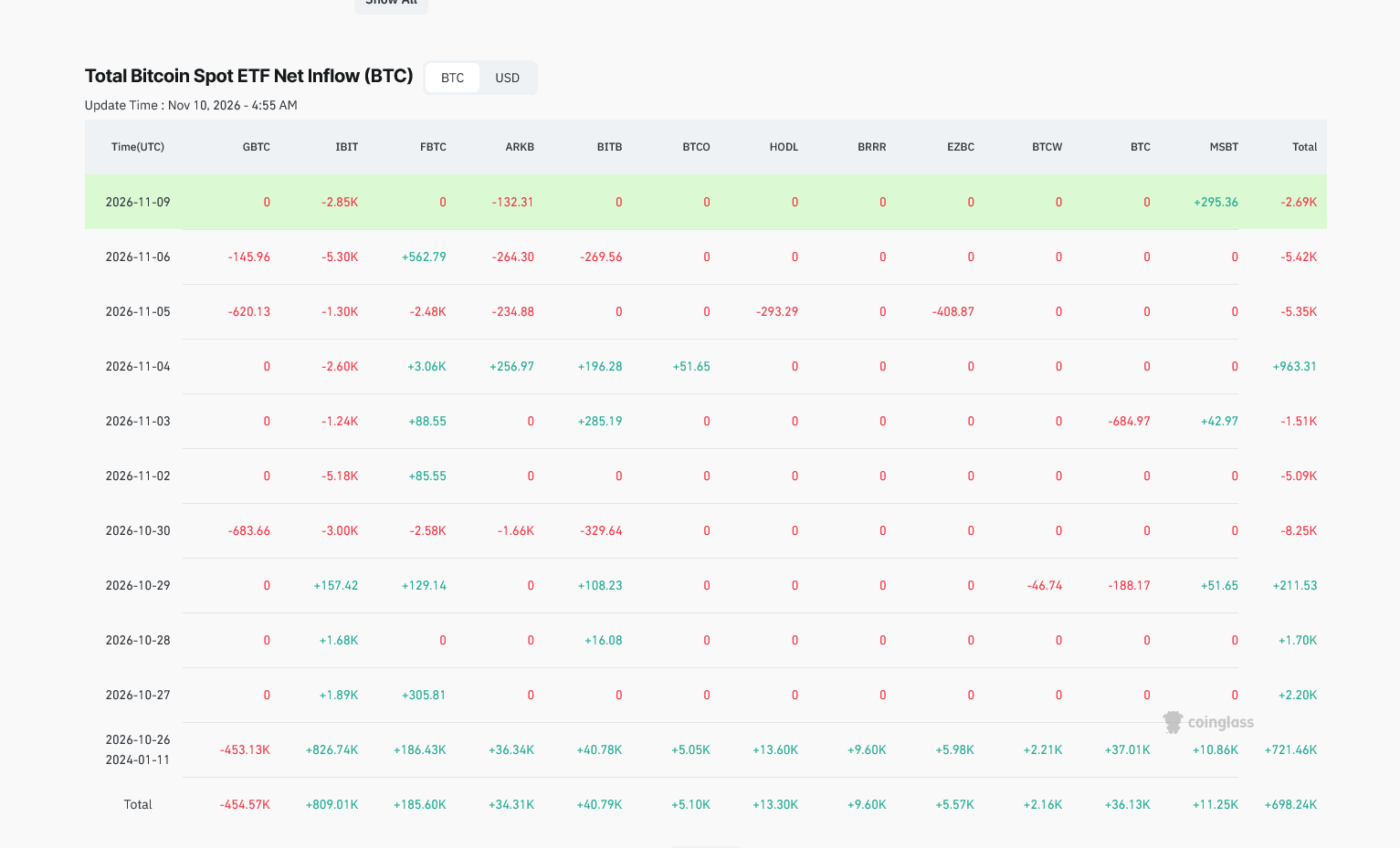
US spot bitcoin ETFs have moved into net outflows for 2026, with the year-to-date total passing $1.1 billion after another $95 million left on Nov. 10, according to Sosovalue data cited by Bitcoin.com News. Total net assets stood at $92.82 billion.
The shift is sharp. Three weeks earlier the funds were up $1.43 billion for the year; as of Nov. 9 they had $1.03 billion in net outflows. By this point in 2025 the products had taken in $24.7 billion, versus $25.8 billion in 2024, Bitcoin.com News said. Blockonomi, citing Coinglass, put 2026 net withdrawals at $1.1 billion through Nov. 9 and compared that with about $25 billion of inflows by early November in both 2024 and 2025.
BlackRock's iShares Bitcoin Trust has driven much of the selling. IBIT recorded seven consecutive sessions of outflows since Oct. 30 totaling $1.66 billion, according to Farside Investors data cited by Blockonomi. On Nov. 9, IBIT lost $213.2 million while all US spot bitcoin ETFs lost $201.1 million, with Morgan Stanley's MSBT taking in $22.1 million, per TFTC's daily tracker cited by Bitcoin.com News.
First $81.8KLatest $74K-9.5% over the period
Points are daily observations, not closing prices.
Why it matters
The streak puts the funds at risk of their first calendar year of net withdrawals since US spot bitcoin ETFs launched in January 2024, Bitcoin.com News noted. If the trend holds through December, 2026 would reverse the strong demand of the prior two years.
The reports link selling to changed rate expectations. Bitcoin.com News said October US CPI came in at 0.4% month over month against a 0.3% forecast, and bitcoin fell to $72,787 after the release. It also cited Whale Insider reporting that Goldman Sachs now forecasts two 25-basis-point rate hikes, in December and March 2027. Higher rates can weigh on non-yielding assets, and ETF buyers have stepped back, the report said.
What the data shows
November has been heavy. Including Nov. 10, the funds posted net outflows on six of seven trading days that month, totaling roughly $1.58 billion, Bitcoin.com News said. The worst day was Nov. 5 at $430.2 million; the only positive session was Nov. 4, when Fidelity's FBTC took in $236.7 million. Blockonomi, using Coinglass, said November outflows reached $1.48 billion through Nov. 9. Outside IBIT, US spot bitcoin ETFs have seen $3.8 billion in net outflows this year, per Bitcoin.com News.
Background
US spot bitcoin ETFs debuted in January 2024 and gathered about $25 billion in net inflows by early November in both 2024 and 2025, according to Blockonomi. Bitcoin.com News noted that as recently as Oct. 20 it reported BlackRock had posted its biggest yearly inflow, with its ETFs adding $527 million in one session. The redemptions have continued even after Coinbase's national trust bank charter took effect on Friday, which Blockonomi said lets the company hold digital assets for clients under federal oversight; a trader told Cointelegraph the news barely moved prices.
What is still unclear
The reports differ on some figures and timing. Bitcoin.com News said US spot ether ETFs logged a fourth straight outflow day on Nov. 10 with only $1.3 million leaving, while Blockonomi reported ether funds lost $184.6 million on Nov. 9, their largest daily outflow since Oct. 6. The reports also used different cutoffs for November and annual totals, and they captured different stages of the October CPI release: Blockonomi said investors were waiting for the data, while Bitcoin.com News reported the 0.4% print and its market effect.
What to watch
Flow data through December will decide whether 2026 ends as the first net-outflow year for US spot bitcoin ETFs. Rate expectations and whether IBIT redemptions continue are also key. Bitcoin.com News noted some traders see the washout as a contrarian signal: Charles Edwards of Capriole Investments said bitcoin treasury companies were in capitulation mode, while analyst Joe Consorti argued bitcoin had already had its bear market and that holding the 200-day moving average would make the drop a correction inside a bull market. Those are market views, not ETF data.
Questions readers ask
How much have US spot bitcoin ETFs lost in 2026?
More than $1.1 billion in net outflows, according to the reports, after the funds were up $1.43 billion for the year three weeks before the latest streak.
Which fund is behind the recent outflows?
BlackRock's iShares Bitcoin Trust recorded seven straight outflow sessions totaling $1.66 billion since Oct. 30, per Farside data cited by Blockonomi.
Could 2026 be the first negative year for bitcoin ETFs?
Bitcoin.com News said that if the trend holds through December, 2026 would be the first calendar year of net outflows since the funds launched in January 2024.