BTC $74,004
 EQQQQ $655.75 Last updated 8 Nov 2026, 12:03 UTC
 ETH $2,055
 MGLOEURO $111,813
 USDT $0.9993
 BNB $681.38
 USDC $0.9996
 XRP $1.06
 SOL $83.86
 TRX $0.3170
Markets · Explained
Dogecoin seen near $0.061-$0.063 if bitcoin slides to $70,000
Reports from CoinGape and Coinpedia tie dogecoin's yearly low to hot US inflation, whale selling and bitcoin's break below $75,000.

Key takeaways
- Relative losses. Dogecoin dropped 2.88% in Tuesday's session versus bitcoin's 2.08%, extending a pattern of steeper moves that the reports use to frame downside scenarios.
- Whale retreat. Wallets holding 100,000 to 100 million DOGE cut combined balances by about 750 million tokens since Nov. 3, according to CoinGape.
- Key level. A daily close below roughly $0.061 on rising volume would make a deeper decline more likely, while a bitcoin rebound above $75,000 could help DOGE hold its recent low.
What happened
Dogecoin was trading near $0.068 on Wednesday after losing 2.88% in the prior session, a steeper decline than bitcoin's 2.08%, CoinGape reported. The meme coin traded as low as $0.0666 during Tuesday's selloff, its weakest price this year and below an earlier low of about $0.0670 set on Nov. 8 after a brief rebound failed to hold.
The trigger was US inflation data that came in above expectations. Consumer prices rose 0.4% in October from the previous month, against a 0.3% forecast, while core inflation rose 0.3% versus 0.2% expected. CoinGape reported that exchanges liquidated about $178 million in leveraged bets on rising prices within an hour of the release, and that crypto futures liquidations reached $716 million over 24 hours, mostly from long positions. Bitcoin fell below $73,000 and traded under $73,500 early Wednesday; ether slipped below $2,050 and XRP moved closer to $1.
CoinGape framed a scenario in which bitcoin drops from its Tuesday close near $73,698 to $70,000, a fall of roughly 5%. Dogecoin's losses ran about 1.4 times bitcoin's on Nov. 5 and Nov. 10, a ratio that would imply a 7% decline from $0.068 to about $0.063. A drop twice as steep as bitcoin's would put DOGE near $0.061.
Coinpedia described the same pressure from bitcoin's side, noting the largest cryptocurrency is nearly 15% below its recent peak and has broken below $75,000. Short-term holders moved roughly 48,500 BTC to exchanges within 24 hours, with about 47,300 BTC moved at a loss, or roughly 97.5% of the reported transfers. Coinpedia identified $72,000-$73,000 as immediate support, with a sustained break exposing $70,000 and then $68,000.
First $81.8KLatest $74K-9.5% over the period
Points are daily observations, not closing prices.
Why it matters
Dogecoin's larger percentage moves mean altcoin holders absorb bitcoin's stress at a magnified scale, which is why the reports focus on how the two assets have traded against each other rather than on DOGE in isolation. CoinGape reported that large holders trimmed combined balances by about 750 million DOGE between Nov. 3 and the downturn, across wallets holding 100,000 to 100 million tokens, while trading volume on tracked exchanges rose roughly 35% from Monday. Large orders were seen across spot and futures markets, with sellers dominating both.
The technical picture offers little cushion. DOGE remains below its 50-, 100- and 200-day exponential moving averages, which sit between $0.079 and $0.088. The daily relative strength index is in the low 30s, just above the conventional oversold threshold, and the MACD line is slightly below zero. A break of Tuesday's low would shift attention to support near $0.061.
What the data shows
The numbers behind the scenarios: a move from $73,698 to $70,000 is about a 5% bitcoin decline; a 1.4x multiplier gives roughly a 7% DOGE drop to $0.063, and a 2x multiplier gives about $0.061. CoinGape also noted that a sustained bitcoin break below $70,000 accompanied by fresh liquidations could push DOGE toward $0.060, while a swift recovery above $75,000 could help DOGE defend its recent low and revisit the $0.0685-$0.0702 range. Coinpedia said reclaiming $77,000 would improve bitcoin's short-term outlook and open the way toward $81,000-$83,000.
Background
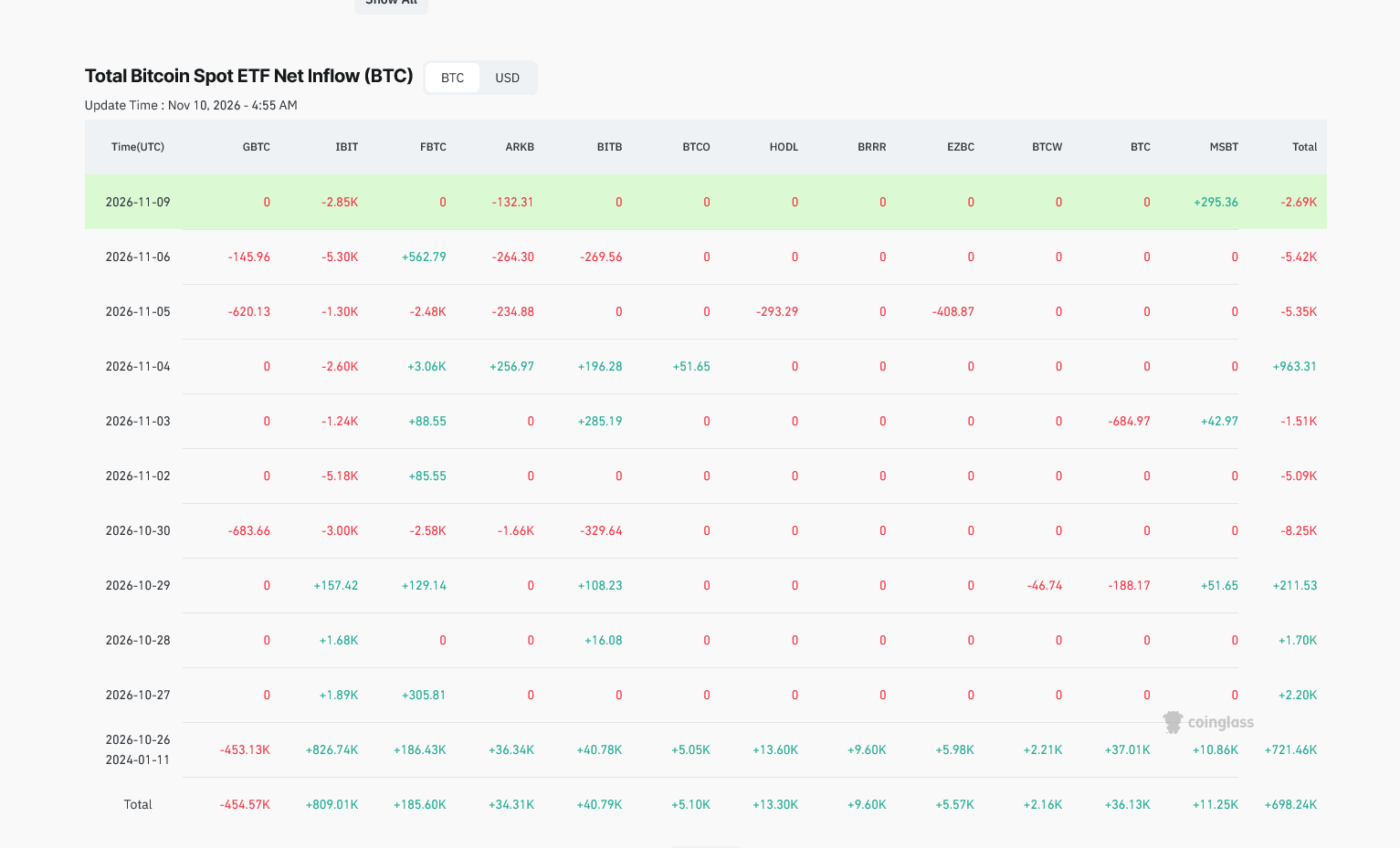
The inflation reading renewed concern that the Federal Reserve could keep interest rates elevated for longer, weighing on risk-sensitive assets. Institutional demand has also softened: CoinGape reported $95 million in net outflows from US spot bitcoin ETFs on Tuesday, a fourth straight session of withdrawals and about $1.6 billion since the start of November, while Coinpedia cited roughly $430.2 million in net outflows on Nov. 5. Coinpedia noted that October's correction was driven largely by profit-taking, whereas recent flows show more investors selling to limit losses. Bitcoin's chart has repeatedly failed near $87,000-$88,000, forming lower highs before breaking the $76,000-$77,000 support zone, which now acts as resistance.
What is still unclear
The multiplier used in the DOGE scenarios is drawn from just two sessions, Nov. 5 and Nov. 10, so it describes an observed pattern rather than a fixed relationship. Neither report specifies how long a bitcoin move to $70,000 would take, which matters because the projections are based on percentage changes between the two assets.
What to watch
The levels to watch are bitcoin's ability to hold the $72,000-$73,000 area and then the $70,000 threshold, and whether DOGE can defend Tuesday's low. Volume behavior matters as much as price: CoinGape said a daily close below $0.061 on rising volume would make a deeper decline more likely.
Questions readers ask
Why did dogecoin fall this week?
CoinGape reported a 2.88% decline in Tuesday's session following hotter-than-expected US inflation data, which drove liquidations across crypto and pushed bitcoin below $73,000. Large DOGE wallets also reduced holdings by about 750 million tokens.
What would send dogecoin to $0.061?
CoinGape calculated that a DOGE decline twice as steep as a 5% bitcoin drop to $70,000 would place it near $0.061. The report also said a daily close below $0.061 on rising volume would make a deeper decline more likely.
What would change the bearish scenario?
CoinGape said a quick bitcoin recovery above $75,000 could help DOGE hold its recent low and revisit $0.0685-$0.0702. Coinpedia said a bitcoin reclaim of $77,000 would improve its short-term structure.