BTC $80,360
 ETH $2,328
 USDT $0.9989
 BNB $744.61
 XRP $1.30
 USDC $0.9994
 SOL $101.54
 TRX $0.3306
 FIGR_HELOC $1.02
 ZEC $1,247
Bitcoin · Explained
Bitcoin and gold post historic first as 2026's worst-performing major assets
Both are down year to date and sit at the bottom of Charlie Bilello's asset-class ranking, a combination never seen before in a calendar year.

Key takeaways
- Bottom of the table. Bitcoin is down 7.3% and gold 7.5% year to date, trailing stocks, bonds and cash, according to a table Bilello published on X on Oct. 23.
- Long-term record intact. Bitcoin has still returned roughly 120.6% annualized since 2011, against 6.3% for gold, per the same data.
- Time remains. With the year not yet over, the final 2026 rankings are not settled.
What happened
Bitcoin and gold are the two weakest major asset classes of 2026 so far, a pairing that Charlie Bilello, chief market strategist at Creative Planning, says has not appeared before in any calendar year covered by his comparative data. A table he posted on X on Oct. 23 put bitcoin down 7.3% year to date and gold down 7.5%, placing both beneath stocks, bonds and cash. U.Today and Finbold both reported the ranking.
The result is striking because both assets are commonly described as stores of value or as alternatives to conventional holdings when markets are unsettled. Neither has delivered a positive return in 2026 to date. According to Finbold, bitcoin's standing had slipped a little further and gold's had improved slightly by press time on Monday, Oct. 26, three days after the table was published.
Bilello's data covers a range of asset classes, and the two former high-flyers now occupy the bottom two positions. Bitcoin was the strongest major asset in 2024 with a 121% gain, and gold took the same title in 2025 with a rise of 63.7%, so the reversal in their fortunes has been sharp.
Because the calendar year has more than two months left to run, the ranking remains provisional, and either asset could still climb off the bottom before the final tally.
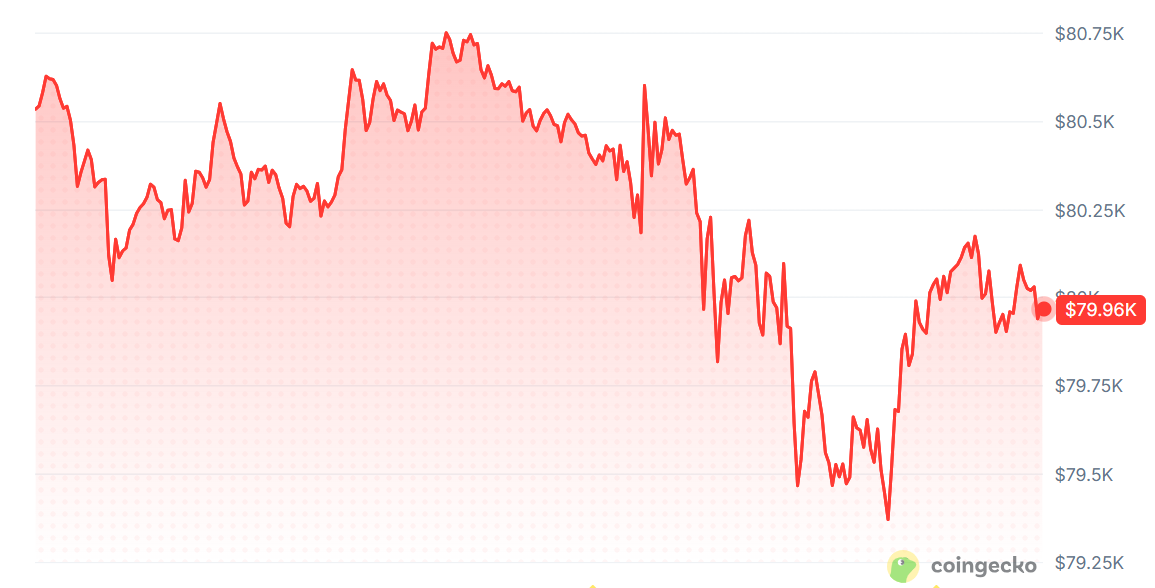
First $84.4KLatest $80.6K-4.5% over the period
Points are daily observations, not closing prices.
Why it matters
The overlap of losses matters for the argument that bitcoin and gold offer protection when other markets struggle. Over a single calendar year, the two have failed together at the very bottom of the performance table, a result that undercuts that pitch even if longer records remain strong.
The causes behind each decline differ, which complicates any single explanation. Finbold tied gold's retreat to persistently high inflation, turbulence in bond markets and a firm U.S. dollar, all of which raise the cost of holding a metal that pays no yield. Bitcoin's slide followed a record high in late 2025 and was punctuated by a drop toward $80,000 as traders reacted to geopolitical developments.
What the data shows
Bitcoin set an all-time high above $125,000 late in 2025 and has since fallen roughly 36% to $80,155, Finbold reported. Gold climbed almost continuously from 2023 into early 2026, peaking near $5,400, before sliding to a support level around $4,000 by late October. The U.S. dollar index was up 3.84% year to date, making the metal more expensive for buyers using other currencies. Finbold also noted that leveraged traders trimmed positions in liquid assets such as gold to meet margin calls as stock volatility rose, driven by oil-market disruption and changing narratives around artificial intelligence.
Background
This is not the first year in which both assets finished a calendar year lower. Finbold noted that bitcoin and gold were each negative in 2014, 2018 and 2022, but they were never simultaneously the worst performers. In those years bitcoin's declines were far deeper, at 58%, 73% and 65% respectively. Over the longer horizon, the picture looks very different: Bilello's figures show bitcoin returning about 120.6% annualized since 2011, compared with 6.3% for gold.
What to watch
The main question is whether the bottom-two ranking survives to Dec. 31. Bitcoin's recent moves have been sensitive to geopolitical headlines and to swings in wider markets, while gold's direction depends in part on the dollar and on bond-market conditions. A change in any of those factors over the final weeks could reshuffle the table before the year closes.
Questions readers ask
How much are bitcoin and gold down in 2026?
As of the Oct. 23 table from Charlie Bilello, bitcoin was 7.3% lower year to date and gold 7.5% lower.
Has this happened before?
Both assets have ended a year in the red in 2014, 2018 and 2022, but they had never previously been the two worst-performing major asset classes in the same year.
Is the ranking final?
No. More than two months remained in the year when the data was published, and both assets could still move up or down the table.